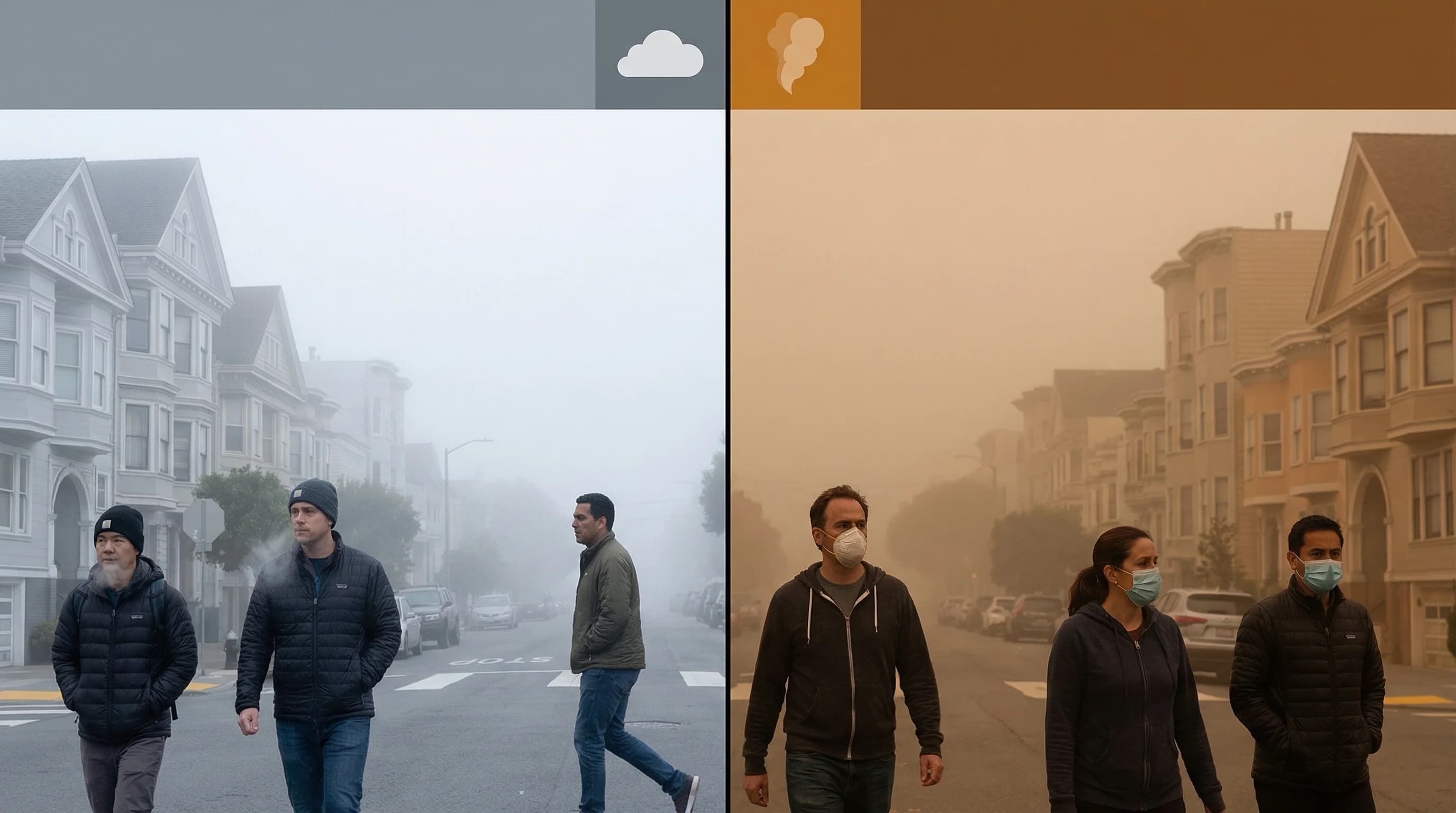
Haze and fog both reduce visibility and both make the sky look gray or milky, but they are entirely different atmospheric phenomena. Fog is made of liquid water droplets suspended in air and forms when humidity is near 100 percent. Haze is a suspension of dry particles, typically dust, smoke, or pollution, and it can form in air that is far from saturated. In the Bay Area, where both fog and poor air quality are common, the confusion between haze and fog is understandable but consequential. One clears with sunshine and represents no health risk. The other may represent significantly degraded air quality and require different decisions about outdoor activity, driving, and health precautions.
What Is Fog?
Fog is a cloud at ground level. It forms when air cools to its dew point, the temperature at which the air can no longer hold all its water vapor in gaseous form, and that vapor condenses into tiny liquid droplets suspended in the air. Relative humidity in fog is at or very near 100 percent. The droplets are small enough to remain suspended rather than falling as rain, but large enough to scatter light and reduce visibility.
In the Bay Area, fog comes in two main varieties: the marine advection fog that rolls in from the Pacific in summer and early fall, and the radiation fog that forms in inland valleys on clear winter nights. Both are water-droplet fog. Both reduce visibility through light scattering. Both feel cool and damp. And both clear when temperatures rise or the atmospheric conditions that created them change.
What Is Haze?
Haze is atmospheric obscurity caused by fine particles rather than water droplets. The particles can be dust, smoke, sea salt, industrial pollution, or secondary aerosols formed when vehicle emissions and other pollutants react in sunlight to form fine particulate matter. Unlike fog, haze does not require high humidity. It can form on dry, sunny days in polluted air.
In the Bay Area, the most significant sources of haze are wildfire smoke, vehicle emissions, and industrial pollution. During fire season, smoke from wildfires in Northern California and the Sierra Nevada frequently drifts over the Bay Area, creating haze that can reduce visibility to a few miles and simultaneously push air quality into the unhealthy range. The 2018, 2020, and 2021 fire seasons all brought extended periods of heavy haze to the Bay Area, with characteristic orange skies that were visually dramatic and deeply unhealthy.
During winter, temperature inversions trap vehicle emissions near the surface in inland Bay Area valleys, creating pollution haze that can persist for days during calm, windless weather. This is particularly common in San Jose and the South Bay, where the Santa Cruz Mountains and the Diablo Range reduce air circulation on stagnant weather days.
How to Tell Fog and Haze Apart
Several visual and contextual clues help distinguish fog from haze.
Color is the most immediate indicator. Fog is white or light gray. Haze from smoke or pollution has a brownish, yellowish, or orange cast, especially near the source or when wildfire smoke is present. The characteristic orange sky of a Bay Area smoke day is entirely distinct from the clean gray of marine fog.
Temperature and humidity are the next check. Fog forms in cool, humid conditions, typically when temperatures are within a few degrees of the dew point and relative humidity is above 95 percent. Haze can be present on hot, dry days with low relative humidity. If it is 85 degrees and the air feels dry but visibility is reduced, it is almost certainly haze, not fog.
The smell test works for smoke haze. Wildfire smoke has a distinctive woody, acrid smell. Marine fog smells like the ocean. Pollution haze from vehicle emissions can smell faintly of exhaust. If your nose detects something, it is not fog.
Finally, check the Air Quality Index. The Bay Area Air Quality Management District publishes real-time AQI data. If visibility is reduced and AQI is in the orange, red, or purple range, it is haze with air quality implications. If AQI is good and visibility is reduced, it is fog.
Health and Activity Implications
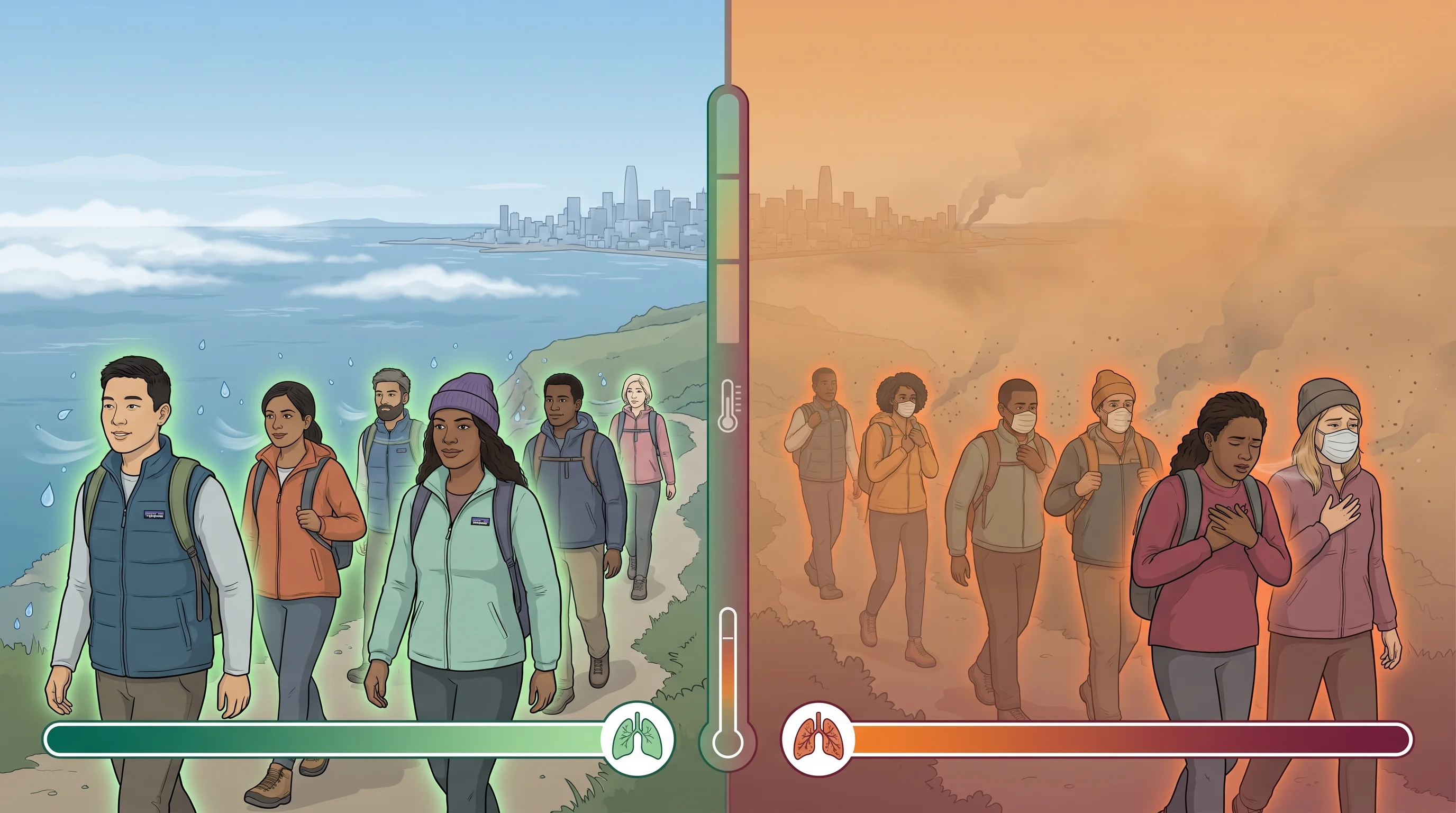
Fog is essentially harmless from a health standpoint. Breathing fog is the same as breathing clean, very humid air. Outdoor exercise in marine fog is fine. The main risks from fog are visibility-related driving hazards and the cold, damp conditions that make outdoor activities uncomfortable.
Haze is a different matter entirely. Fine particulate matter from wildfire smoke and vehicle pollution reaches deep into the lungs and can cause or aggravate respiratory and cardiovascular conditions. When the Bay Area Air Quality Management District issues Spare the Air alerts or when AQI reaches the orange range (unhealthy for sensitive groups) or above, limiting outdoor exertion is genuinely medically recommended. During the worst wildfire smoke events, even healthy adults are advised to limit time outdoors, wear N95 masks outside, and keep windows closed.
If you are planning outdoor activities in the Bay Area and the sky looks gray or milky, it is worth the 30 seconds to check both the fog forecast and the AQI before heading out. The two conditions look similar enough to fool a casual glance, but the appropriate response to each is completely different.