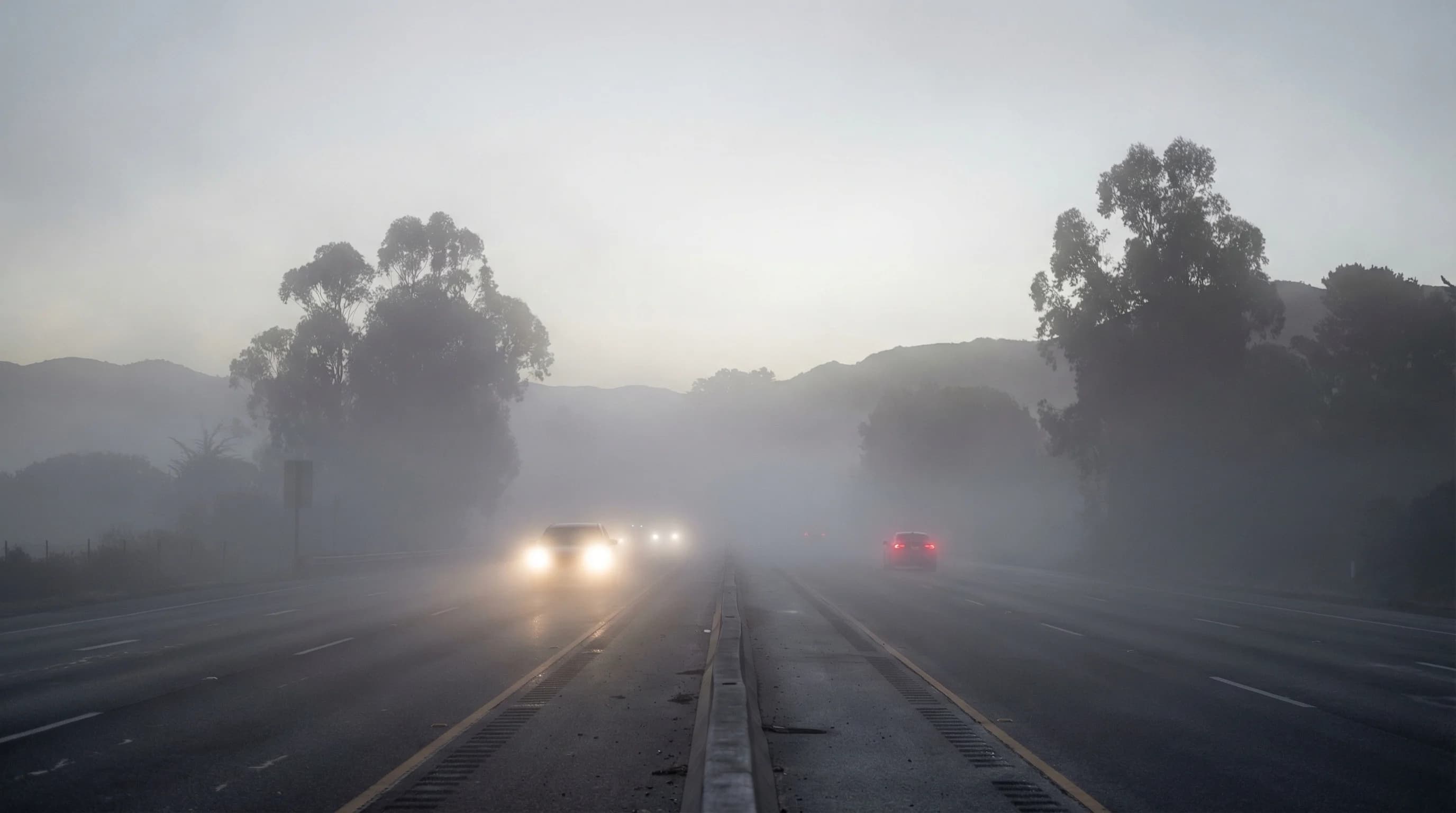
A Dense Fog Advisory is a National Weather Service product issued when fog is expected to reduce visibility to one-quarter mile or less for at least two hours. In the Bay Area, dense fog advisories are issued for very different reasons depending on the time of year and location. Winter advisories often cover the inland valleys and the Central Valley approach routes, where radiation fog and tule fog can drop visibility to near zero. Summer advisories are less common but occur when the marine layer pushes especially thick fog into coastal areas and through the Bay during overnight and morning hours. Knowing what triggers these advisories, and how to respond, can make a real difference for Bay Area drivers caught in low-visibility conditions.
What Triggers a Dense Fog Advisory
The NWS issues a Dense Fog Advisory when forecasters determine that fog will produce visibility of one-quarter mile or less over a widespread area for two or more hours. The quarter-mile threshold represents seriously dangerous driving conditions: at highway speeds, a quarter mile of visibility gives a driver roughly ten seconds of sight distance. Fog does not need to be uniform across the entire advisory area, but it must be widespread enough that the hazard is real for travelers on major routes.
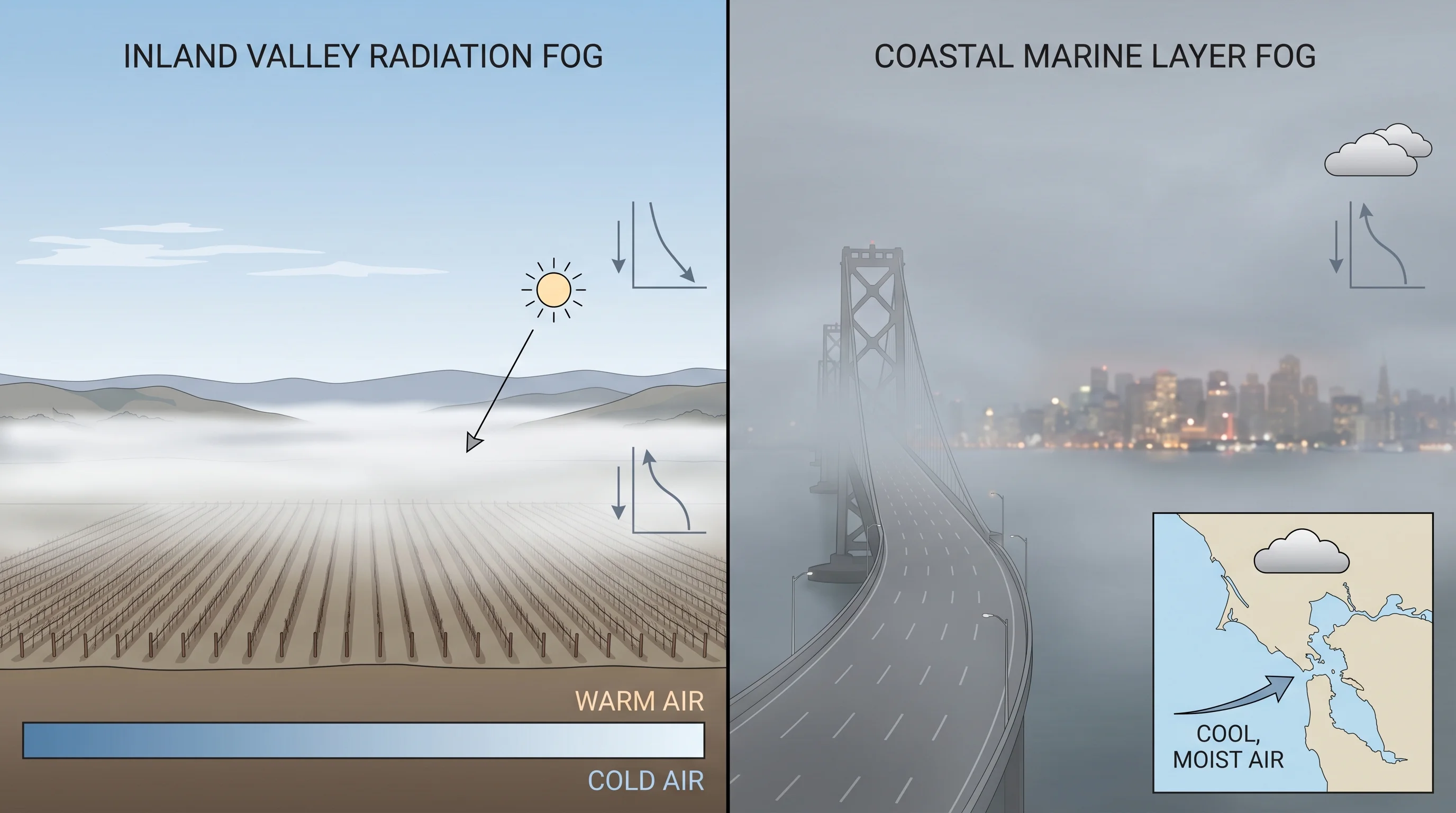
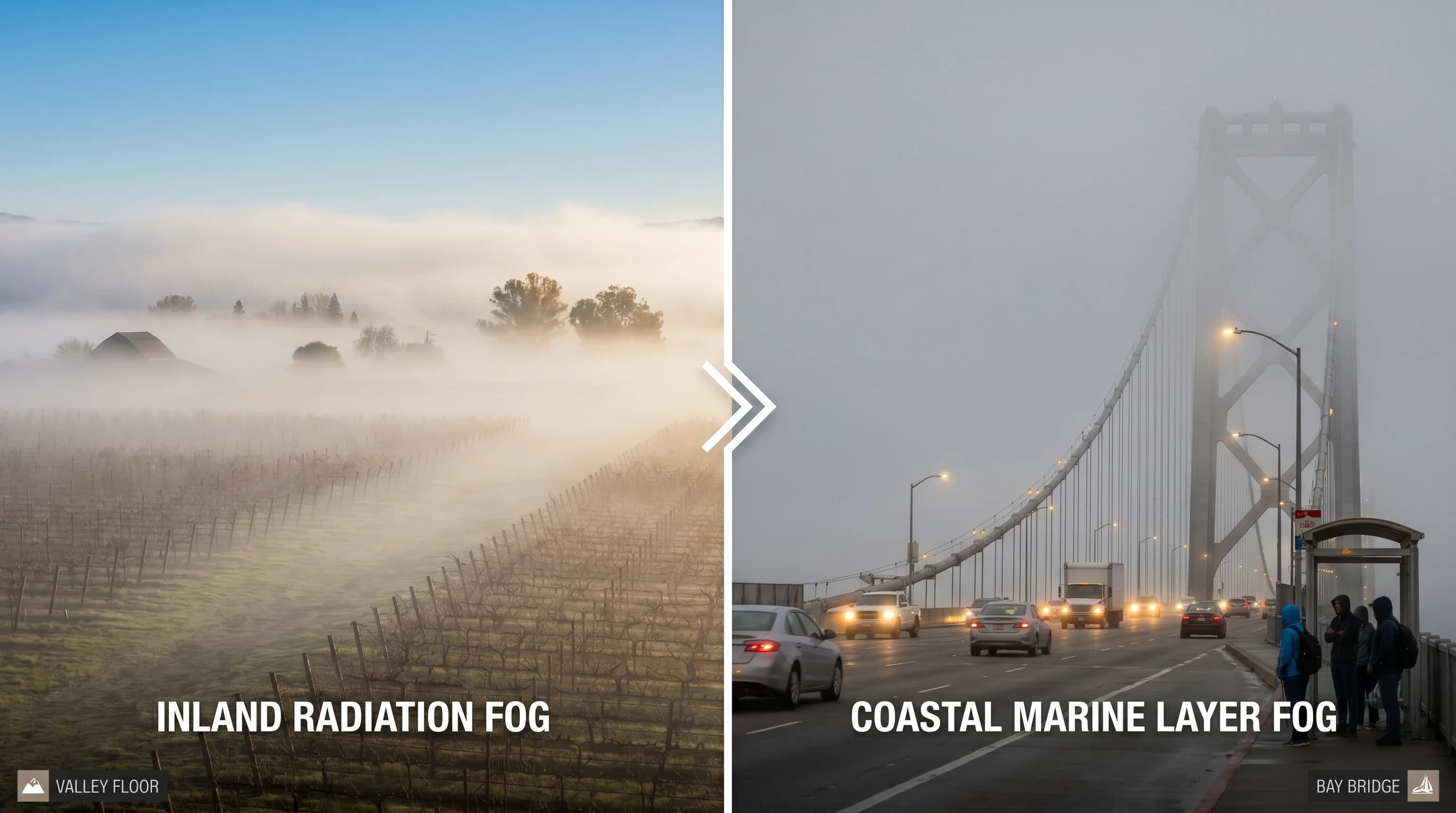
In the Bay Area, the most common triggers are radiation fog events in the inland valleys during fall and winter, when overnight cooling in the Livermore, Napa, and Petaluma basins produces dense ground fog by early morning. Highway 101 through Petaluma and Marin, Interstate 580 through the Altamont Pass approaches, and Highway 121 through Carneros are among the corridors that regularly see Dense Fog Advisory conditions in winter. Coastal advisories are issued when the marine layer produces unusually thick fog over the Bay Bridge approaches or along Highway 1.
Dense Fog Advisory vs. Other Fog Products
The NWS issues several weather products related to fog, and they are not interchangeable. A Dense Fog Advisory is the standard product for areas where fog will reduce visibility to the quarter-mile threshold. It is a lower-tier product than a warning, meaning conditions are hazardous but not life-threatening if proper precautions are taken.
In California's Central Valley, the NWS sometimes issues a Special Weather Statement or upgrades to more urgent language when tule fog produces near-zero visibility over a wide area of high-speed highway. The phrasing depends on the duration, geographic extent, and severity of the fog event. A Dense Fog Advisory covering the Bay Area typically means inland valleys are experiencing the worst conditions, with coastal and elevated areas potentially clear.
Marine fog alerts are handled separately. The NWS San Francisco Bay Forecast Zone covers marine conditions on the Bay itself, and separate coastal point forecasts address visibility at specific locations like the Golden Gate and the Bay Bridge. A Dense Fog Advisory for Zones in the inland Bay Area does not necessarily mean the Bay surface is foggy, and vice versa.
How to Drive Safely in Dense Fog
When a Dense Fog Advisory is in effect for your route, the most important decisions are whether to drive at all and, if you must, how to adjust your behavior. Dense fog removes the visual cues drivers rely on for speed judgment and hazard avoidance. The standard advice covers several specific behaviors that meaningfully reduce risk.
Use low-beam headlights, not high beams. High beams reflect off fog droplets and scatter light back at the driver, reducing rather than improving visibility. Low beams direct light toward the road surface and make your vehicle visible to others without creating a blinding wall of backscatter. In very dense fog, front fog lights add useful illumination low to the ground.
Slow down significantly and increase following distance. In quarter-mile visibility, the standard three-second following distance is nowhere near adequate. Double or triple your normal following distance. If you cannot see the vehicle ahead of you clearly, you are too close.
Use road markings as navigation aids. In very dense fog, keeping your eyes on the right edge of the road rather than straight ahead helps maintain lane position when visibility is reduced to a few car lengths. If you must pull over, pull completely off the road, turn off your headlights, and turn on your hazard lights to avoid being mistaken for a moving vehicle by drivers following the light source.
Dense Fog Advisories and Bay Area Airports
Dense fog at San Francisco International Airport (SFO) is a recurring operational problem. SFO sits directly in the path of marine layer fog flowing in from the Pacific, and its location on the Bay shore means it is exposed to both marine layer and radiation fog depending on the season. When visibility at SFO drops below instrument landing system minimums, the airport switches to Low Visibility Operations, which reduce the arrival rate and create delays that ripple through the national air traffic system.
Fog-related delays at SFO affect more flights per year than at any other major California airport. Oakland International, located slightly further from the heaviest marine layer influence, tends to have better fog conditions than SFO on many mornings, which is one of the operational advantages of flying through OAK during winter months. If a Dense Fog Advisory covers the Peninsula, checking whether your SFO flight has fog-related delay history is a reasonable precaution before heading to the airport.