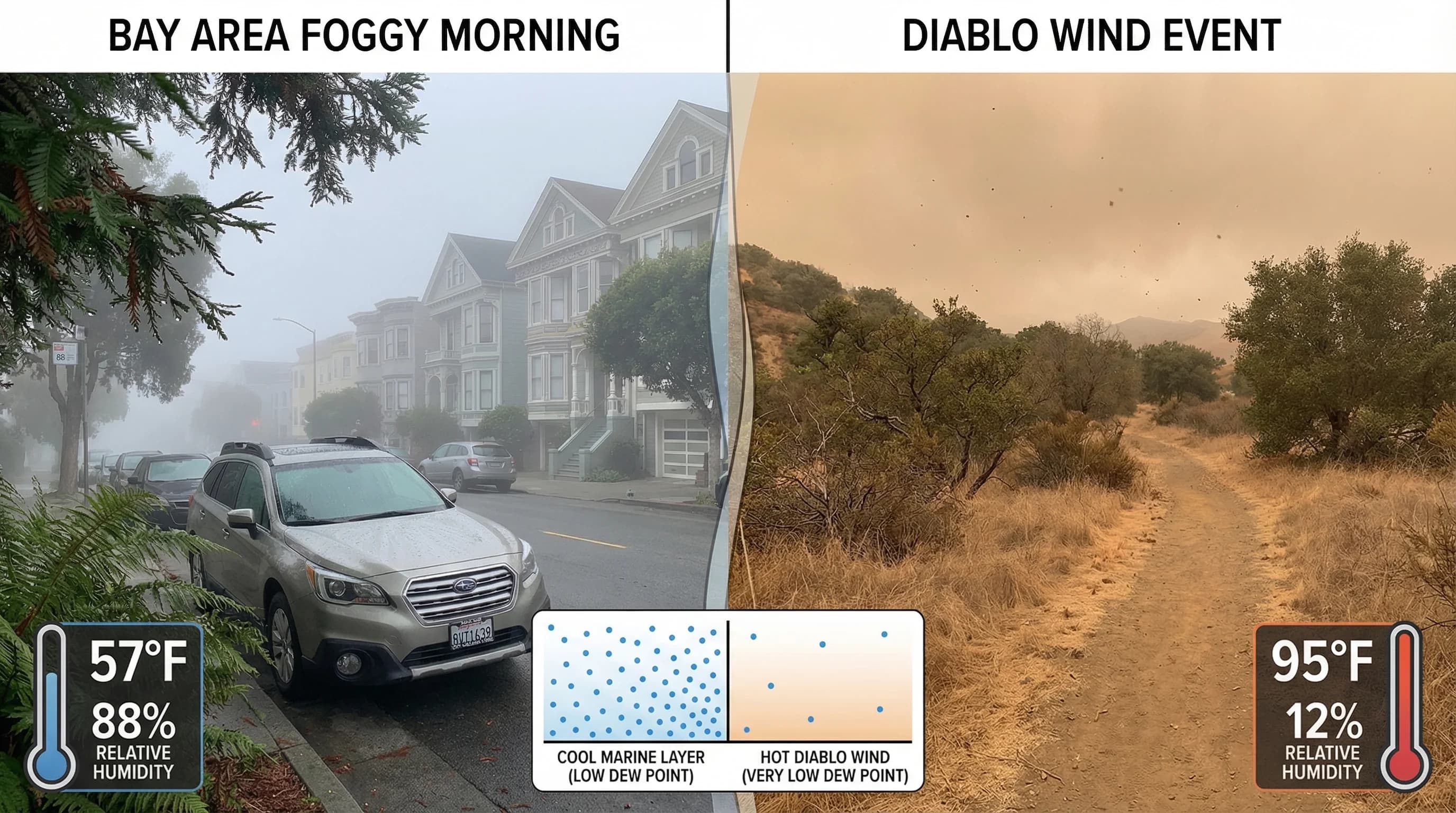
Bay Area weather reports sometimes note relative humidity figures that sound alarming, 90 percent humidity on a summer morning, followed by conditions that feel nothing like 90 percent humidity feels in Houston or Miami. The fog is real and the air is moist, but it is not oppressive. Then the same reports will note 15 percent humidity during a Diablo wind event, and the air feels genuinely parching: furniture cracks, sinuses ache, and vegetation wilts. The difference between these two states is not just humidity in the abstract. It is dew point, and dew point is a more reliable guide to what Bay Area weather actually feels like on your skin than relative humidity alone.
Relative Humidity vs. Dew Point
Relative humidity expresses moisture content as a percentage of how much moisture the air could hold at its current temperature. A relative humidity of 90 percent means the air is holding 90 percent of its maximum possible moisture content. The problem is that maximum moisture capacity changes dramatically with temperature: warm air can hold far more moisture than cold air. So 90 percent relative humidity at 55 degrees carries much less actual moisture than 90 percent humidity at 85 degrees.
Dew point is different. It measures the temperature to which air must be cooled before moisture begins to condense, the temperature at which relative humidity reaches 100 percent and fog or dew forms. Dew point is an absolute measure of how much moisture is in the air, independent of air temperature. A dew point of 65°F always indicates a significant amount of moisture in the air. A dew point of 35°F always indicates dry air. Human comfort correlates more directly with dew point than relative humidity: dew points above 65°F feel muggy regardless of air temperature; dew points below 45°F feel noticeably dry.

Bay Area Dew Points by Season
The Bay Area's marine layer has high relative humidity but modest dew points. A summer morning with 90 percent relative humidity and 55 degrees air temperature has a dew point of around 52°F. That is cool and damp, fine for a fog effect, but far below the 65°F dew point that defines muggy conditions. This is why Bay Area fog feels refreshing rather than oppressive: the air is very close to saturation, but it is saturated with a modest amount of moisture at a cool temperature, not saturated with a vast amount of moisture at a warm temperature.
During Diablo wind events, the dynamic reverses completely. Hot, dry air from the interior descends and warms, and relative humidity can fall to 10 to 15 percent. More importantly, the dew point also crashes: to 20°F, 25°F, sometimes lower. At these levels, wood furniture shrinks and cracks, contact lenses dry out, nosebleeds become common, and the vegetation becomes combustible. The distinction between "dry" and "very dry" matters enormously here: a dew point of 30°F is genuinely desiccating in a way that 45°F is not, and the Bay Area routinely experiences the extreme end of this range during fall wind events.
Why Summer Bay Area Doesn't Feel Humid
The Bay Area is surrounded by water and has fog most summer mornings, yet summer afternoons after the fog burns off rarely feel humid. By noon, temperatures have risen to the 60s or 70s at the coast and 80s or 90s inland. The relative humidity drops as temperature rises, the same amount of moisture represents a lower percentage of what the warmer air can hold. The dew point stays roughly constant through the day at 50 to 55°F, which is comfortable by any standard. For an inland valley at 90 degrees, a 52°F dew point translates to about 25 percent relative humidity, dry-feeling, comfortable, and nothing like the muggy 90-degree days familiar to residents of the Southeast United States.
This is the characteristic Bay Area summer experience: cool, foggy mornings with high relative humidity that does not feel oppressive, followed by warm, dry afternoons that feel comfortable well above temperatures that would be miserable in humid climates. The secret is the dew point, which stays low regardless of relative humidity, because the fog is cool, not warm. The same day in Miami at 90 degrees with a dew point of 75°F would feel suffocating; the same day in Walnut Creek at 90 degrees with a dew point of 52°F feels like a perfect summer afternoon.