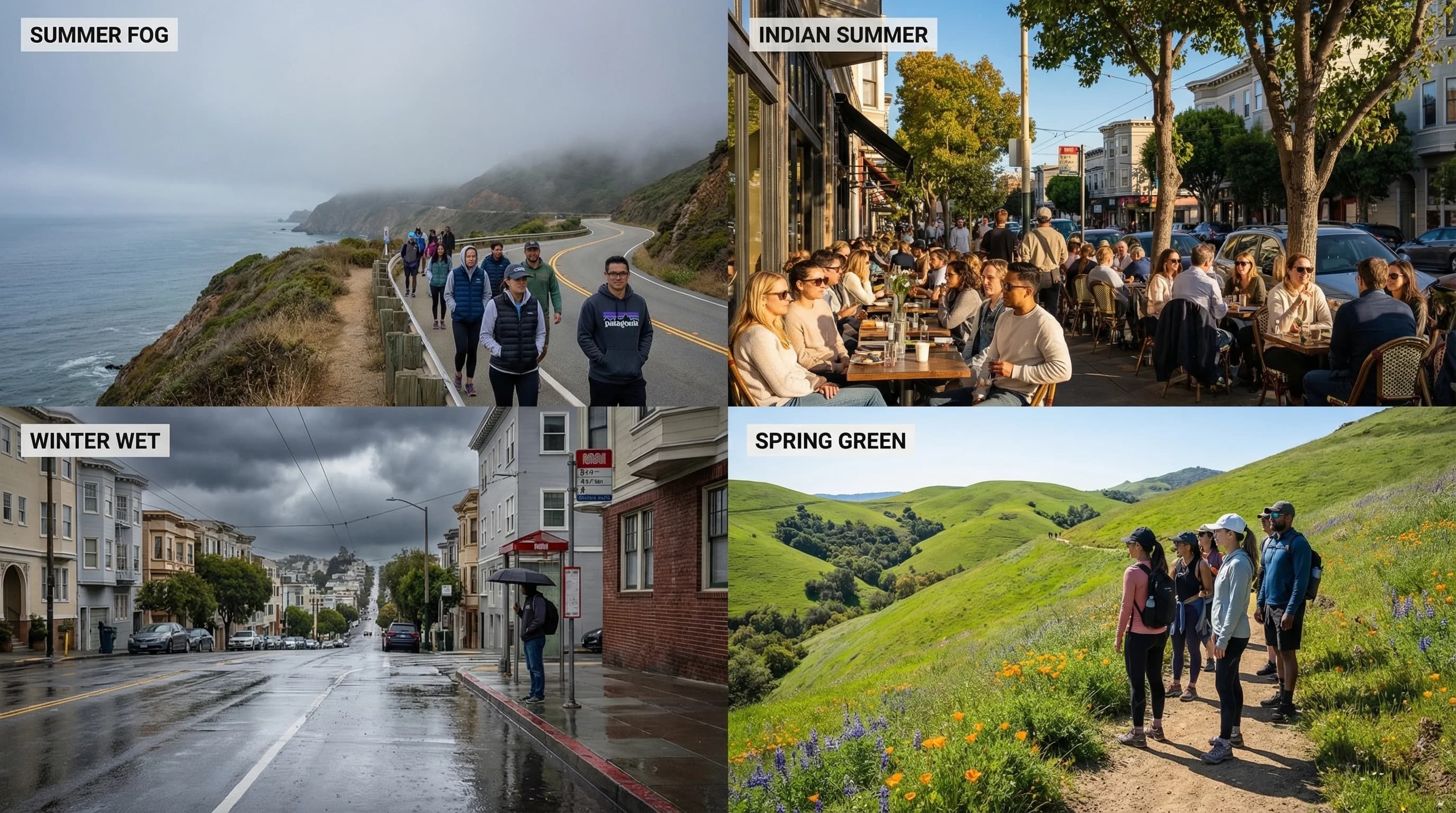
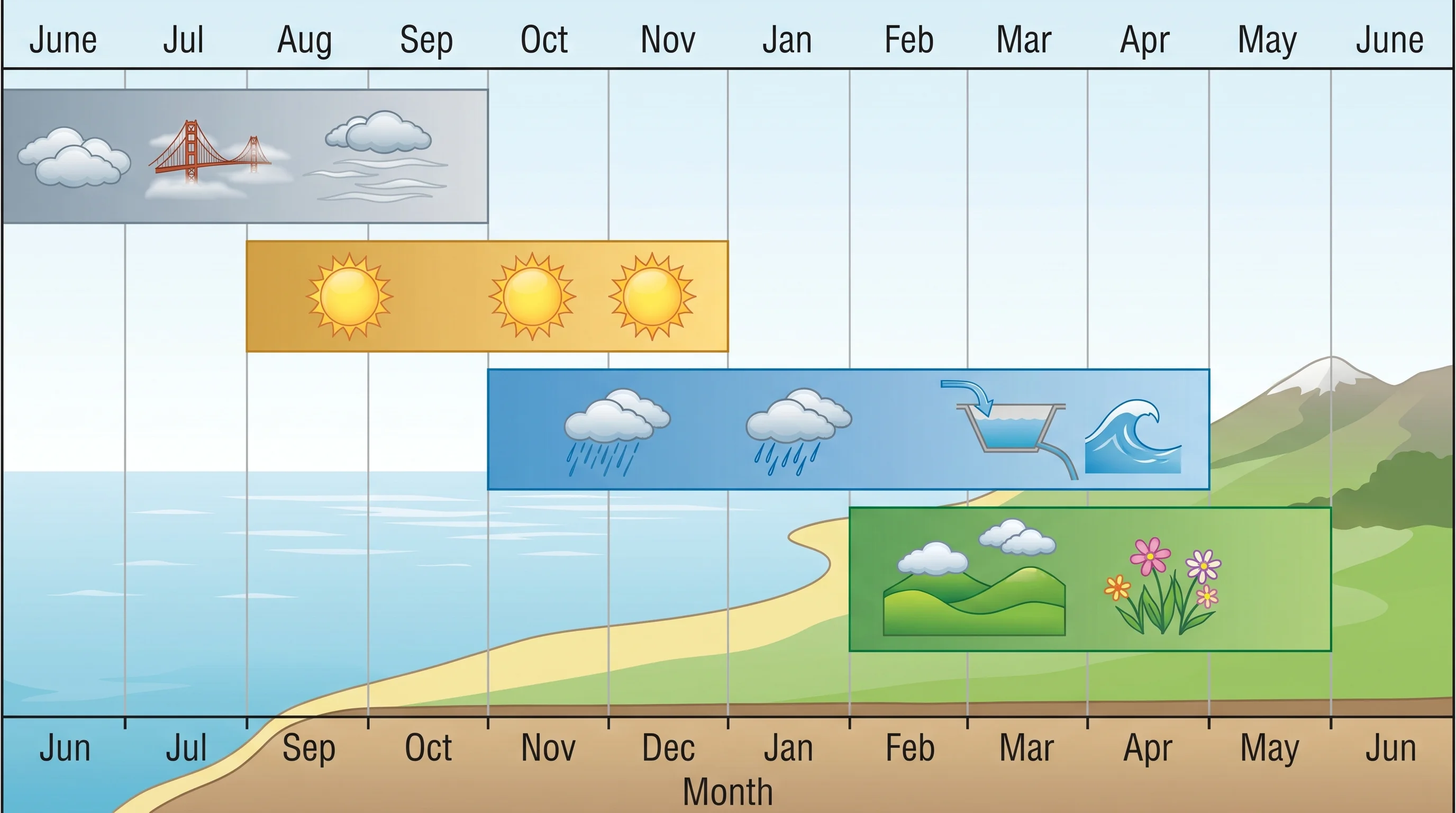
The Bay Area does not have four seasons in the conventional sense. It has something more interesting and less tidy: a set of distinct weather regimes that don't map onto the calendar the way seasons do in most of North America. There is no Bay Area spring that reliably arrives in March or fall that begins in September. There is no summer heat, in the usual sense, along the coast. What the Bay Area has instead are four recognizable weather patterns: fog season, Indian summer, the wet season, and the green season, each with its own character and each driven by specific atmospheric mechanics. Once you recognize them, the region's weather is far more predictable than the standard "San Francisco weather is unpredictable" narrative suggests.
Fog Season: June Through August
The Bay Area's summer is its fog season, which surprises most visitors expecting California sunshine. From roughly June through August, the North Pacific High sits at its strongest position offshore, driving the marine layer through the Golden Gate and across the coastal communities every afternoon. San Francisco's western neighborhoods sit in thick fog most of the day. The inland communities bake in triple-digit heat while the coast shivers at 58 degrees.
Fog season is the most regionally distinctive of the Bay Area's weather patterns, the one that sets it apart most sharply from the rest of California. The marine layer is not universally present: the inland Bay Area, from Concord to Livermore to San Jose, sees far less fog and far more heat than the coast. But the pattern of cool, gray coastal summers while the rest of California swelters is the Bay Area's defining seasonal identity.
Indian Summer: September Through October
When the North Pacific High weakens in September, the marine layer retreats and the Bay Area experiences its warmest, clearest weather of the year. Indian summer is when the region finally delivers on the California weather promise: warm sunny days, clear skies, low winds. Inland communities like Napa, Walnut Creek, and San Jose see September temperatures that exceed their July averages. Even San Francisco gets its clearest, most pleasant days.
Indian summer is also fire season. The same offshore atmospheric conditions that bring warmth and clarity bring extreme dryness and, when the flow strengthens into Diablo wind conditions, create the fire weather that has produced the region's most destructive blazes. September and October are simultaneously the Bay Area's best weather months for outdoor activities and its most dangerous months for wildfire. The two are products of the same atmospheric pattern.
Wet Season: November Through March
The Bay Area's wet season is its winter, but it bears little resemblance to winter in most of the country. Temperatures remain mild, San Francisco rarely drops below 45 degrees Fahrenheit, and snow is essentially unknown at sea level. What the wet season brings is rain: a concentrated dose of Pacific moisture delivered in storm systems that arrive at irregular intervals from November through March.
The character of the wet season varies dramatically by year, depending largely on the state of El Nino and La Nina in the tropical Pacific. Some years bring week after week of atmospheric river events, flooding valleys and filling reservoirs to capacity. Other years are so dry that the wet season passes almost unnoticed, leaving reservoirs low and setting up the following summer's fire conditions. The wet season's variability is one of the defining features of California's Mediterranean climate.
Green Season: February Through May
After the winter rains, the Bay Area hills turn spectacularly green in a transformation that happens fast enough to be visibly dramatic. What was brown and dry from September through November becomes lush and vivid by February or March, depending on when the first significant rains fall. Wildflowers bloom in the grasslands, streams run full, and the entire regional landscape looks like a different place than it does in late summer.
Spring in the Bay Area is the green season: mild temperatures, alternating rain and sunshine, and the brief window before the dry summer suppresses the vegetation again. It is one of the most beautiful times in the region, and one of the least celebrated by visitors who come primarily in summer. The East Bay hills in April, the Point Reyes headlands in March, the oak woodlands of Mount Diablo in May: these are Bay Area landscapes at their most vivid and most alive.
These four weather regimes are not the seasons of a calendar. They overlap, start early, arrive late, and occasionally skip a year entirely. But they are the actual weather patterns that define life in the Bay Area, and they map onto the region's ecology, agriculture, fire risk, and daily experience in ways that the conventional spring-summer-fall-winter framework simply does not.