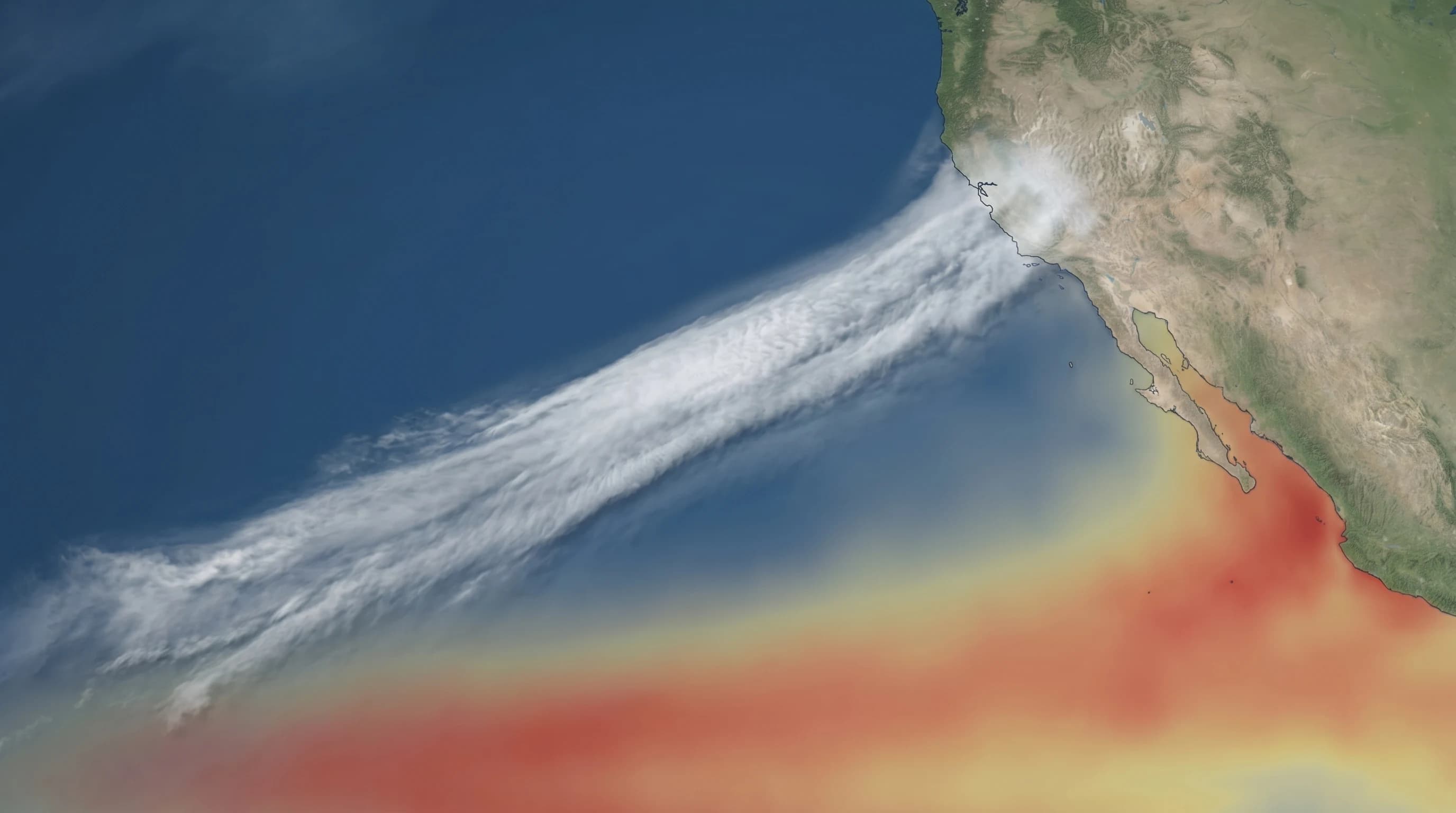
El Niño is strengthening in 2026. NOAA's Climate Prediction Center said on September 10 that El Niño should strengthen through the end of the year, with a greater than 90% chance of a very strong event during fall and winter 2026-27. A strong El Niño can change California's winter storm track, but it does not guarantee a wet Bay Area winter.
NOAA gives El Niño a 98% chance of becoming very strong during October-December 2026. Its September 17 seasonal forecast says above-normal rainfall is more likely in the Bay Area during winter 2026-27 and spring 2027, while October-December rainfall remains equally likely to finish above, near, or below normal. Warmer-than-normal temperatures are more likely in October-December and December-February, while spring temperatures have equal chances of finishing above, near, or below normal.
What the 2026 El Niño Means for the Bay Area
In its September 17 seasonal discussion, NOAA reports a strengthening coupled ocean-atmosphere El Niño pattern: sea surface temperature anomalies above +3.0°C in the eastern equatorial Pacific, a latest weekly Niño-3.4 value of +2.0°C, and atmospheric signals consistent with El Niño. NOAA's official strength outlook gives October-December a 98% chance of a very strong event and a separate 75% chance of reaching its historic-strength threshold of a three-month RONI of at least +2.5°C. Those numbers describe the strength of El Niño in the tropical Pacific, not the chance that Bay Area rainfall will be historic. For Bay Area residents, this is a signal to pay closer attention to drainage, trees, hillsides, creek forecasts, coastal flooding, and travel plans for the coming wet season.
The Bay Area impact will depend on where the Pacific jet stream sets up. If the jet aims repeated storms into Central and Northern California, the region can see frequent rain, saturated hillsides, reservoir inflows, and strong south winds. If the storm track targets Southern California or shifts north toward the Pacific Northwest, the Bay Area can still end up closer to normal even during a strong El Niño. That is exactly why El Niño should be treated as a seasonal risk factor instead of a deterministic forecast.
Source: NOAA Climate Prediction Center, issued September 2026. Each bar covers three months. The percentage on the right is the total chance of El Niño. A stronger El Niño does not guarantee more Bay Area rain.
What Are El Niño and La Niña?
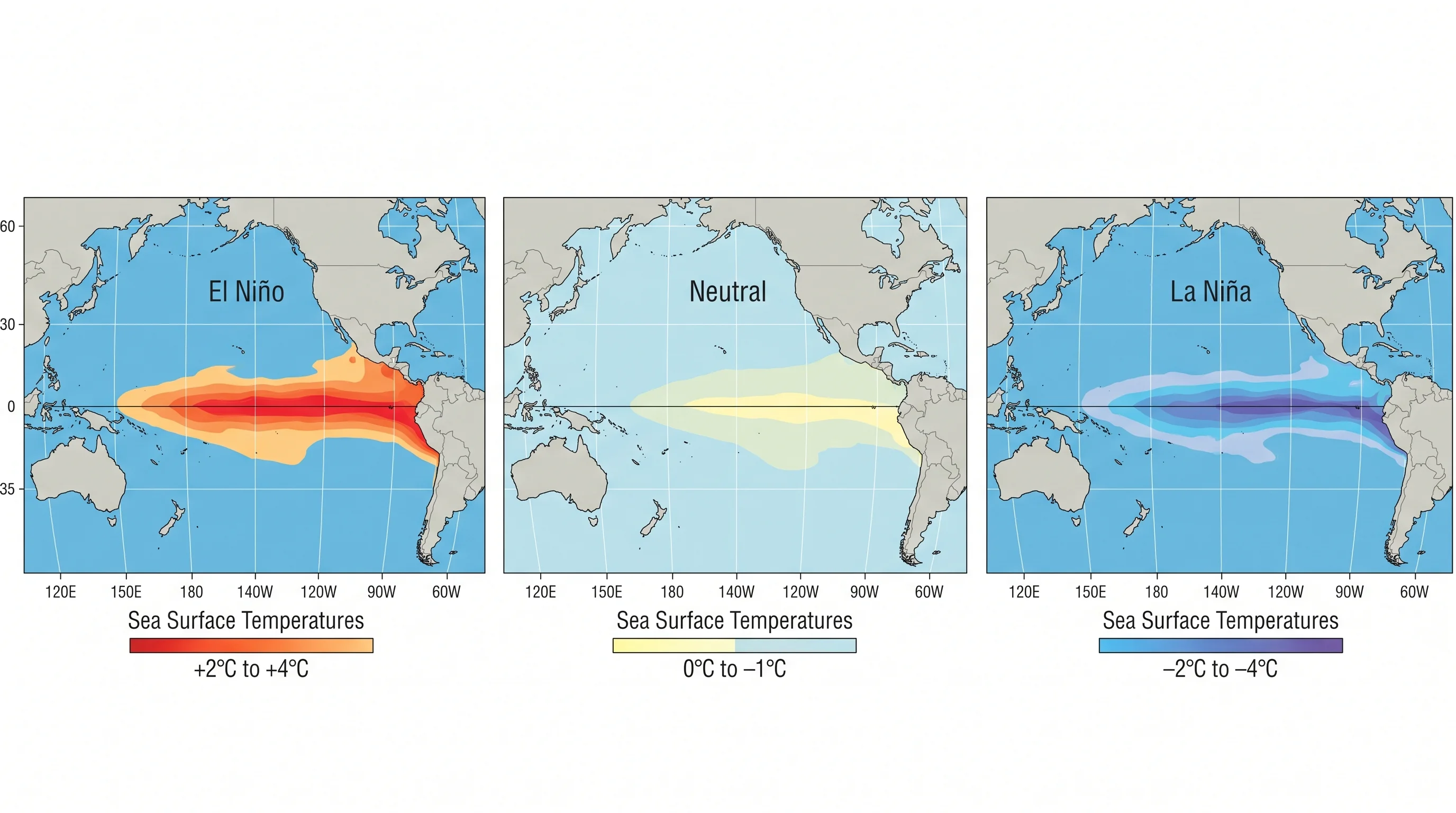
El Niño and La Niña are the two opposite phases of the El Niño Southern Oscillation, or ENSO: a large-scale fluctuation in ocean surface temperatures across the tropical Pacific, centered roughly between the International Date Line and the South American coast. During El Niño, ocean temperatures in this region run warmer than normal, sometimes by as much as 2 to 3 degrees Celsius above the historical average. During La Niña, they run cooler than normal. The neutral phase, when temperatures are near average, is simply called neutral ENSO.
The reason these ocean temperature patterns matter for weather in California, which is thousands of miles from the tropical Pacific, is that they alter the behavior of the jet stream. Warmer-than-normal tropical ocean water changes where and how strongly the jet stream positions itself over the Pacific, which in turn steers storm systems toward or away from California during the winter months. The tropical Pacific is the engine; the jet stream is the transmission; the weather in the Bay Area is what comes out the other end.
NOAA has traditionally tracked ENSO history with the Oceanic Nino Index, or ONI, which follows the three-month average sea surface temperature anomaly in the central equatorial Pacific. Historical warm and cold episodes are often identified when the ONI threshold of positive or negative 0.5 degrees Celsius persists for at least five overlapping three-month seasons. In 2026, NOAA's Climate Prediction Center notes that the Relative Oceanic Nino Index, or RONI, is used for official monitoring and prediction, while ONI remains useful for historical comparison. You can check the current status and forecast at cpc.ncep.noaa.gov.
How El Niño Changes Bay Area Weather
The most important Bay Area effect is winter storm-track risk. El Niño often strengthens the subtropical jet stream and can steer more Pacific storms toward California. When that pattern lines up with warm ocean moisture, storms can arrive as atmospheric rivers: long plumes of water vapor that deliver heavy rain, rapid creek rises, urban flooding, and landslide risk. The strongest impacts usually occur after soils are already wet, so the second or third major storm in a sequence can be more damaging than the first.
El Niño can also affect the coast. A more energetic Pacific storm pattern raises the odds of big surf, coastal erosion, and high-water problems when winter storms overlap with king tides. Warmer-than-normal ocean water can reduce some summer fog tendencies, but that signal is weaker and more local than the winter storm signal. For 2026, the practical Bay Area takeaway is to watch the winter and especially late-winter forecasts, not to expect every storm to behave differently. NOAA says the wet signal may strengthen during the core and late-winter months.
How Past El Niños Have Hit the Bay Area
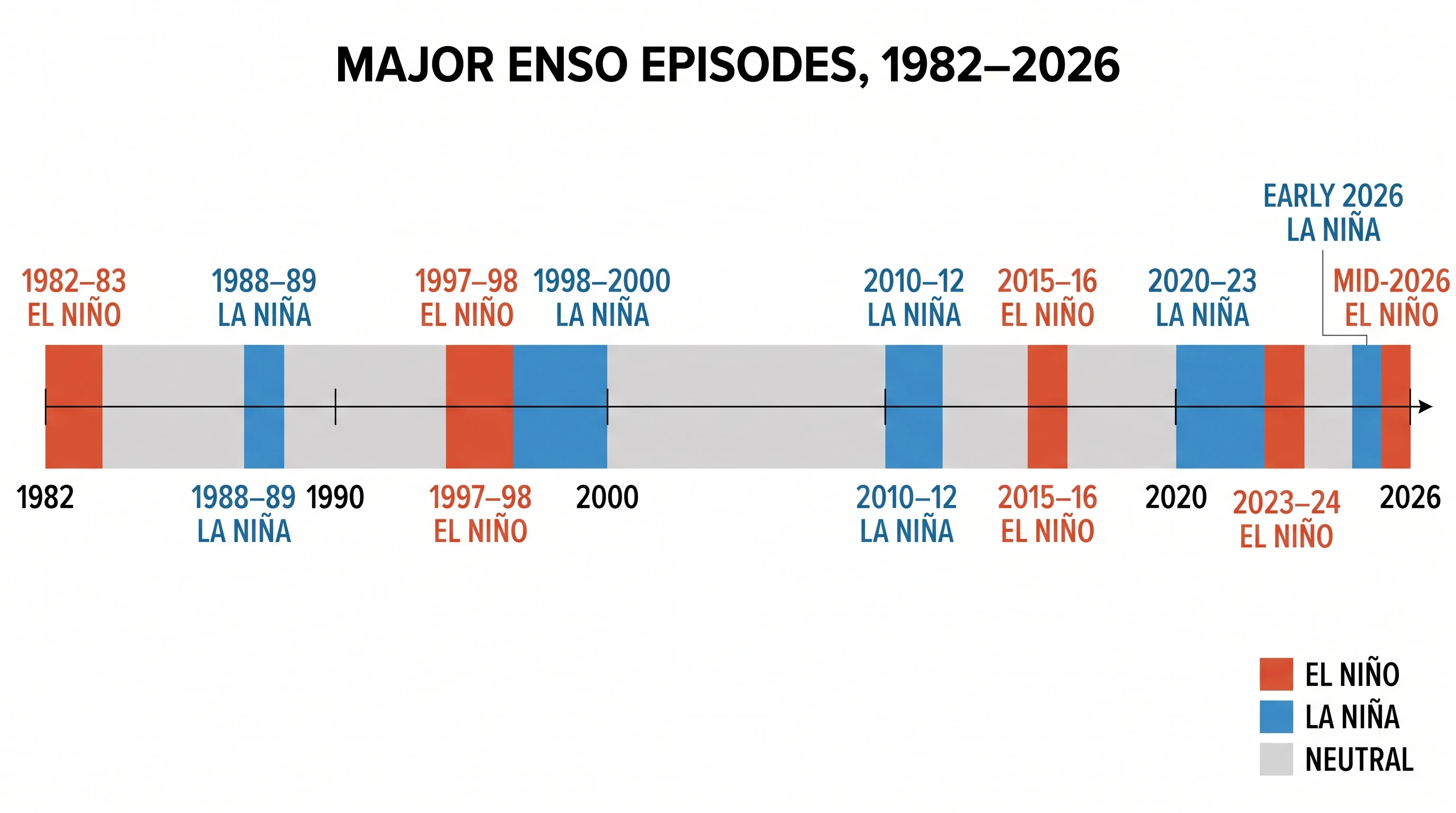
The 1997-98 El Niño is the Bay Area reference case because it delivered repeated storms, flooding, landslides, and major infrastructure strain. The 1997-98 storm season sent the Russian River and smaller creeks high, damaged roads along the coast and in the hills, and made El Niño preparedness a regular part of California winter planning. It is the reason many people still hear "El Niño" and immediately think of sandbags.
The 1982-83 El Niño was another extremely wet California winter, with San Francisco rainfall totals running far above normal and damaging storms across the state. More recently, 2023-24 brought another El Niño with active California storm periods, though the wettest and most damaging impacts leaned heavily toward Southern California. The lesson is not that every El Niño behaves the same. The lesson is that El Niño raises the ceiling on winter storm risk, especially when atmospheric rivers repeatedly find the same part of the coast.
The counterexample is 2015-16. That El Niño was one of the strongest on record in the tropical Pacific, but Northern California did not get the 1997-98 repeat many people expected. Storms did not repeatedly focus on the Bay Area and Northern California at key moments. For the Bay Area, 2015-16 is the caution label on every 2026 outlook: a strong El Niño can increase risk without guaranteeing a locally historic rain year.
El Niño vs. an Average Bay Area Year
Compared with an average Bay Area year, El Niño mainly changes the upper end of the winter-risk distribution. A normal winter can still bring a few strong storms, and an El Niño winter can still miss the Bay Area. But when El Niño is strengthening into winter, the months that already carry the most rain risk, December through February, become the ones to watch most closely.
Bay Area Forecast for Late 2026 Through Spring 2027
NOAA published its latest seasonal forecast on September 17, 2026. It expects warmer-than-normal temperatures in the Bay Area during October-December and December-February, while above-normal, near-normal, and below-normal temperatures are equally likely in spring. For rainfall, NOAA says above-normal totals are more likely during winter and spring, while October-December has equal chances of finishing above, near, or below normal.
Source: NOAA Climate Prediction Center, issued September 17, 2026.
Equal chances does not mean NOAA expects average rainfall. It means the forecast does not predict one outcome as more likely than the others. A very wet or very dry season remains possible.
For December-February, much of the Bay Area has about a 40-50% chance of finishing in the wettest third of years. That chance rises to roughly 50-60% for January-March. In the September update, that stronger chance now extends into February-April around San Francisco, Oakland, and San Jose, up from 40-50% in August. Santa Rosa and Concord remain in the 40-50% band for February-April. These percentages do not describe how much rain will fall, and they do not guarantee that atmospheric rivers will repeatedly target the Bay Area.
How La Niña Is Different
La Niña is different, but not simply opposite in every Bay Area winter. A classic La Niña pattern shifts the Pacific storm track north toward the Pacific Northwest and often leaves central and southern California drier. The Bay Area sits near the transition zone, so its signal is messier: many La Niña winters are dry, but some still deliver major atmospheric rivers when the jet stream lines up over Northern California. During the extended La Niña period from 2020 to 2022, California experienced severe multi-year drought, with reservoir storage dropping to crisis levels and statewide water conservation measures returning. But the very wet 2022-23 winter unfolded while La Niña was still lingering, which is another reminder that ENSO is only one ingredient in California storm seasons.
When La Niña contributes to a drier winter and spring, the weather can feel sunnier and warmer earlier in the year, especially inland. That can make spring and fall outdoor weather pleasant, but it also means less soil moisture entering the dry season. The tradeoff is important: pleasant shoulder-season weather and drought risk can come from the same dry pattern.
Fire weather is also part of the dry-pattern picture. Drier-than-normal winters leave vegetation with less soil moisture heading into summer, and warm springs can accelerate vegetation dry-out. By fire season in late summer and fall, those fuel and soil-moisture conditions can amplify fire spread when the Diablo winds arrive. The 2020 fire season, which included the SCU Lightning Complex, showed how dangerous dry fuels, lightning, heat, and wind can become even without a simple one-to-one ENSO explanation.
How Long the 2026 El Niño Could Matter
El Niño and La Niña events often last about a year, though some persist longer. Multi-year La Niña episodes are more common than multi-year El Niños, and the 2020-23 La Niña was unusual in lasting across three winters. The 2023-24 El Niño faded, 2025 brought a cool-to-neutral stretch, and the new 2026 El Niño developed after that. NOAA's September 2026 update says confidence is very high that El Niño will continue through early 2027, with a 97% chance during February-April and an 82% chance during March-May. The next ENSO Diagnostic Discussion is scheduled for October 8, 2026.
For seasonal planning, focus on fall 2026 through spring 2027. NOAA expects a strong or very strong El Niño and says above-normal Bay Area rainfall is more likely during winter and spring, but a wet season is not guaranteed. Prepare for individual storms: clear gutters, inspect drains, trim risky limbs, and understand local flood routes. Follow short- and medium-range forecasts once storms start crossing the Pacific.
How to Check the Current ENSO Status and What It Means for Your Plans
The primary resource is NOAA's Climate Prediction Center, especially its monthly ENSO Diagnostic Discussion. The page publishes the current status, the ocean and atmosphere evidence behind it, and the probabilistic forecast for the months ahead. NOAA's seasonal outlook maps are the next step because they translate the ENSO pattern into odds for above-normal, below-normal, or equal-chance precipitation and temperature.
The California Department of Water Resources is also worth watching during the fall and winter, especially for snowpack, reservoir storage, runoff, and statewide water-supply conditions. NOAA is the better source for ENSO status itself; DWR is the better source for how the season is actually translating into California water supply.
ENSO cannot tell you what any specific week will look like. A strong El Niño can send storms toward California, but the jet stream may aim them north or south of the Bay Area. Use ENSO for broad planning, then use short- and medium-range forecasts for rainfall, wind, flooding, and travel decisions.