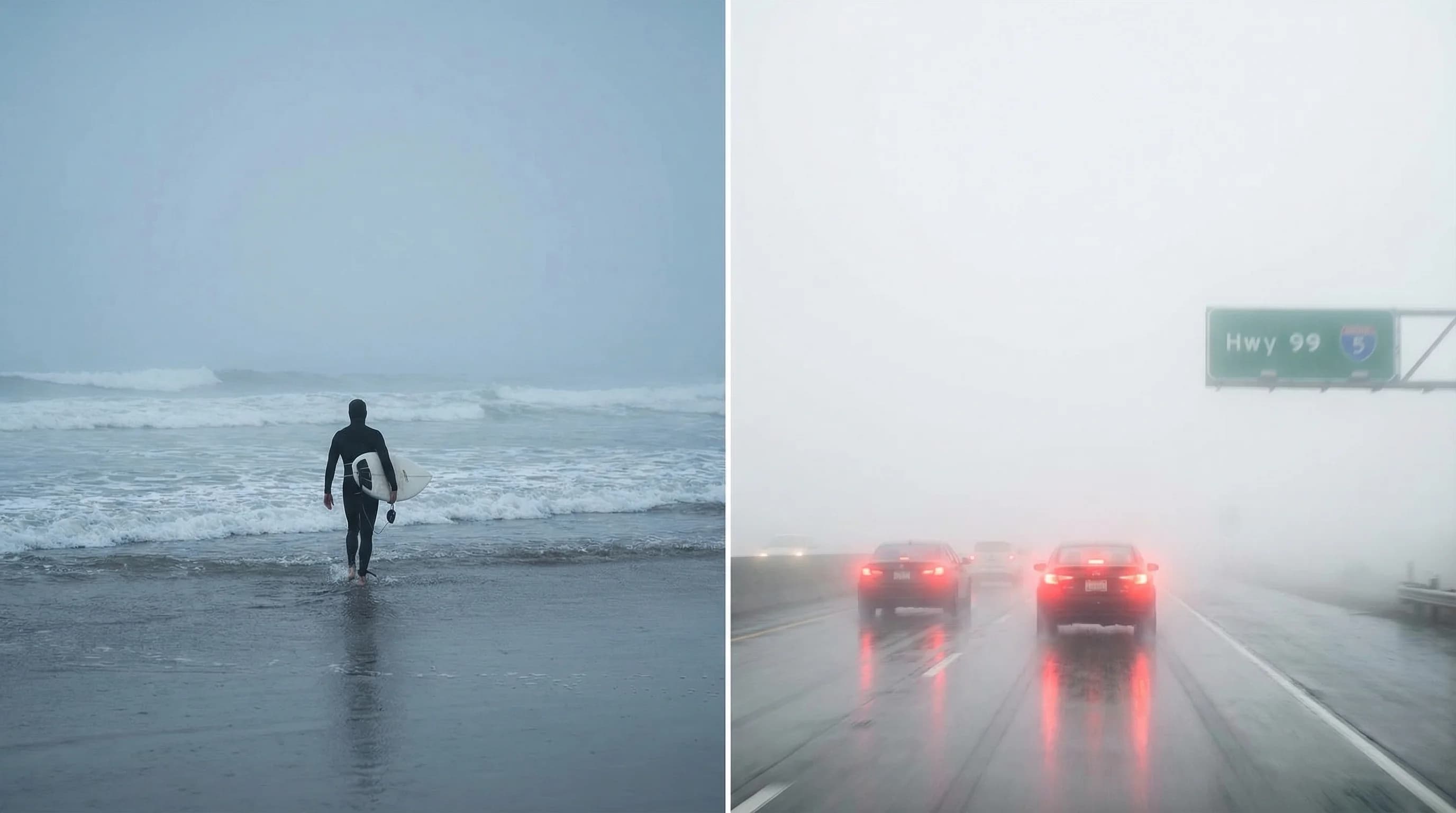
If you commute across the Bay Area in winter and can't see the car in front of you, that is probably tule fog. If you commute in summer and the Golden Gate Bridge has vanished into a gray wall, that is the marine layer. These are two completely different weather phenomena that happen to share the word “fog,” and confusing them is not just a matter of semantics. One is a nuisance. The other is genuinely dangerous. Every Bay Area driver, hiker, and weather-curious resident should know the difference.
How They Form
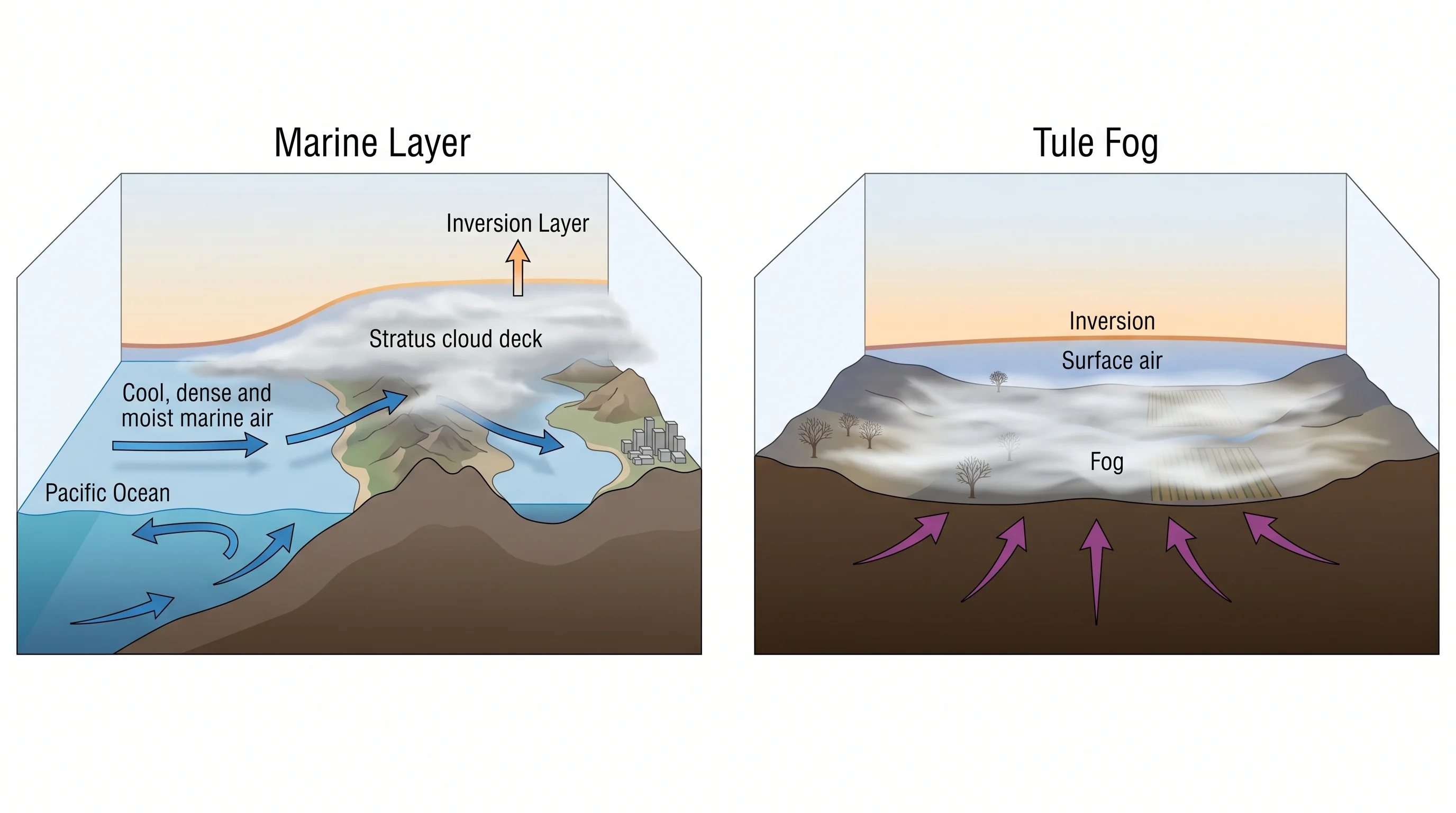
Marine layer fog forms when cold, moist air blows in from the Pacific Ocean and condenses as it moves over slightly warmer coastal land. The ocean surface off San Francisco stays at 55 to 58 degrees year-round, kept cold by the California Current and coastal upwelling. When warm inland air creates a pressure gradient, that cold marine air gets pulled eastward through the Golden Gate and other coastal gaps. As it moves over land and meets warmer air above, it sits in a shallow, stable layer near the surface. The result is the classic San Francisco marine layer: a ceiling of gray cloud that hugs the ground and rolls through neighborhoods like slow-moving cotton.
Tule fog forms by an entirely different mechanism. It is radiation fog, which means it forms when the ground loses heat rapidly on clear, cold nights. The Central Valley floor, with its flat topography and agricultural soils, is exceptionally good at radiating heat away after sunset. As the ground cools, it chills the air immediately above it to the dew point, and fog condenses from the bottom up. There is no ocean involved, no pressure gradient, no marine air mass. Tule fog is a product of clear skies and cold ground, which is why it forms most intensely in the valley interior, far from any coast.
Seasonal Timing
Marine layer season runs roughly May through September, peaking in June, July, and August. This aligns directly with the period when Central Valley heat is strongest and the pressure gradient between coast and inland is at its maximum. The marine layer is, in a real sense, a product of summer heat rather than summer cold. It is the coast's response to what is happening 60 miles inland.
Tule fog is a winter phenomenon. It runs November through March, peaking in December and January. This is when the Central Valley floor gets cold enough at night to generate strong radiation cooling, and when the atmosphere is stable enough to trap the fog near the ground for extended periods. The two seasons barely overlap, which is one of the cleaner ways to distinguish them. If it's August and foggy, you're in the marine layer. If it's December and foggy, you may well be in tule fog, especially if you're anywhere near the valley.
Danger Level
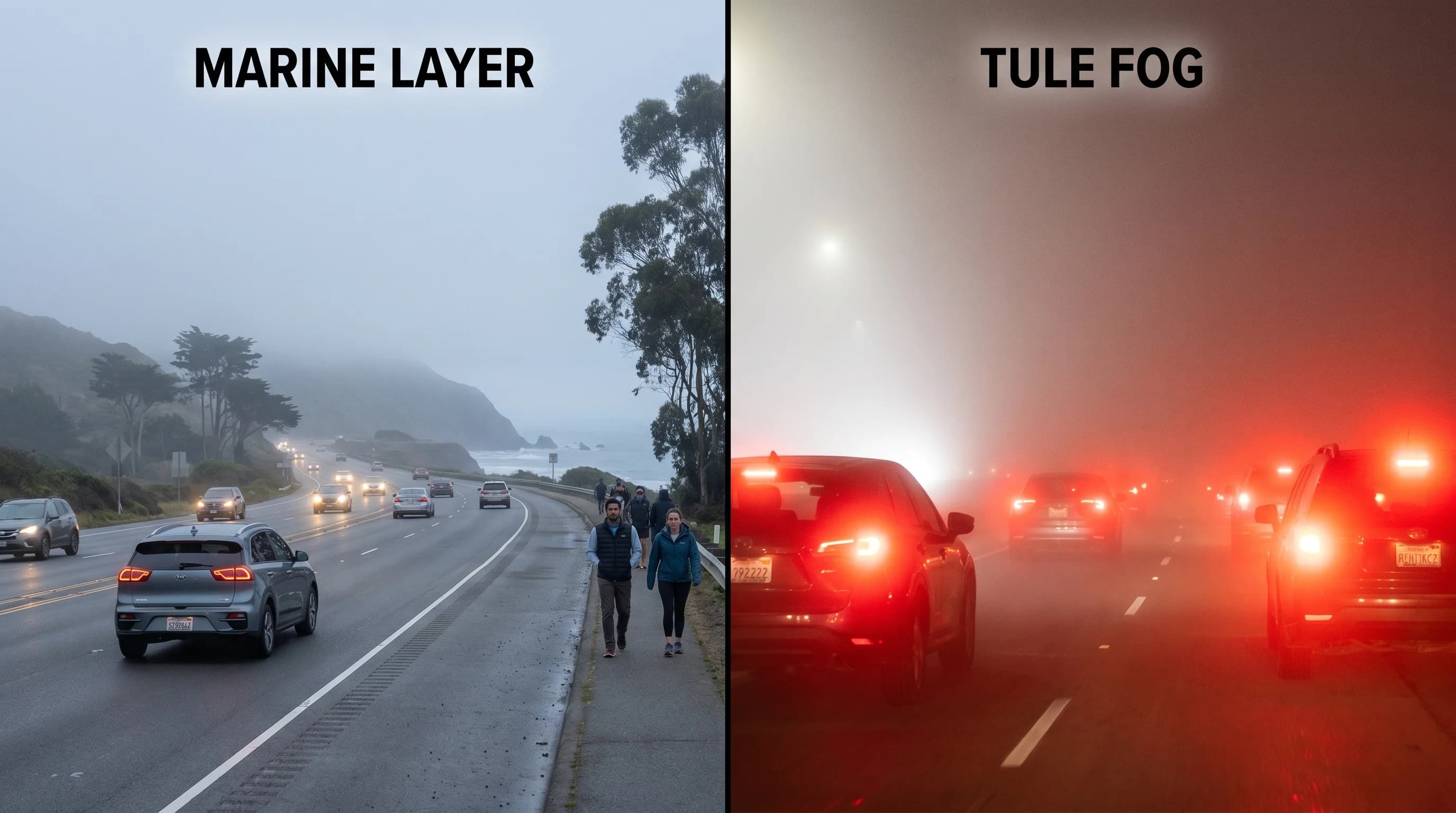
This is where the comparison becomes serious. Marine layer fog is an inconvenience. Tule fog is a public safety hazard. Tule fog is the leading cause of weather-related traffic fatalities in California, accounting for hundreds of accidents and dozens of deaths in bad years. The California Highway Patrol issues tule fog advisories the way other states issue blizzard warnings. The fog can descend in minutes, reducing visibility from a quarter mile to essentially zero. On Interstate 5 through the Central Valley, multi-car pileups involving 30, 50, even 100 vehicles have occurred during major tule fog events.
Marine layer fog, by comparison, tends to sit at 0.25 to 1 mile visibility. That is low enough to obscure the Golden Gate Bridge towers and make driving unpleasant, but rarely the kind of zero-visibility wall that tule fog can create. Marine layer fog also has predictable behavior: it burns off by late morning in most locations, and it follows coastlines and valleys in patterns that experienced local drivers learn to anticipate. Tule fog is less predictable, patches up suddenly, and can persist all day without burning off.
Visibility Comparison
On a typical marine layer morning in San Francisco, visibility ranges from a quarter mile to about one mile. The fog is thick enough to obscure landmarks and make the bay look like a featureless gray plane, but you can still see the road ahead and navigate normally. Pilots describe the marine layer ceiling as typically sitting at 500 to 1,500 feet, low enough to close SFO to visual approaches but not necessarily to instrument-equipped aircraft.
Tule fog in a serious event can drop below 10 feet of visibility. That is not a typo. In extreme cases, drivers cannot see the front of their own vehicle. The fog is dense, uniform, and white in headlights, which creates a disorienting whiteout effect. Valley fog of this intensity is as visually impenetrable as a complete whiteout snowstorm, and it is far more dangerous because drivers are less psychologically prepared for it.
Duration
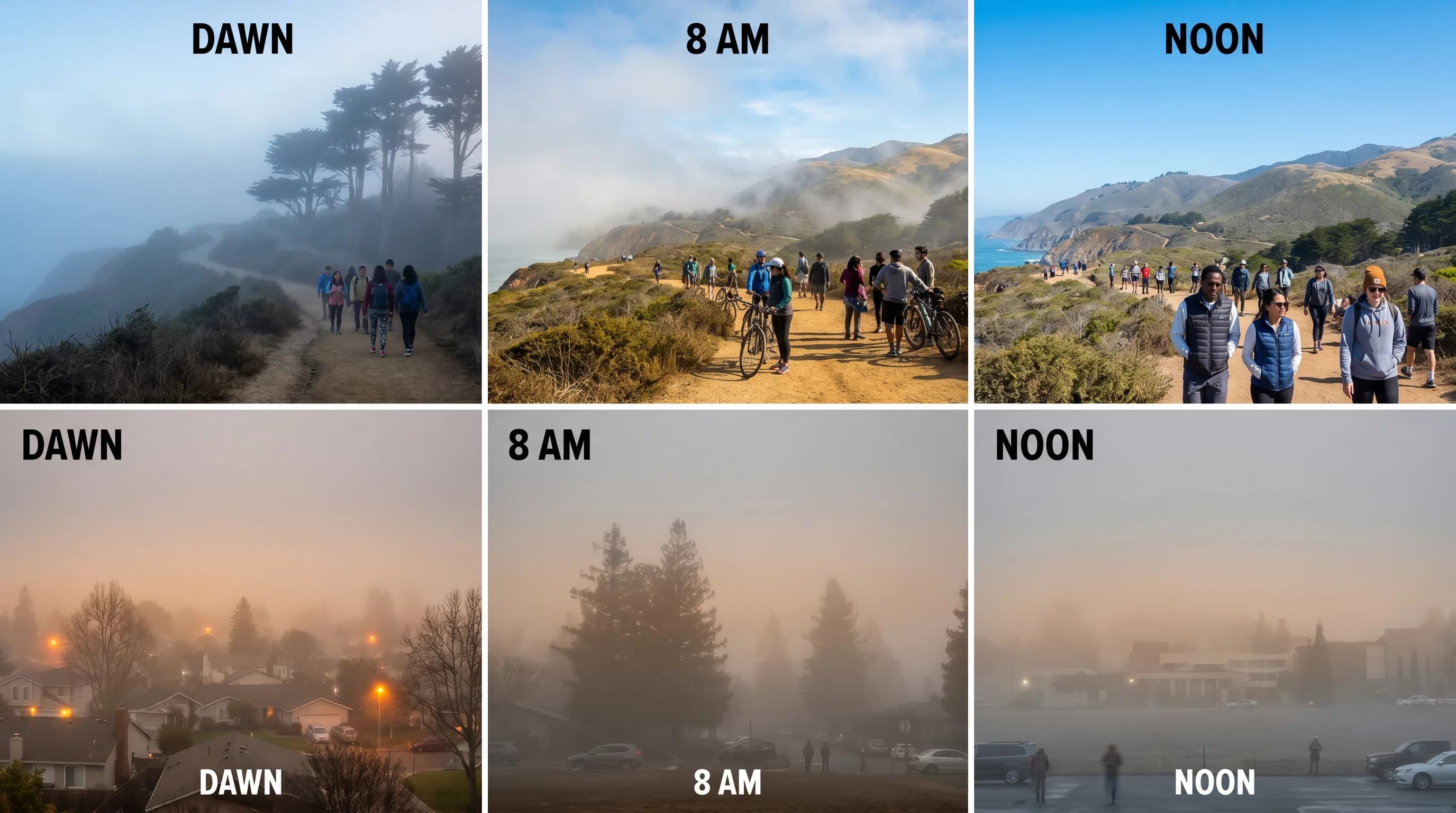
Marine layer fog typically affects any given location for 2 to 6 hours. It rolls in overnight or in the early morning, often intensifies around sunrise, and then burns off as solar heating warms the surface and breaks the temperature inversion capping the layer. By noon in most Bay Area locations, the marine layer has retreated to the coast or dissipated. Afternoon sun is the norm.
Tule fog is different. In a strong event, it can persist for days to weeks without meaningful clearing. The same mechanism that creates it, stable air and slow-to-warm valley soil, also prevents it from breaking up. Without strong winds or a significant warm front to lift it, valley tule fog can sit stubbornly in place through an entire week. Agricultural workers in the Central Valley during January know weeks of almost no direct sunlight, with the sun appearing only as a dim, diffuse glow through the fog ceiling.
Bay Area Spillover
Tule fog is primarily a valley phenomenon, but it does push into the Bay Area through specific corridors. The Carquinez Strait, a narrow water gap connecting the Sacramento Delta to San Pablo Bay, acts as a channel for cold foggy air to spill westward. When tule fog builds up in the Sacramento Valley and pressure differences push it toward the bay, communities like Livermore, Antioch, and Concord can find themselves wrapped in valley-sourced fog that has nothing to do with the Pacific Ocean. This is disorienting for people who expect Bay Area winter fog to behave like summer marine layer. It doesn't.
Half Moon Bay and the coast get marine layer spillover even in winter, when a strong pressure pattern pushes Pacific air inland. But the two fog types can sometimes coexist in different parts of the Bay Area simultaneously, with marine-influenced fog on the coast and tule fog pushing in from the northeast. Reading a Bay Area winter forecast requires knowing which fog you're talking about.
How to Identify Which Fog You're In
Season is the fastest clue. Summer fog is marine layer. Winter fog is likely tule, especially if you are east of the hills or anywhere near the delta. Location is the second clue: if you are on the coast or in San Francisco proper, you are almost certainly in the marine layer regardless of season. If you are in Livermore, Antioch, or the Tri-Valley in December, you are quite possibly in tule fog spillover.
The feel of the fog matters too. Marine layer fog tends to move. You can watch it drift through streets and pour over hills in visible currents. It has a directional quality because it is being pushed by wind off the ocean. Tule fog is still. It sits. It does not drift dramatically because it forms in place, a product of the cold ground beneath it rather than air moving horizontally. If the fog feels static and silent and the ground is cold, you are probably in tule fog.
Escaping Each Type
Escaping marine layer fog means going east. Oakland, Berkeley, and the East Bay hills block the marine air, and anything on the inland side of those hills tends to see more sun. Crossing the bay is often enough. Escaping tule fog in the Central Valley is harder: you generally need to gain elevation or wait it out. The fog sits in the valley floor, so even a modest climb into the foothills can put you above the fog ceiling and into brilliant winter sunshine. Interstate 80 heading up toward Auburn will often take you from dense valley fog into clear sky within 20 minutes of climbing. The contrast is striking every time.
The simplest rule of thumb: treat them as entirely separate weather events with different causes, different seasons, and different levels of risk. Marine layer fog is a feature of Bay Area coastal summers, worth understanding if you want to plan a day trip or know which neighborhoods to avoid in July. Tule fog is a winter safety issue, worth taking seriously if you drive Highway 99 or I-5 between November and February. Both are part of living in Northern California. Knowing which one you are dealing with changes how you respond to it.