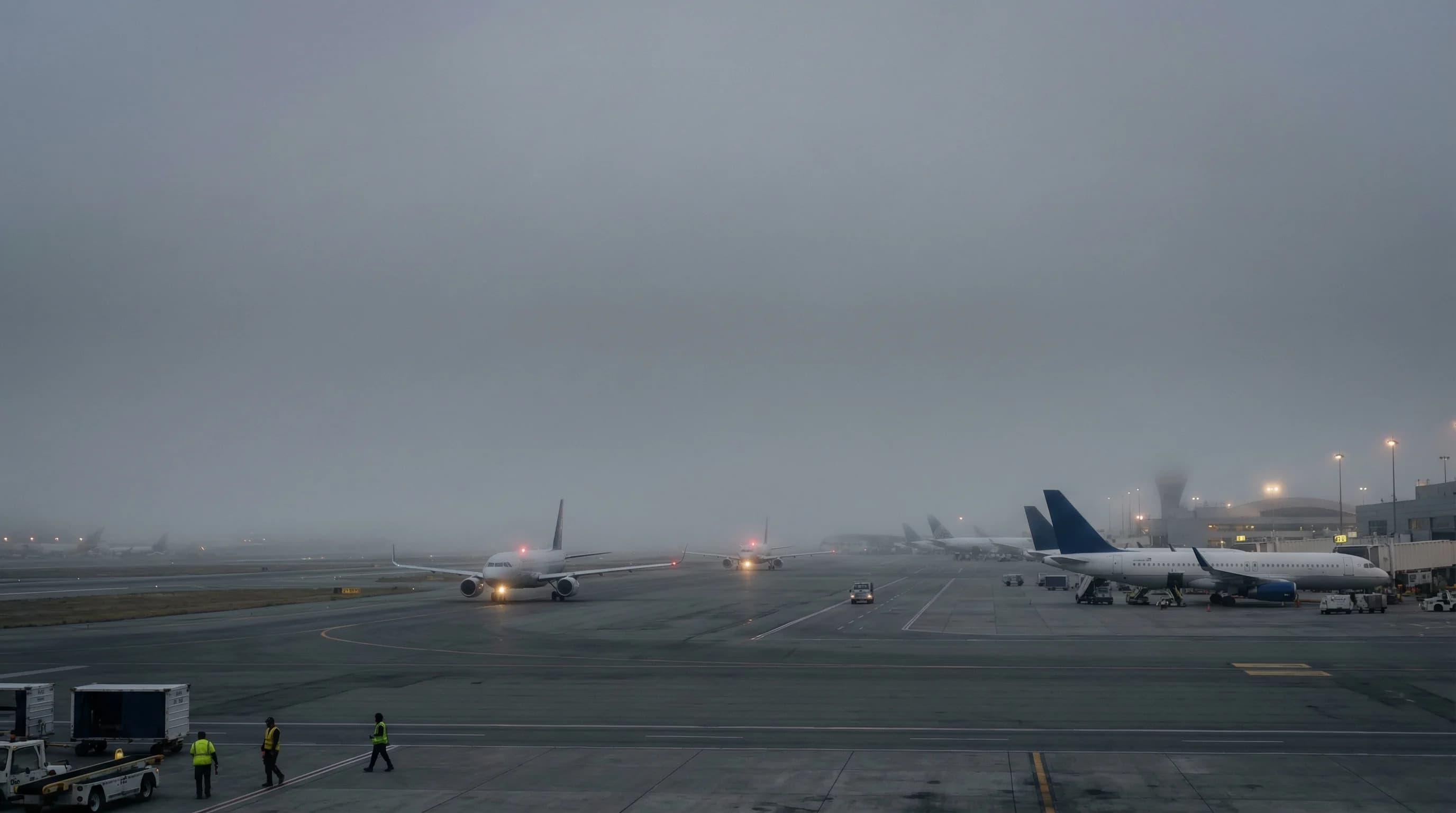
Weather-related flight delays at San Francisco International Airport and Oakland International Airport follow a completely predictable pattern that most travelers do not know about in advance. SFO is among the most delay-prone major airports in the United States, not because of severe weather, but because of low-visibility conditions created by the Bay Area's summer marine layer. Fog that burns off in downtown San Francisco by 10 a.m. can persist at SFO through noon or later, reducing the airport to instrument-only operations and cutting arrival capacity in half. Understanding when and why this happens is genuinely useful for anyone flying into or out of the Bay Area, because the delay patterns are seasonal and predictable even if the specific affected flights are not.
SFO, Fog, and Reduced Arrival Capacity
SFO sits on the bay shoreline in a location that receives the marine layer at moderate intensity on most summer mornings. The airport's orientation means that in low-visibility conditions, only one of its two parallel runway pairs can be used for arrivals under instrument approach procedures. When visibility drops below the threshold for independent parallel approaches, the FAA requires separation distances that effectively cut the arrival rate from roughly 60 arrivals per hour to 30. The resulting ground delay programs where aircraft are held at departure airports to balance the arrival queue, cascade across the national air traffic network. A morning fog event at SFO can delay flights arriving from New York or Chicago by two to three hours even when the sky at those departure airports is perfectly clear.
The worst delays at SFO occur on mornings when the marine layer is low and thick enough to keep visibility below approach minimums, and when the afternoon sea breeze disperses the fog slowly. July and August are the most reliably delay-prone months. The typical pattern is: ground delay programs in effect from early morning through late morning, gradual improvement as fog lifts, clearing by early afternoon, and normal operations through the evening. Flights scheduled for 7 to 11 a.m. arrivals into SFO are the most vulnerable. Afternoon arrivals are much less likely to experience weather-related delays.
Oakland as the Alternative
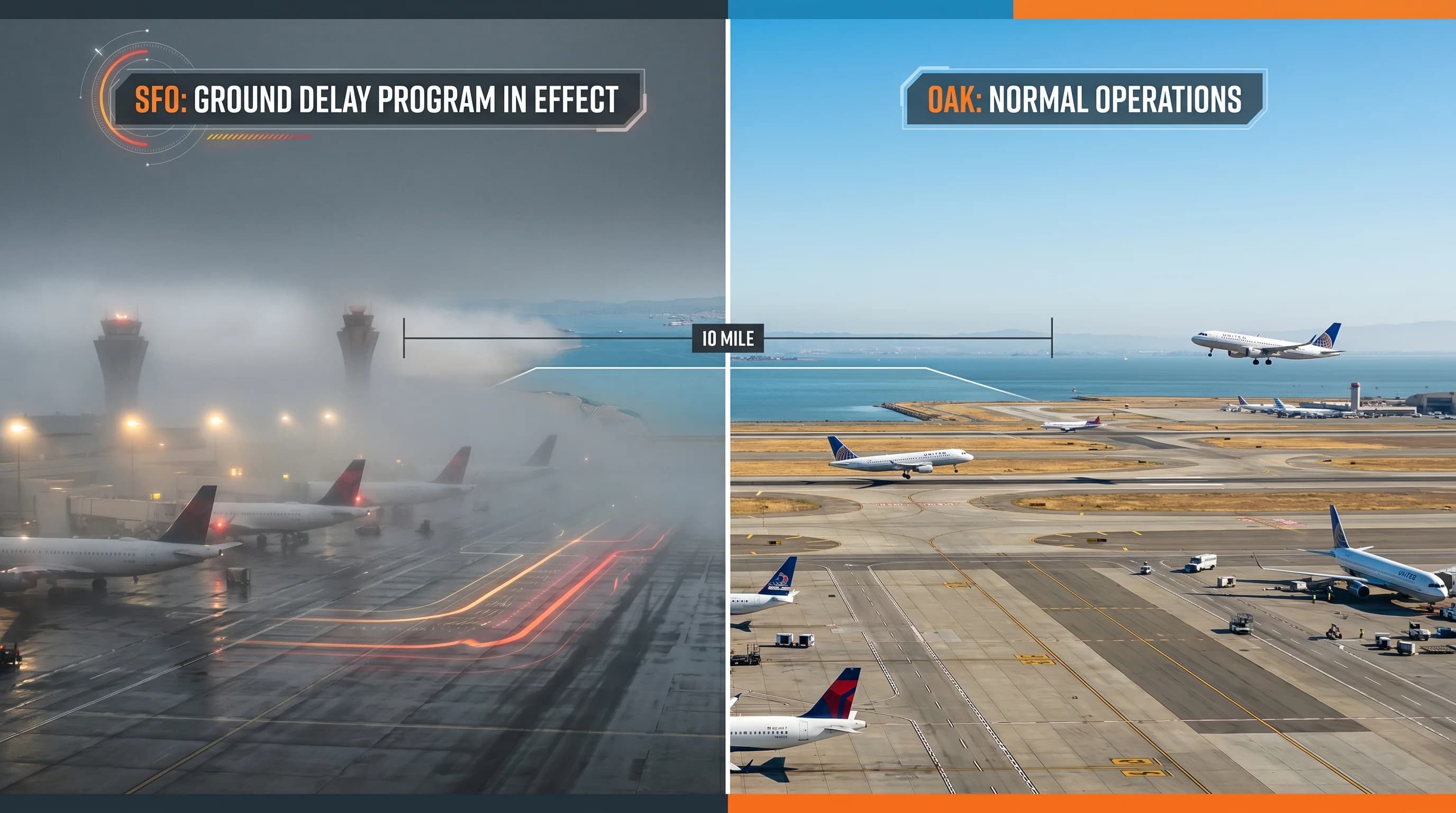
Oakland International Airport, located on the East Bay shoreline 12 miles from SFO, typically has better visibility than SFO on summer mornings. Oakland's position on the eastern side of the bay means it sits slightly away from the densest marine air, and its runway orientation is different enough that low ceilings do not trigger the same capacity constraints. When SFO is running ground delay programs, OAK is often operating normally or with minor delays. This difference is well-known in aviation circles and drives some traffic toward Oakland as an alternative for early morning arrivals.
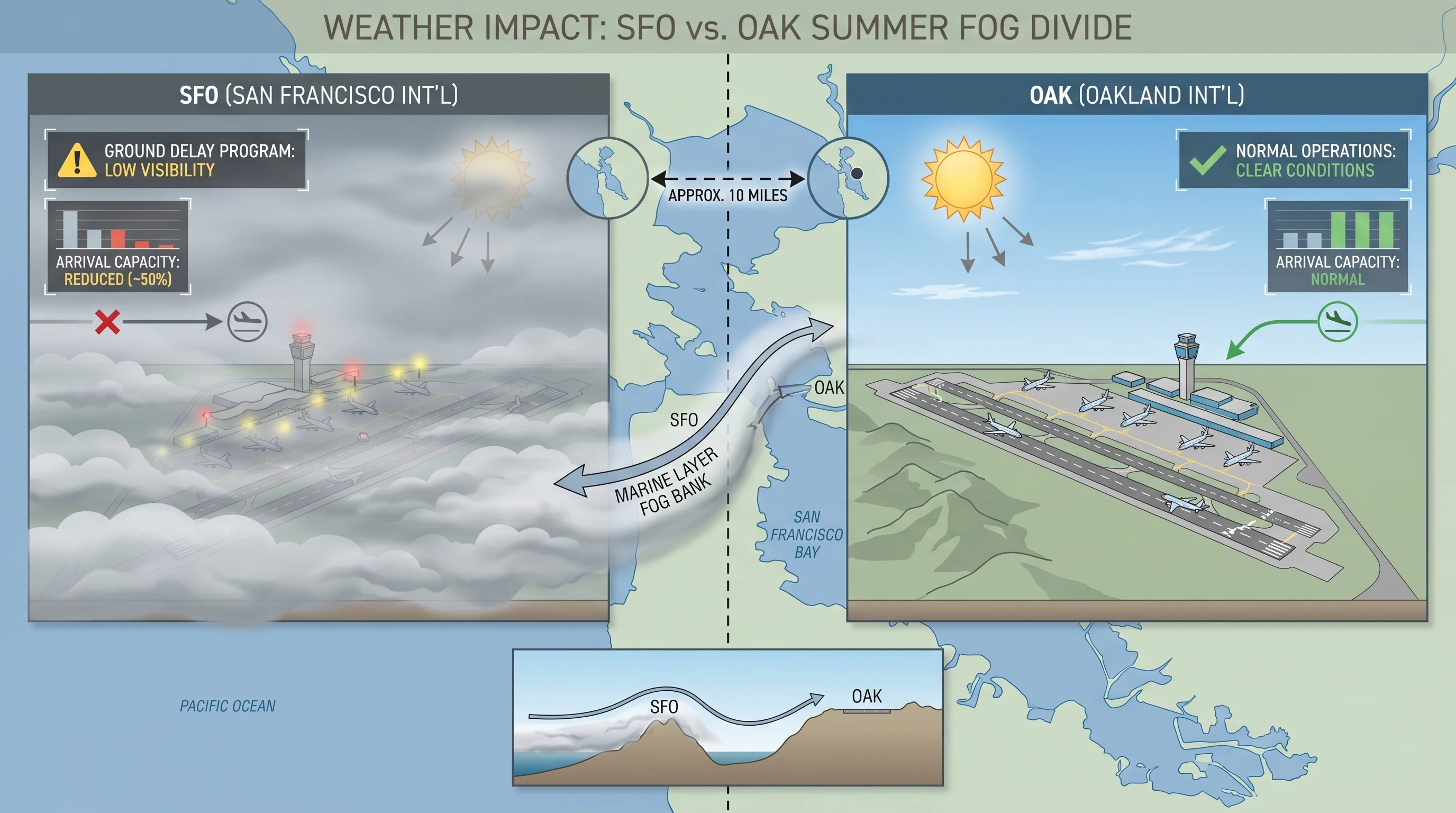
The trade-off is that OAK has fewer airline destinations, fewer terminal amenities, and less frequent service to many markets than SFO. For travelers with flexibility on routing, checking both airports for the same destination is a legitimate strategy during summer months. An OAK routing that avoids morning fog delays can save two to three hours on a day when SFO is running arrival restrictions.
Seasonal Delay Patterns
The fog-related delay pattern at SFO is seasonal and predictable at the macro level, even if individual days vary. June through August are the highest-risk months for morning fog delays. September through October see improved conditions as the marine layer weakens and the Indian summer pattern takes hold. From November through April, winter storm systems can cause delays from wind and low ceilings, but these events are shorter in duration than the persistent summer fog pattern and typically clear faster.
Spring, from late March through May, is actually one of the better periods for on-time performance at SFO. The summer fog has not yet established, the winter storm season is winding down, and clear weather is more common. Late fall through early winter can also bring high-pressure periods with exceptional clarity and near-perfect flying conditions. Travelers with flexibility on travel dates who are primarily concerned about weather delays would do well to avoid July mornings.
What Travelers Can Do
The most practical strategy for avoiding SFO weather delays in summer is to book afternoon departures or arrivals rather than morning. This does not guarantee delay-free travel, but it significantly reduces exposure to the fog-related capacity constraints. Flights departing SFO in the morning are less affected than arrivals; the delay impact on departures is indirect, from gate holds and late-arriving aircraft. Afternoon departures and arrivals are much less likely to be caught in the morning fog cycle.
Checking the FAA's Air Traffic Control System Command Center for ground delay program status before leaving for the airport is straightforward and informative. When a GDP is active at SFO, the expected delays are published in real time. Building an extra hour of connection buffer into itineraries that route through SFO in summer mornings is a reasonable precaution for anyone whose schedule can accommodate it.