fogseasonaldestinations

When Does San Francisco's Summer Fog Peak?

By SFBayWeather||Updated |5 min read
When Does San Francisco's Summer Fog Peak?

Key Takeaways

  • July is San Francisco's foggiest month, when the North Pacific High is strongest, the sea surface is coldest relative to the land, and the marine layer is deepest.
  • Fog is most intense overnight and in the early morning, when the land has cooled and the temperature gradient reinforces the marine push. Burn-off, when it happens, occurs in the morning hours.
  • Strong marine push days in July may see no afternoon sun at all. The fog persists through the full day. In June and September, burn-off is more reliable.
  • Neighborhood fog varies dramatically: the Outer Sunset and Outer Richmond are consistently foggier than the Mission District, which is sheltered by the Twin Peaks ridge.
  • For visitors seeking sunny San Francisco days, plan for September-October (Indian summer) or late April-May rather than July-August.

San Francisco's summer fog follows a pattern as predictable as the tides, driven by the same large-scale atmospheric dynamics that shape the entire Bay Area's weather. The fog is not random. It peaks in July, not June or August. It is most intense in the evening and night, not the afternoon. It burns off by noon in some neighborhoods and never burns off in others. And the foggiest days are not the coldest ones. They are the ones when the temperature contrast between the coast and the inland valley is sharpest. Once you know the pattern, you can plan around it.

July Is the Foggiest Month

July is statistically San Francisco's foggiest month, not the coldest or the most overcast in the sense of winter, but the month with the most intense marine layer fog measured by frequency, persistence, and density. This seems paradoxical: July is midsummer, with the longest days and highest sun angles. But July is when the North Pacific High reaches peak strength, when the pressure gradient between the coast and the inland valleys is greatest, and when the sea surface temperature is coldest relative to the land temperature. All three factors drive maximum marine air flow and maximum fog production.

June is often called "June Gloom" locally for its persistent morning overcast, but June's overcast tends to burn off reliably by midday or early afternoon; the sun angle is still high enough to break the inversion. In July, the marine layer deepens and the inversion strengthens, making afternoon burn-off less reliable. Some July days in San Francisco see no afternoon sun at all, with the fog persisting through the entire day. August begins to see the marine layer weaken slightly as the North Pacific High starts its fall retreat.
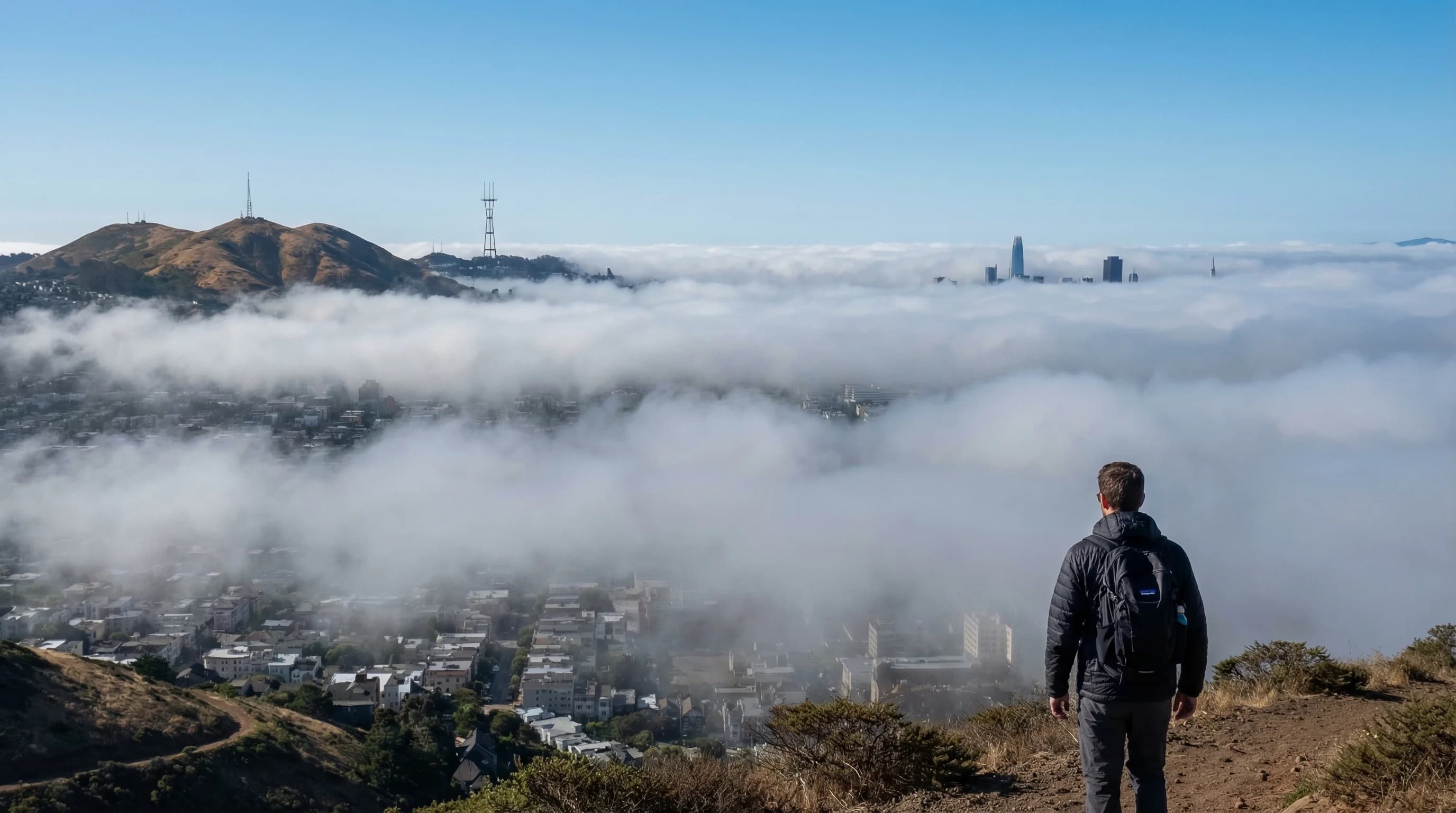
San Francisco fog rolling over the Twin Peaks hills in a classic July marine layer scene, dense white fog flowing through the streets below Twin Peaks, surrounding hilltops poking into sunshine
July is San Francisco's foggiest month. The North Pacific High reaches peak strength, the sea-to-land temperature gradient is greatest, and the marine layer deepens enough that some July days see no afternoon sun at all, a pattern that surprises visitors expecting classic summer weather.

When During the Day Is Fog Most Intense?

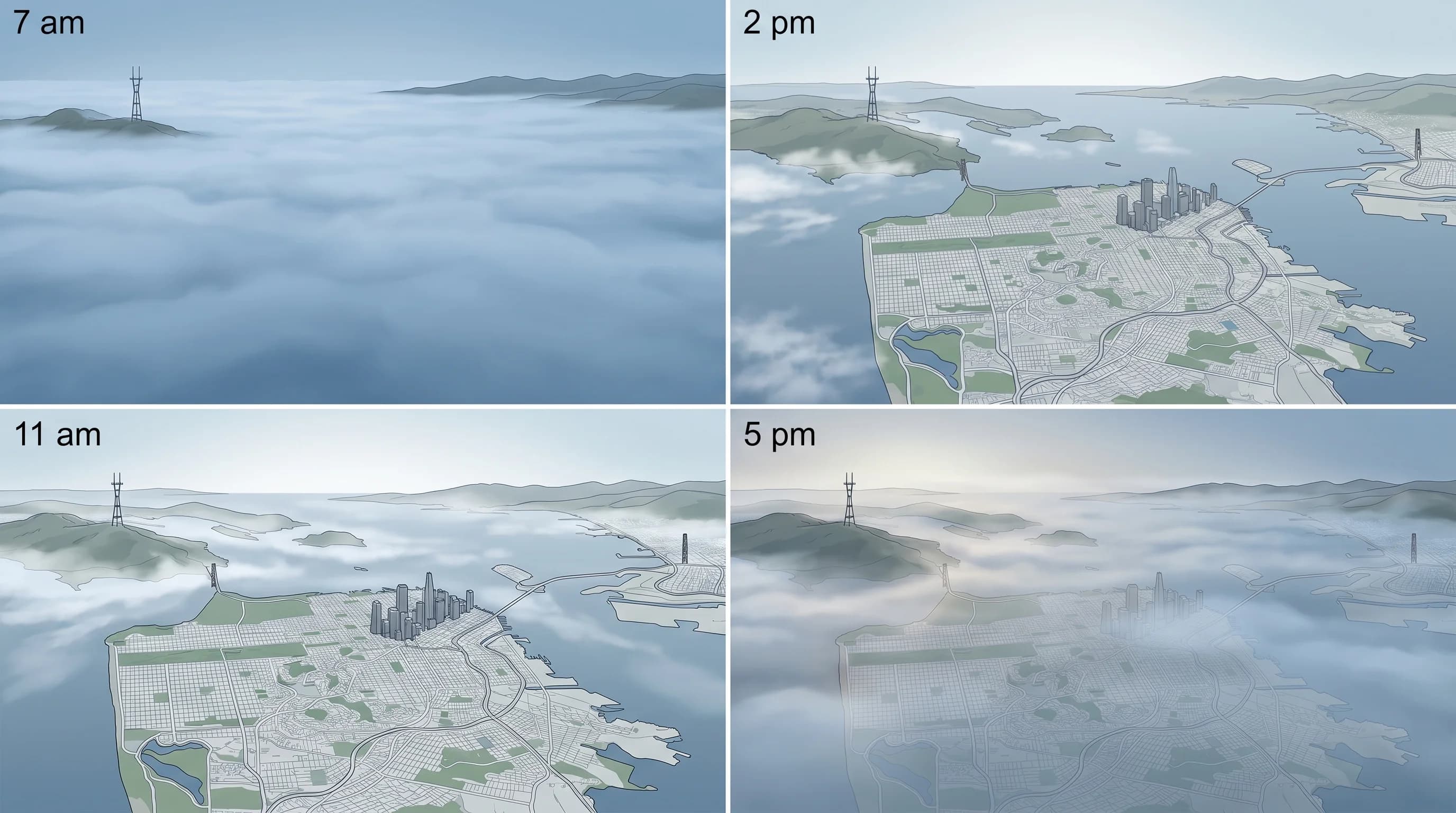
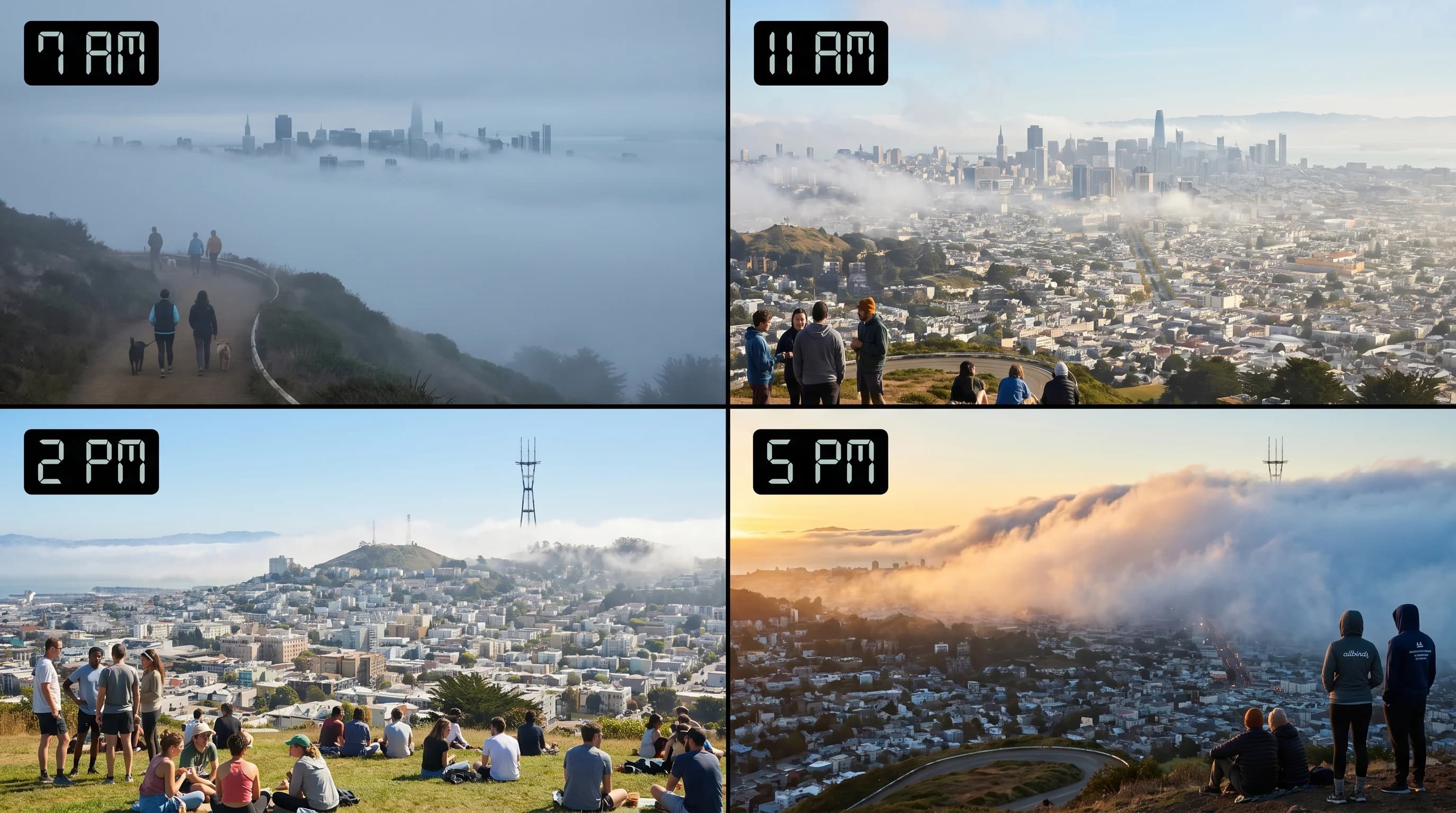
San Francisco's fog is most intense in the late evening through early morning. After the afternoon burn-off, the marine layer reforms as the land cools and the temperature gradient between land and ocean reverses or weakens. The fog flows back in through the Golden Gate, typically in the late afternoon or evening, and densifies overnight. By dawn, the marine layer is at its maximum depth and density. Then the morning cycle begins: solar heating warms the surface, gradually weakening the inversion, and the fog burns off from inland and high-elevation areas outward toward the coast.
Scientific illustration explaining When Does San Francisco's Summer Fog Peak?

Whether and when the fog burns off depends on the marine layer depth and the strength of the inversion. On weak marine layer days in late June or September, the fog burns off by 9 a.m. and the afternoon is sunny and warm. On strong marine push days in July, the fog may not burn off until 2 or 3 p.m., or it may persist all day. The weather forecast phrase "patchy morning fog, clearing by noon" describes the median July day. "Dense fog advisory through the afternoon" describes the strong marine push days that characterize the foggiest parts of the fog season.

Neighborhood Variation in SF Fog

Not all of San Francisco experiences the same fog on the same day. The western neighborhoods, the Outer Sunset, Outer Richmond, and Ocean Beach, are consistently foggier than the eastern neighborhoods, because they face directly toward the Pacific and are in the first path of the marine air. The Mission District, sheltered on its western side by the Twin Peaks ridge, is noticeably sunnier than the Sunset, often by 10 to 15 degrees, on the same afternoon. Neighborhoods at higher elevation that poke above the marine layer ceiling see sun on foggy mornings when the streets below are gray.

The practical implication for visitors is that San Francisco's fog is not a uniform blanket. A July day that seems completely fogged in from the outside may offer sunshine in the Mission District by noon, while the Sunset remains gray. Planning activities for the eastern neighborhoods or the mid-afternoon hours can provide far better weather than assuming the city is uniformly overcast.

Frequently Asked Questions

What is San Francisco's foggiest month?

July is the foggiest month in San Francisco by most measures. The North Pacific High reaches peak strength in July, driving the strongest onshore flow and the deepest marine layer. Sea surface temperatures are coldest relative to land temperatures in July, maximizing the temperature gradient that drives fog formation. June is often described as foggy ("June Gloom"), but June's fog typically burns off more reliably by midday. August begins to see the marine layer weaken.

What time of day is fog worst in San Francisco?

The marine layer is thickest and most persistent in the early morning, typically from 3 to 10 a.m., when the land has cooled overnight and the temperature gradient is strongest. As the morning progresses, solar heating gradually erodes the inversion and fog begins to thin or lift. On typical days in summer, fog burns off by 10-11 a.m. in the sunnier eastern neighborhoods, but may persist until 2-3 p.m. in the western neighborhoods and along the coast. On strong marine push days, the fog may not burn off at all.

Why is the Mission District sunnier than the Sunset District?

The Twin Peaks ridge (922 feet) and the hills of the Castro and Noe Valley create a geographic barrier that partially blocks the westerly marine air from reaching the Mission District directly. The Outer Sunset faces the Pacific directly and receives the first surge of marine air. By the time that air flows over or around the Twin Peaks ridge, it has warmed slightly and thinned. The temperature difference on a typical foggy summer afternoon can be 10-15°F between the Outer Sunset and the Mission, even though they are less than 3 miles apart.

When is the best time to visit San Francisco for clear weather?

September and early October are the best months for reliably clear, warm San Francisco weather. The North Pacific High weakens, the marine layer pulls back, and the city experiences its "Indian summer"; often the warmest, sunniest days of the entire year. Late April and May are the second-best window, before the July-August fog season fully establishes. If you are visiting in July or August, plan morning activities in the East Bay or further inland and return to the city in the afternoon when fog sometimes burns off.

Does the Bay Area summer fog affect inland cities?

Indirectly, yes. The same sea breeze that drives fog into San Francisco also pushes cool marine air 50 miles inland to Livermore and beyond by mid-afternoon. Inland cities do not get the fog itself, but they get the temperature drop; Livermore can drop from 98°F to 78°F in an hour when the marine push arrives. The fog peak in July corresponds to the strongest marine push events, which produce the most dramatic afternoon temperature swings in the inland valleys.

Live Bay Area Conditions

Compare fog, temperature, wind, and comfort across the map.

See which microclimates are clear, cool, windy, or warming up right now.

Open the Weather Map
🔒Privacy Policy📄Terms of Service