
Morning fog is the Bay Area's most familiar weather pattern. You wake up to gray skies and mist, step outside into cool damp air, and check the time: will this burn off by noon? The answer depends almost entirely on which type of fog you are dealing with, because the Bay Area's morning fog comes from two completely different sources depending on the season. In summer, morning fog is the tail end of the marine layer that rolled in the previous afternoon. In winter, morning fog in the inland valleys is radiation fog that formed overnight. Both look the same from inside your house, but they behave differently, burn off at different times, and affect different parts of the region.
Summer Morning Fog: The Tail of the Marine Layer
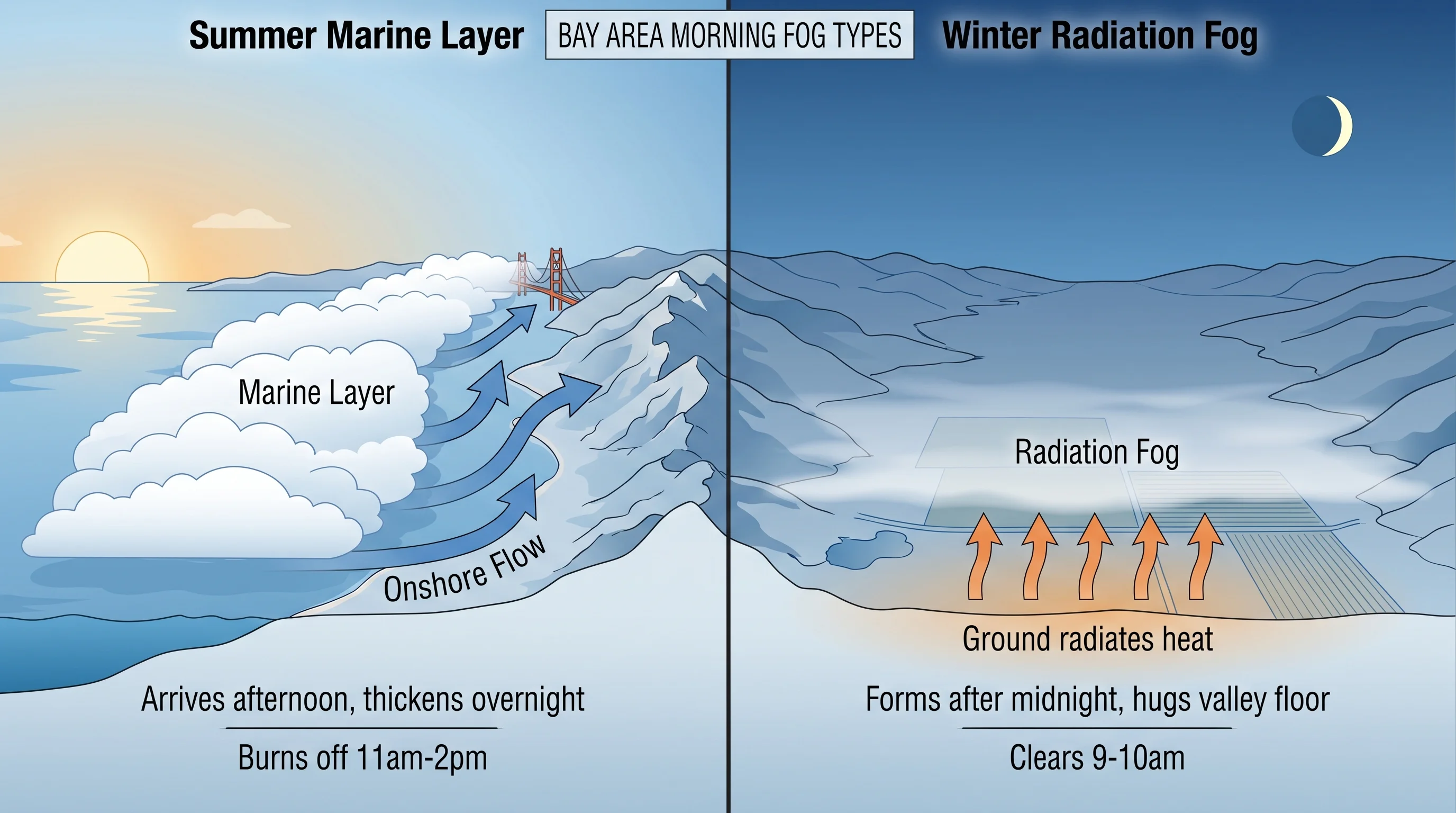
San Francisco's summer fog follows a predictable daily cycle that is almost clockwork on most June, July, and August days. The marine layer rolls in from the Pacific in the afternoon, pushed inland by the pressure gradient between the cold ocean and hot inland air. It covers the western neighborhoods by 3 or 4 p.m. and thickens through the evening. By morning, the fog is at its thickest and most widespread, often extending well past its afternoon boundaries, reaching neighborhoods that were sunny when it arrived.
The morning thickening happens because overnight cooling weakens the convection that allows some of the fog to mix out during the day. By dawn, the marine layer has had all night to consolidate. The fog ceiling is typically at its lowest point around 7 or 8 a.m., often sitting at just a few hundred feet above the surface, completely obscuring the sky.
The burn-off process begins when the sun rises and starts heating the fog layer from above and the ground from below. Heating from the ground creates convection that mixes the cool foggy air with the warmer, drier air above the marine layer. The fog ceiling lifts, the layer thins, and patches of blue sky appear. In San Francisco's western neighborhoods, the burn-off typically completes between 11 a.m. and 2 p.m. on a typical summer day, though on strong marine push days, it may never fully clear.
Winter Morning Fog: Radiation Fog in the Valleys
In fall and winter, the Bay Area's inland valleys experience a different kind of morning fog. The Napa Valley, the Livermore Valley, and the Petaluma lowlands frequently wake up to dense ground fog that formed overnight through radiative cooling. This fog is often thicker and more visually dramatic than the marine layer, sitting close to the ground in the valley floor while the hillsides above are in clear air.
Radiation fog forms when the ground loses heat rapidly on clear, calm nights. The air in contact with the ground cools to its dew point, and water vapor condenses into fog. The process accelerates through the night, so by dawn the fog is at its densest. Visibility in Napa Valley radiation fog on a still winter morning can be well under a quarter mile in the valley floor, while the ridgelines 500 feet above are in sunshine.
Winter inland fog burns off much faster than summer coastal fog. As soon as the sun rises and begins heating the surface, radiation fog starts to lift and evaporate. By 9 or 10 a.m. on most winter days, the fog has cleared in the inland valleys, leaving sunny and surprisingly warm afternoons. This predictable burn-off is why winter in Napa and Livermore can be beautiful: foggy mornings followed by clear, 55 to 65 degree afternoons.
How to Tell Which Type of Morning Fog You Have
Season and location are the primary clues. Summer morning fog in San Francisco is almost always the marine layer. Winter morning fog in an inland valley is almost always radiation fog. But there is also a visual tell: radiation fog hugs the ground in a flat layer, with the fog base at the surface and clear air above. Marine layer fog extends from the surface up to a ceiling that may be hundreds or thousands of feet high, and it feels like being inside a cloud rather than below one.
Wind is another indicator. Radiation fog forms in calm air and is associated with still or very light wind. Marine layer fog arrives with wind and often has a perceptible breeze associated with it. If it is foggy and windy, it is almost certainly the marine layer. If it is foggy and completely still, radiation fog is the more likely culprit.
Burn-Off Times by Bay Area Location
Burn-off times vary significantly by location and season. In the Outer Sunset and Outer Richmond in San Francisco, summer marine layer fog often does not burn off until noon or later, and on strong marine push days, it may persist all day. In the Mission District and the Castro, which sit somewhat sheltered from the direct marine flow, burn-off often happens by 10 or 11 a.m.
In the East Bay hills, fog can sit in the lower elevations while the ridgelines above 800 feet are in clear air. Berkeley and Oakland often burn off earlier than San Francisco because they are on the lee side of the hills relative to the marine flow. In the Napa Valley and Livermore, winter radiation fog typically clears between 9 a.m. and noon.
The most reliable way to predict whether your morning fog will clear is to check the marine layer forecast. When the National Weather Service forecasts a strong onshore flow and a low pressure gradient, expect a slow or incomplete burn-off. When the forecast calls for weakening onshore flow, morning fog is likely to clear by early afternoon. In winter, radiation fog in inland areas almost always clears by noon regardless of coastal conditions.