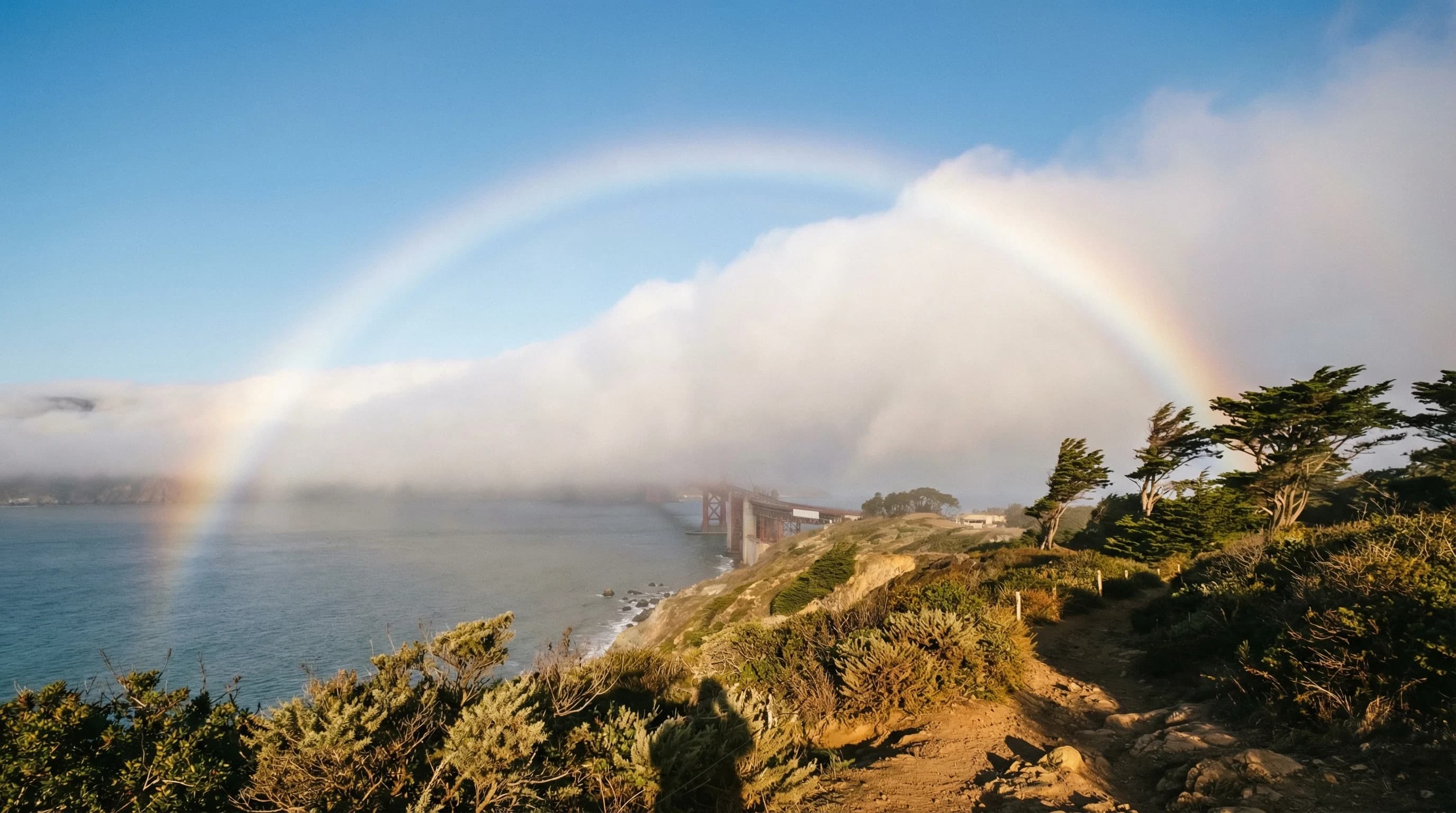
A fogbow is a rainbow that forms in fog rather than rain. It is white or very faintly colored, arch-shaped like a rainbow, and appears when sunlight shines through the tiny water droplets suspended in fog. The Bay Area is one of the best places in North America to see fogbows, because the combination of reliable marine layer fog, low sun angles, and clear breaks at the fog edge creates the exact atmospheric geometry required. When conditions are right, fogbows appear over the ocean from the Marin Headlands, off Ocean Beach, and at coastal viewpoints where the sun shines into a fog bank from behind the observer. They are less famous than the Bay Area's dramatic fog visuals but genuinely extraordinary to witness.
How a Fogbow Forms
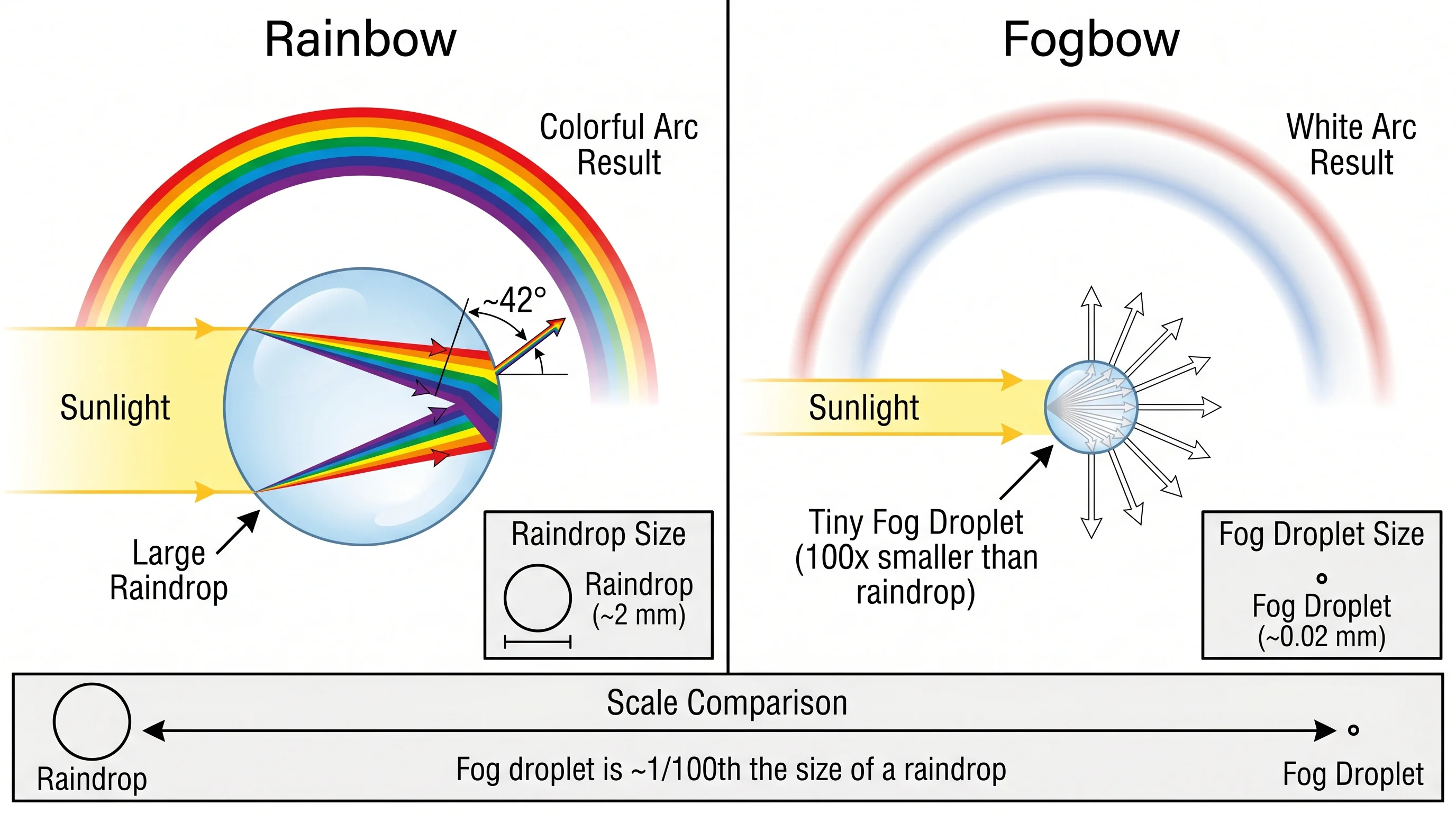
Fogbows form through the same physics as rainbows: sunlight enters a water droplet, reflects off the inside surface, and exits at an angle that depends on the wavelength of light. In a rainbow, large raindrops separate light into distinct colors because the droplets are big enough to spread different wavelengths at different angles. The result is a colorful arc.
Fog droplets are hundreds of times smaller than raindrops. At this scale, a different optical process dominates: diffraction. Light bends around the edges of tiny fog droplets rather than cleanly refracting through them. The bending spreads the different colors of light in overlapping patterns that largely cancel each other out, washing the fogbow white or nearly white. A fogbow typically lacks the vivid spectral colors of a rainbow, appearing as a pale, ghostly white arc, sometimes with faint hints of blue on the outer edge and red on the inner edge. The smaller the fog droplets, the whiter and broader the fogbow.
The geometry of fogbow viewing is the same as for rainbows: the observer must have the sun directly behind them, and the fog must be in front of them and below the observer's sightline or at eye level. The fogbow appears at a specific angle from the antisolar point, the point directly opposite the sun from the observer's position. This means fogbows are most visible from elevated coastal viewpoints looking out over a fog bank with the sun rising behind the observer.
Where to See Fogbows in the Bay Area
The Marin Headlands are the Bay Area's premier fogbow location. The high coastal bluffs offer elevated views directly into the marine layer, and on summer mornings when the fog bank sits offshore or partially in the Golden Gate, a rising sun behind the observer illuminates the fog at exactly the right angle. The fogbow appears as a white or faintly colored arc floating over the fog surface, often with the fog-shrouded ocean visible below and clear air above.
Point Reyes offers similar opportunities. The bluffs and ridgelines above the Drakes Bay area look directly into the marine layer, and with the sun rising to the east behind the observer, fogbows are possible on summer mornings when the marine layer is not yet fully burned off. The lighthouse area at the tip of the Point Reyes peninsula, which sits at the fog's edge on many days, is one of the most reliable fogbow locations on the California coast.
Within San Francisco, the Twin Peaks summit and Bernal Heights provide elevated views into the fog on days when the marine layer is present but below the summit elevation. From these heights, looking west or northwest with the sun rising to the east, fogbow conditions occasionally occur. The Sutro Tower viewing areas on foggy mornings with the sun behind you can also produce fogbow sightings when you look down into the fog-filled valleys below.
Fogbow Variations and Related Phenomena
Several related optical phenomena appear in similar conditions and are worth knowing. A glory is a set of concentric colored rings that appear directly opposite the sun around the antisolar point, also visible when looking down into fog from above. If you have ever looked down from an airplane window onto clouds and seen a ring of colored light surrounding the shadow of the plane, that is a glory. From Bay Area hilltops looking down into fog, glories occasionally appear around your own shadow.
A corona is a set of rings around the sun or moon caused by diffraction through thin cloud or fog. Unlike a fogbow (which requires sunlight behind you and fog in front), a corona appears around a light source you are looking toward. On evenings when the marine layer is thin enough to let moonlight through, lunar coronas are sometimes visible in the Bay Area.
Fogbows are also observed at sea. Sailors have documented fogbows for centuries, and they appear frequently along the Northern California coast on any vessel running along the edge of the marine layer with the sun behind it. If you are on a ferry, a whale watching boat, or a sailing vessel running along the coast on a partly foggy morning, watch for white arcs in the fog to the west or northwest when the sun is behind you.
Best Conditions to See a Bay Area Fogbow
The ideal Bay Area fogbow conditions: a summer morning with the marine layer present but partially burned off, so the fog is at a distance rather than surrounding you completely. You need to be above or at the fog level, with the sun rising in the east behind you and the fog bank in front of you to the west or northwest. The sun angle matters: fogbows are most visible when the sun is relatively low in the sky, typically within the first two to three hours after sunrise. As the sun climbs and the marine layer burns off, the window closes.
The Marin Headlands in June and July, reached early in the morning before 9 a.m., offer the most reliable opportunities. Check whether the marine layer is present offshore but the headlands themselves are clear. If you can stand in sunshine at the headlands while looking at a fog bank over the water or in the Golden Gate, fogbow conditions are in play. Look for a pale white arc at roughly 40 degrees from the shadow of your head on the fog surface. When you spot one, it is one of those Bay Area moments that make the region's meteorological peculiarity feel like a genuine gift.