
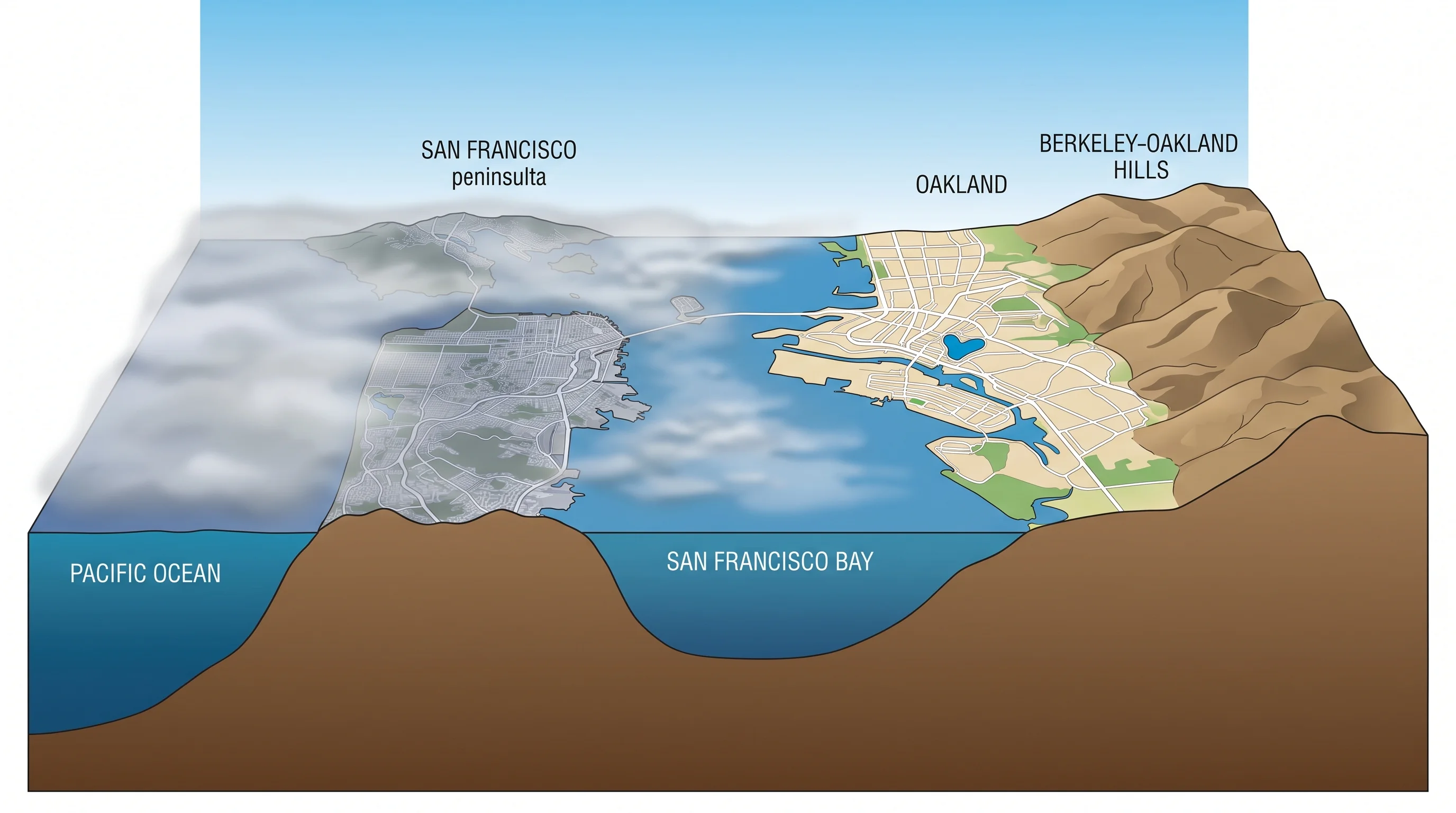
Oakland has a legitimate claim to better weather than San Francisco, and residents make this claim constantly. The city sits on the eastern shore of the Bay, shielded from the direct marine layer by the Berkeley Hills and positioned to receive sunshine that coastal San Francisco misses. Oakland averages around 260 sunny days per year, significantly more than San Francisco's approximately 160. This is not a small difference. On a July afternoon when San Francisco is huddled under 60-degree fog, Oakland is sunny and 72 degrees, six miles away across the water. The Bay Bridge connects two genuinely different microclimates.
Why Oakland Is Sunnier Than San Francisco
The mechanics are simple. The marine layer enters the Bay Area primarily through the Golden Gate, the dominant gap in the coastal range. It spreads first into the Central Bay and the western neighborhoods of San Francisco, with the densest fog hugging the coast and western slopes. The Berkeley Hills, rising to over 1,700 feet directly behind Oakland, provide a significant barrier to the marine layer's eastward expansion.
When the marine layer is shallow, its ceiling below 1,500 feet, as it often is in summer, it fails to overtop the Berkeley Hills and Oakland sits in sunshine while San Francisco is fogged in. When the marine layer is deep, its ceiling above 2,000 feet, it overtops the hills and Oakland gets its share of fog. But on the majority of summer days, Oakland's hilltop barrier keeps it sunnier and warmer than the city to its west.
Temperature Comparisons
The temperature difference between Oakland and San Francisco is most dramatic in summer and largely disappears in winter. In July, Oakland averages highs around 72 degrees Fahrenheit while San Francisco averages around 65. Both cities see their lowest temperatures in January: Oakland at around 58 degrees high, San Francisco at around 57. The year-round temperature curves are nearly identical except for the summer months, when Oakland pulls ahead by 5 to 10 degrees on a typical afternoon.

The comparison within Oakland is also worth noting. The flatlands near the waterfront and the airport typically run warmer than the hills above. The Temescal and Piedmont neighborhoods, at mid-elevation in the hills, can be 3 to 5 degrees cooler than the Jack London Square waterfront area. The upper Montclair and Redwood Regional Park areas, high enough to sometimes catch the top of the marine layer, can be genuinely cool and foggy on strong marine push days when the flatlands below are sunny.
The Oakland Hills and Fire Weather
The Oakland Hills have a weather profile that differs from the flatlands below in ways that matter for fire risk. The hills receive more precipitation than the flatlands, around 28 inches annually at higher elevations, compared to about 20 inches in downtown Oakland. This seems beneficial until fall, when the Diablo winds arrive. The same ridgeline that blocks marine fog in summer acts as a deflection surface for the hot, dry Diablo winds that blow from the northeast in fall, accelerating the wind as it moves through the gaps in the hills and delivering extremely low humidity to the dry summer vegetation.
The 1991 Oakland Hills Fire, which destroyed 3,354 structures and killed 25 people, occurred on an October day with single-digit relative humidity and Diablo wind gusts exceeding 65 mph. The conditions that make Oakland a livable, sunny alternative to San Francisco, the hills, the inland position, the dry summers, are the same conditions that create severe fire risk in fall. Oakland residents who appreciate the sunshine live with this seasonal risk as part of the local weather equation.
The Best Bay Area Weather?
The claim that Oakland has the best weather in the Bay Area has genuine merit, depending on what you value. If you want more sunshine and warmth than San Francisco's summer fog provides, without the extreme heat of Walnut Creek or Livermore, Oakland delivers. The city's average July high of 72 degrees with mostly clear skies is the Bay Area sweet spot between coastal cool and inland baking.
Berkeley, just north of Oakland and sharing much of the same climate, makes a similar claim. The distinction between Oakland and Berkeley weather is modest; Berkeley sits slightly more exposed to the marine layer in its western neighborhoods and slightly more sheltered in its hill neighborhoods. The Berkeley Hills weather station at 1,200 feet elevation occupies a genuinely different climate than the flatlands below, sometimes catching fog and marine air that misses Oakland entirely. The Bay Area's microclimates operate at neighborhood scale, and the Berkeley-Oakland hills are as concentrated an example of that variation as exists anywhere in the region.