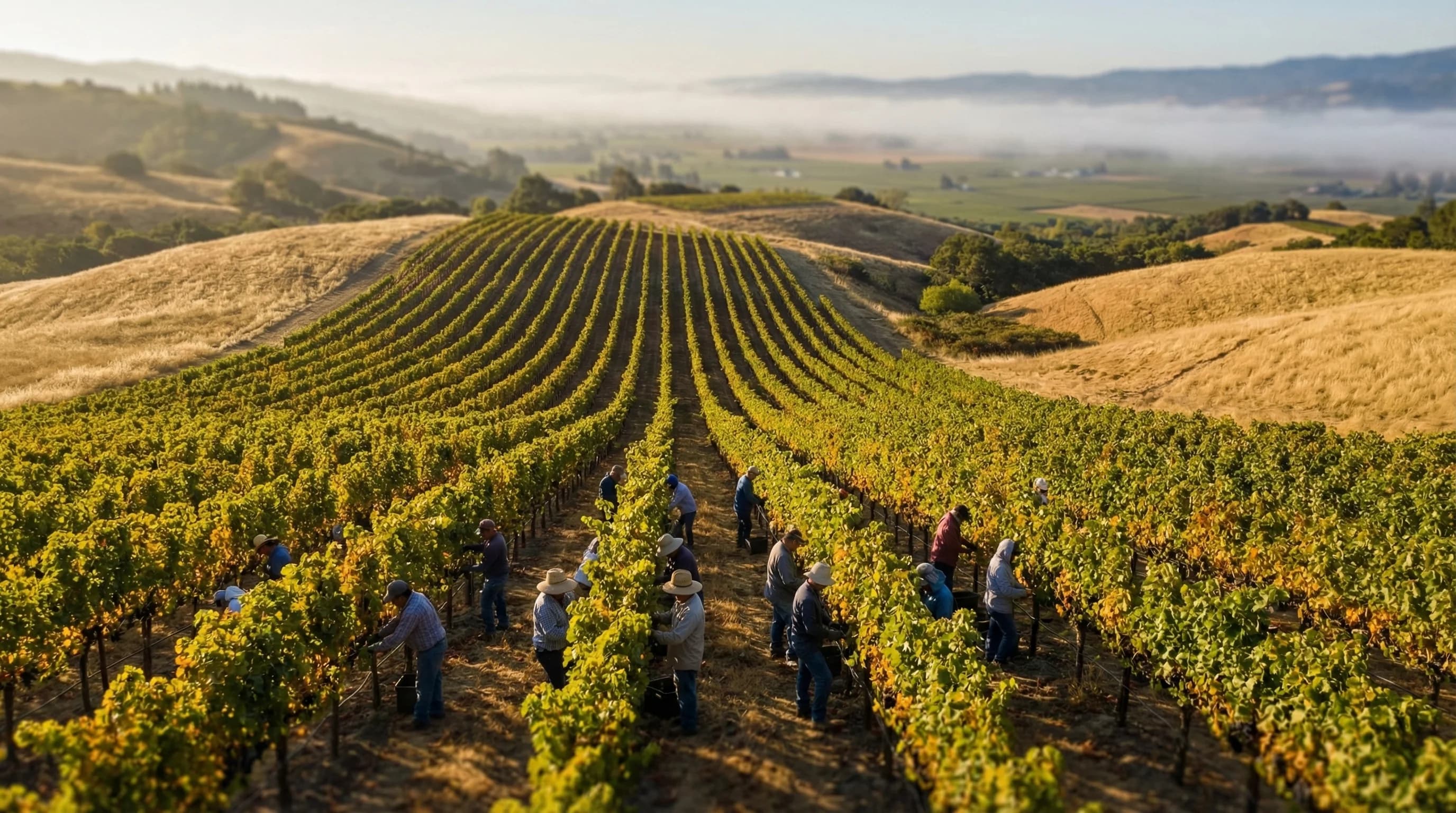
Wine country weather is the result of the same forces that shape all of Bay Area climate, marine air from the Pacific, topographic barriers, and the inland heating that drives onshore flow, but playing out in a set of valleys that happen to be ideal for growing grapes. Napa Valley and Sonoma are not simply warmer versions of San Francisco. They are distinct climate regions with their own fog patterns, temperature swings, and seasonal rhythms that happen to make them among the best places in North America to grow Cabernet Sauvignon and Chardonnay.
Why Wine Country Gets Hot Days and Cool Nights
The defining characteristic of Napa and Sonoma valley climates is the dramatic daily temperature swing. Summer days in Napa regularly reach 90 to 95 degrees Fahrenheit, but by midnight the temperature has often dropped into the mid-50s. This diurnal range, sometimes exceeding 40 degrees between afternoon high and overnight low, is exactly what wine grapes need. Hot days build sugars in the fruit; cold nights preserve acidity. The result is wine with the complexity that cool climate regions produce alongside the ripeness that warm regions provide.
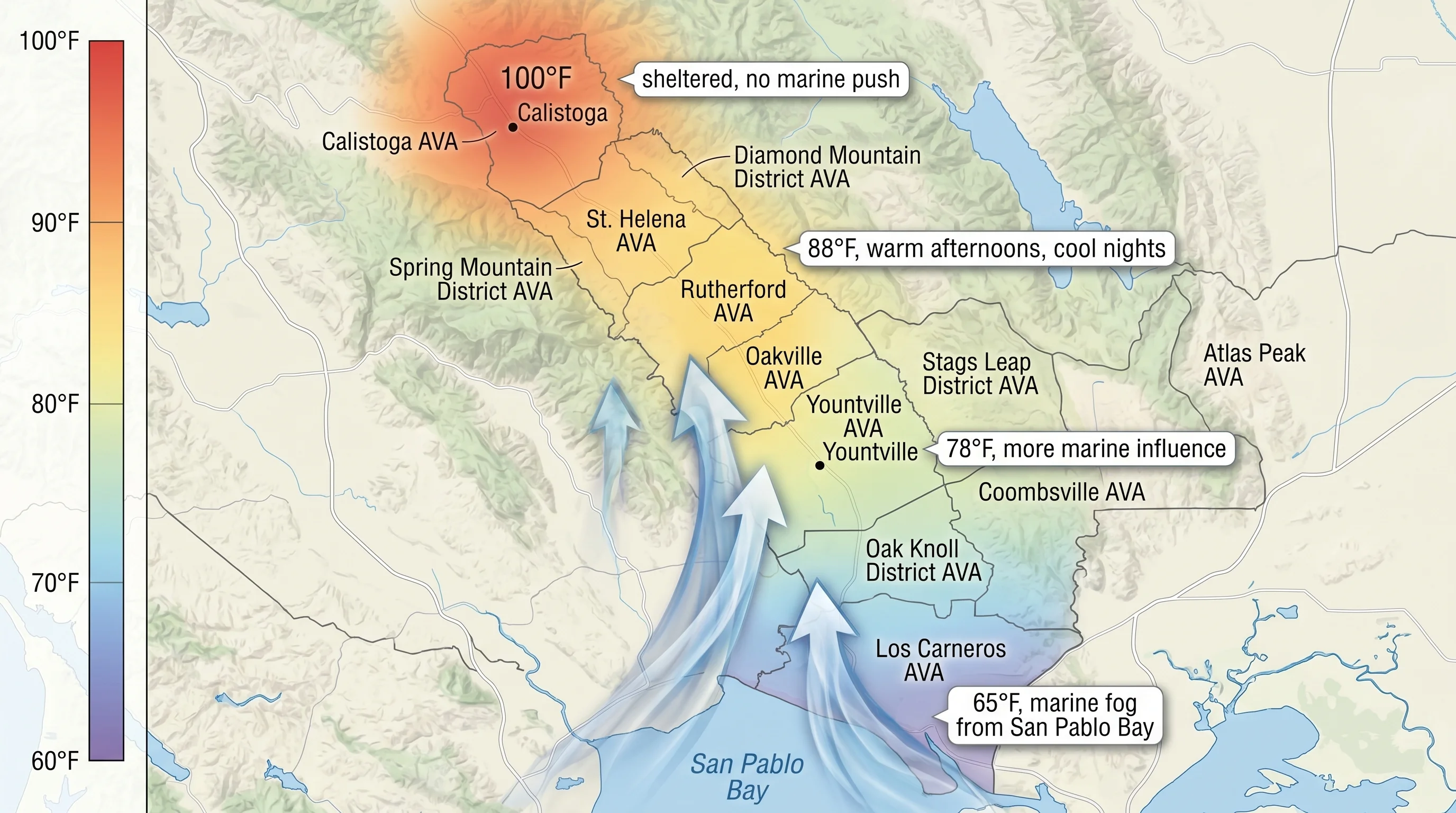
The mechanism is the daily marine push through the San Francisco Bay system. As the inland valleys heat up each afternoon, they create low pressure that draws cool, moist Pacific air through the Golden Gate and up the Bay. By late afternoon, this onshore flow reaches Napa and Sonoma as a genuine cooling force: wind dropping temperatures by 15 to 20 degrees in under an hour. The cooling continues through the night as the marine air fills the valleys. By morning, the marine layer often produces fog in the lower valley floors, particularly around Carneros, the cool southern end of both Napa and Sonoma valleys.
Napa Valley: A North-to-South Temperature Gradient
Napa Valley is not a single climate; it is a spectrum of climates arranged along a 30-mile corridor from Calistoga in the north to Carneros at the southern end where the valley opens to the Bay. Calistoga, at the northern end, is sheltered from the marine push by the hills of the Mayacamas Range and the surrounding terrain. It gets the full force of the valley heat and the least marine cooling, regularly reaching 100 degrees Fahrenheit or more in summer. The wines from Calistoga tend to be big, ripe, and high-alcohol as a result.
Moving south down the valley, each appellation gets progressively more marine influence. Rutherford and Oakville sit in the classic warm middle zone, warm enough for Cabernet to fully ripen but cool enough to maintain elegance. Yountville and Stags Leap receive noticeably more marine air and tend to produce more refined, aromatic wines. Carneros, at the southern terminus of both Napa and Sonoma, is directly influenced by San Pablo Bay and its cool, foggy conditions. Carneros specializes in Chardonnay and Pinot Noir, the cool-climate grapes, for exactly this reason.
Sonoma County: A More Varied Wine Region
Sonoma County covers more geographic territory than Napa Valley and has correspondingly more climate variation. The Sonoma Valley AVA, running from Glen Ellen south toward Carneros along the western flank of the Mayacamas Mountains, shares many characteristics with Napa: warm days, cool nights, marine push in the afternoon. But Sonoma County also contains the Sonoma Coast and the Russian River Valley, two of California's coolest wine regions.
The Russian River Valley is cut through by the Russian River, which drains cool marine air from the Sonoma Coast deep into the interior during summer. The fog that forms over the Pacific pushes inland through the river gap, filling the Russian River Valley with thick morning fog that often doesn't burn off until noon or later. Average summer high temperatures in Guerneville sit around 78 degrees, with morning lows in the 50s, a completely different climate from Calistoga 35 miles away. Russian River Valley Pinot Noir and Chardonnay are among California's most acclaimed cool-climate wines.
The Sonoma Coast appellation, particularly the western Sonoma Coast near Bodega Bay, experiences conditions similar to Half Moon Bay: persistent marine layer, temperatures rarely above 65 degrees in summer, and fog most mornings. These are extreme growing conditions by California standards, producing wines of remarkable tension and acidity that have attracted attention from collectors seeking something different from warm-valley Napa Cabernet.
Winter and the Threat of Frost
Wine country winters are mild by most standards but carry genuine risk for viticulture. The valley floors of Napa and Sonoma, particularly near the low points where cold air pools overnight, experience regular frost from November through April. Frost during bud break, typically in late March or early April, can destroy an entire vintage. Grape growers use wind machines, frost fans, and overhead sprinklers to protect vines during frost events, and some years the frost risk period extends well into April.
The same inversion dynamics that produce cold valley floors in winter are what make midslope vineyard sites on the hillsides so valuable. Hill vineyards above the fog line (typically above 600 to 800 feet) sit above the cold air pooling below and experience warmer overnight temperatures, reducing frost risk while still receiving the afternoon marine cooling that preserves acidity. Many of Napa's most celebrated single-vineyard wines come from these hillside sites, which owe their reputations partly to frost protection and partly to the rocky, well-drained soils that stress the vines productively.
Wine country weather is, in the end, a particularly consequential expression of Bay Area microclimate geography. The same forces that give San Francisco its fog and Livermore its heat also give Napa its warm afternoons and cold nights, and Russian River Valley its persistent morning fog. The Bay Area is large enough and topographically complex enough to contain, within its boundaries, nearly every wine climate that exists in California. Wine country is just the place where the stakes are highest.