
The claim that San Francisco is 20 degrees colder than the inland Bay Area is more often understated than exaggerated. On a typical summer afternoon, the temperature difference between San Francisco and the inland East Bay is frequently 25 to 35 degrees. The claim is familiar enough that it functions as a local shorthand, but the actual number varies widely depending on the day, the time, and the specific inland location. Knowing when the gap is largest and when it narrows is useful for anyone planning Bay Area activities, and it is also a window into how one of the most dramatic urban temperature gradients in the world actually works.
The Summer Temperature Gradient
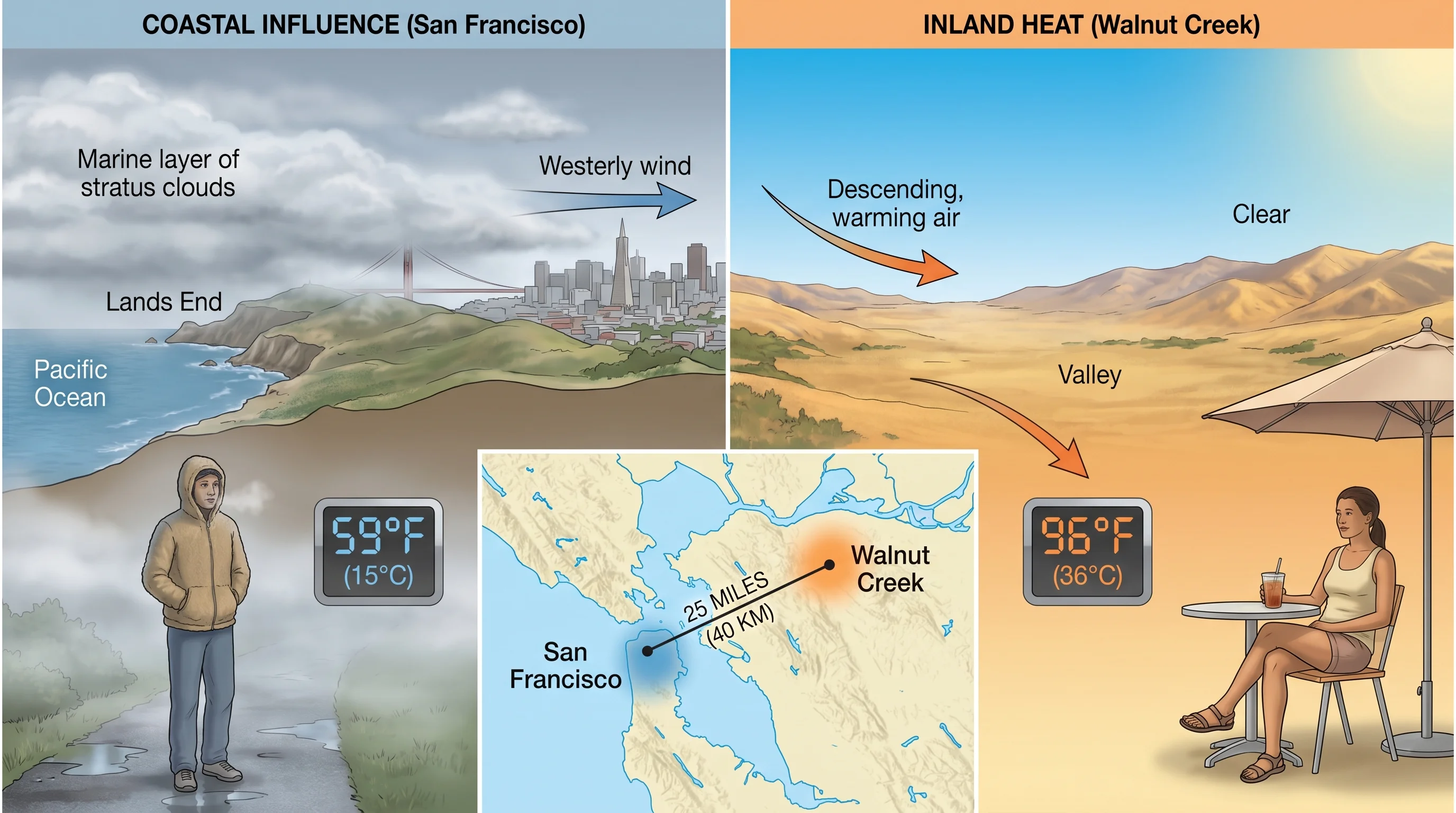
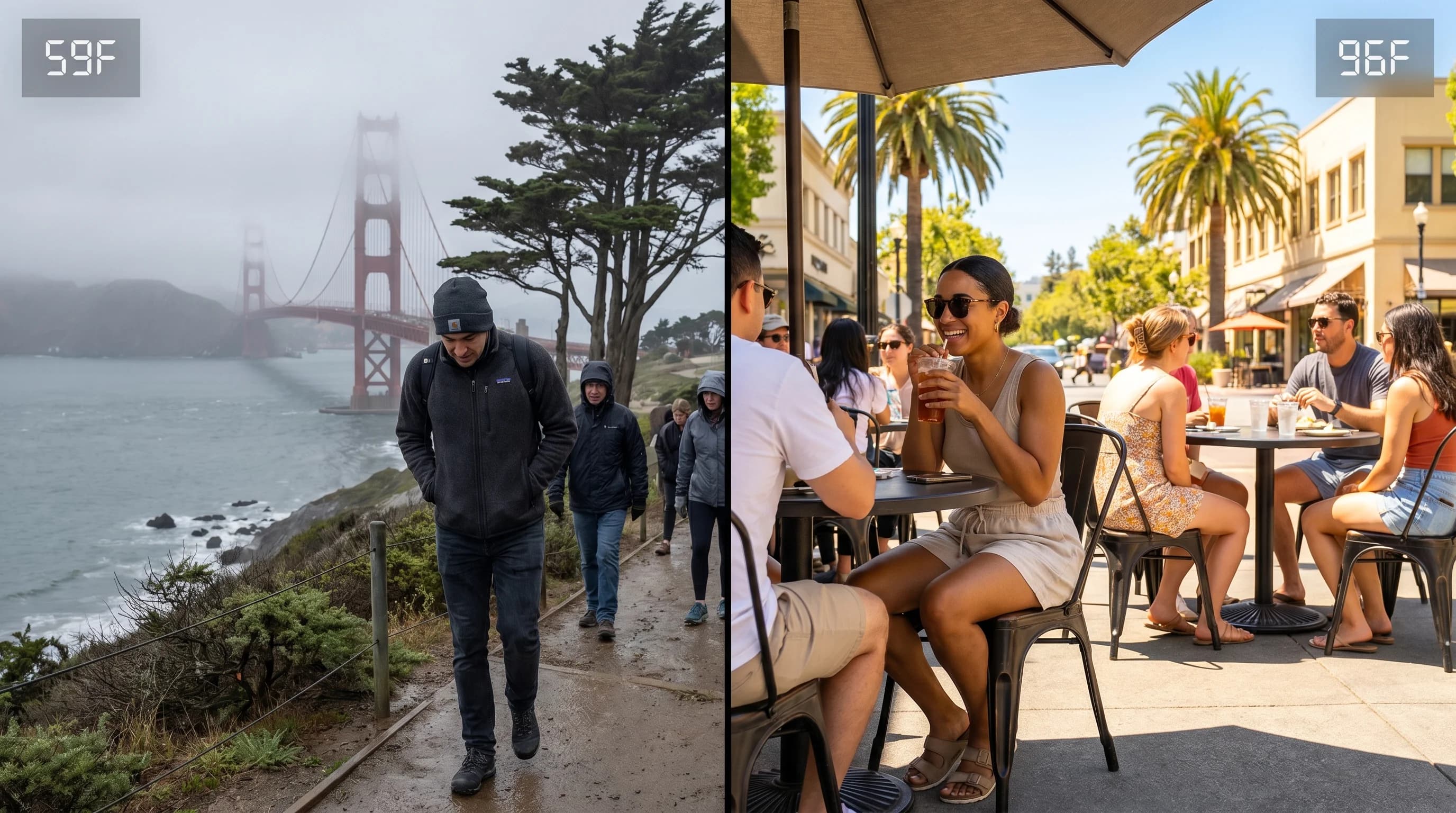
On a strong marine push day in July, the temperature difference between San Francisco and the inland East Bay can be extraordinary. San Francisco at 58 degrees under dense fog, Walnut Creek at 95 degrees in full sunshine, a difference of 37 degrees across 25 miles. San Francisco at 62 degrees and breezy, Concord at 98 degrees, 36 degrees across 30 miles. These numbers are not weather anomalies. They are the normal summer pattern on the most marine-influenced days.
On a weak marine push day, when the sea breeze is lighter and the marine layer shallower, the gradient is smaller. San Francisco might reach 70 while Walnut Creek reaches 88. The difference is still significant but less extreme. On hot Diablo wind days in fall, the gradient can reverse briefly: San Francisco reaches 85 or 90 while the inland valleys hit 105, but the proportional difference narrows because the marine layer is suppressed everywhere.
Why the Difference Exists
The temperature gradient between San Francisco and the inland Bay Area exists because the marine layer's cooling effect is powerful near its source and diminishes with distance inland. San Francisco sits at the entry point of the marine air, within the densest part of the marine layer, surrounded by water on three sides. It receives the marine influence at maximum intensity. Every mile of travel inland reduces the direct marine exposure, and the terrain effects of the hills block and modify the marine air flow.
The Bay itself moderates temperatures in the East Bay cities. Oakland and Berkeley are cooler than Walnut Creek or Concord partly because they have direct bay exposure. But by the time you reach the communities east of the Berkeley Hills, the marine layer's influence is diluted enough that summer temperatures are primarily controlled by solar heating, which is intense on long June, July, and August days.
Seasonal Variation in the Gradient
The coast-to-inland temperature difference is a summer phenomenon. In winter, when the North Pacific High has weakened and the marine layer is thin or absent, inland temperatures can actually dip below coastal temperatures on cold, clear nights, because radiation cooling is more effective inland and the bay's thermal mass moderates coastal temperatures. On a January morning, San Francisco might be at 50 degrees while Livermore is at 35, with frost on the valley floor. The gradient reverses, with inland colder and coast warmer, because the temperature-moderating mechanism is now the bay's thermal mass, not the cooling marine layer.
The transition months of April and October see the most variable gradients, as the marine layer waxes and wanes. The "20 degrees colder" effect is essentially a summer observation, and it is at its most extreme in July and August, when the North Pacific High is strongest and the marine layer is at maximum depth and reach.