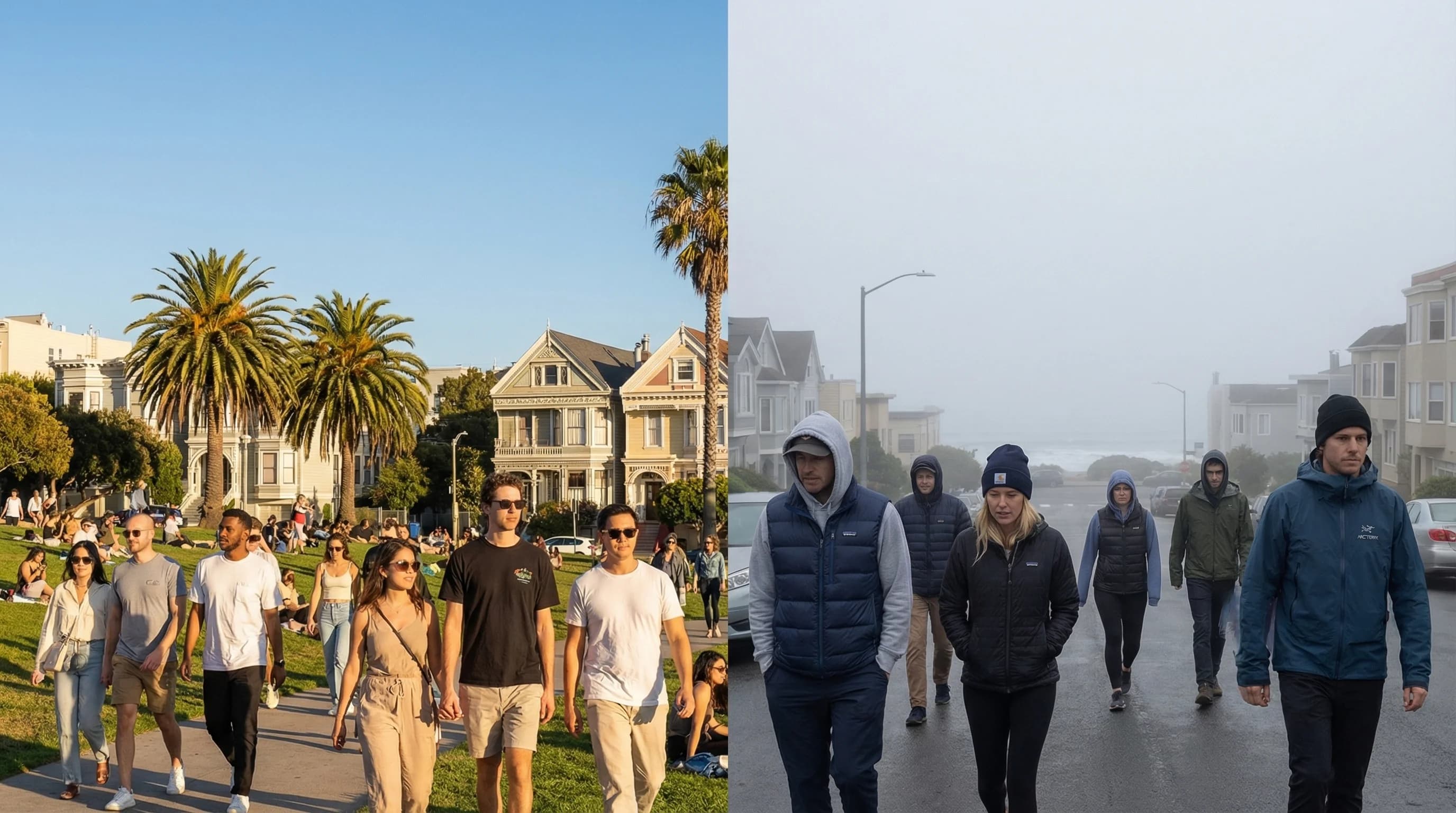
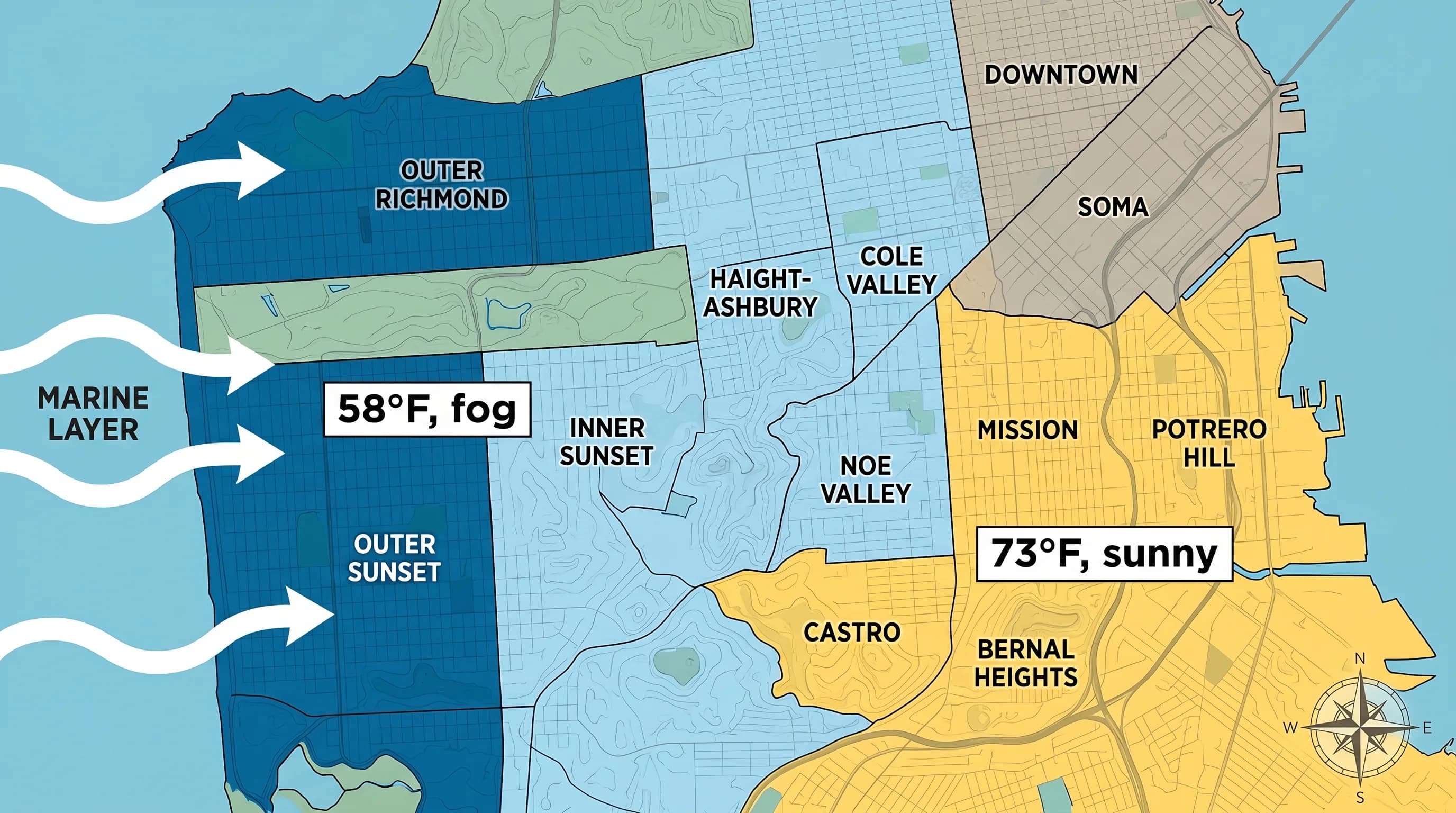
San Francisco is one of the few cities in the world where the neighborhood you choose for dinner can mean the difference between wearing a T-shirt and needing a winter coat. On a typical summer afternoon, the Mission District sits in warm sunshine at 72 degrees while the Outer Sunset, three miles to the west, shivers under a thick marine layer at 58 degrees. The city spans roughly seven miles by seven miles, but its San Francisco microclimates contain what amounts to four or five distinct climates stacked against each other. Knowing which neighborhood has which weather is genuinely useful information for residents planning outdoor events, visitors deciding where to stay, and anyone who has ever been blindsided by fog while packing for a sunny afternoon.
The Fog Corridor: Outer Sunset and Outer Richmond
The Outer Sunset and Outer Richmond are the foggiest neighborhoods in San Francisco, and it is not particularly close. These western neighborhoods face the Pacific Ocean directly, with nothing between them and the cold California Current but the Great Highway. The marine layer rolls in from the west every afternoon in summer, reaches these neighborhoods first, and tends to linger there longest. On days when the fog burns off entirely, the Outer Sunset may see only two or three hours of direct sun before the afternoon marine push returns.
Summer temperatures in the Outer Sunset routinely sit between 55 and 62 degrees Fahrenheit. Strong westerly winds off the ocean add a wind chill that makes the felt temperature considerably colder. Residents of these neighborhoods have a particular relationship with layers. A light jacket is not optional; it is furniture. The fog is so persistent in the Outer Sunset that longtime residents measure good summer days not by sunshine but by whether the fog burns off before noon.
The Richmond District behaves similarly to the Sunset, but with a slight geographic advantage: the headlands of the Marin side of the Golden Gate deflect some of the direct marine flow, and the Richmond runs along the park-protected corridor of the Panhandle and Golden Gate Park. The Inner Richmond, closer to the park's eastern edge, tends to be slightly warmer and less foggy than its outer counterpart.
The Fog Shadow: Mission District and Castro
The Mission District and the Castro occupy a geographic sweet spot that makes them the warmest neighborhoods in San Francisco proper. Twin Peaks and the hills of Noe Valley rise to the west, forming a natural barrier that deflects and weakens the marine layer before it reaches these neighborhoods. This orographic shadow effect means the Mission can be in bright sunshine while the Sunset, just over the hills, remains completely socked in.
On warm summer days, the Mission regularly reaches the mid-70s Fahrenheit, occasionally pushing into the low 80s during heat events. The neighborhood's dense urban fabric also retains heat better than the windswept western streets. This is one reason the Mission has a thriving outdoor dining and street culture in a way that the Outer Sunset, objectively beautiful as it is, simply cannot replicate.
The Castro sits slightly higher in elevation and catches more wind than the Mission proper, but it benefits from the same hill shadow. Dolores Park, in the Mission, has become almost a meteorological landmark: on weekends when the Outer Sunset is cold and foggy, Dolores Park is packed with people in shorts. The temperature difference between Dolores Park and Ocean Beach, four miles away, can exceed 20 degrees on a summer afternoon.
The Middle Ground: Noe Valley, Haight, and Cole Valley
Noe Valley occupies an interesting position in San Francisco's microclimate hierarchy. It sits in a sheltered valley between the Castro hills and the Twin Peaks massif, which gives it protection from the strongest marine winds while still allowing fog to spill over on heavy marine push days. On most summer days, Noe Valley is warmer and sunnier than the western neighborhoods but does not quite reach the warmth of the Mission. Temperatures typically run five to eight degrees warmer than the Outer Sunset and three to five degrees cooler than the Mission.
The Haight-Ashbury neighborhood straddles the transition zone. The Lower Haight, closer to downtown and the Mission, behaves more like the inner, warmer side of the city. The Upper Haight, adjacent to Golden Gate Park, receives more fog intrusion and tends to run cooler and windier. Cole Valley, tucked between the Haight and Twin Peaks, is surprisingly sheltered, one of those pockets where the wind calms noticeably and afternoon temperatures climb a few degrees beyond what you would expect for its location.
Downtown, SoMa, and the Eastern Waterfront
Downtown San Francisco and South of Market occupy a middle position in the city's fog spectrum. They are not as warm as the Mission because they are exposed to the Bay breeze from the east and the marine layer coming through the Golden Gate from the northwest. But they are considerably warmer than the western districts because they sit on the lee side of the city's topographic spine.
The eastern waterfront from the Ferry Building to Mission Bay can feel distinctly different from one block to the next, depending on wind channeling through the downtown canyons. The Bay breeze here is strong enough that outdoor dining along the Embarcadero can feel brisk even in sunshine. SoMa proper, shielded by buildings, tends to run slightly warmer. The Dogpatch and Mission Bay neighborhoods, farther south and east, benefit from additional shelter and tend to be among the city's sunnier southeastern districts.
Fog by Elevation: Telegraph Hill and Potrero Hill
Elevation is the wild card in San Francisco's neighborhood weather. The marine layer in summer typically sits with a ceiling between 1,200 and 1,800 feet. The city's hills mostly sit below this ceiling, which means neighborhoods on hills often sit inside the fog bank rather than above it. But certain elevated areas can poke above the fog ceiling on days when the inversion layer is well defined, giving them paradoxical sunshine while the streets below are gray.
Potrero Hill is a good example of elevation working in a neighborhood's favor in a different way: its south-facing slopes catch more direct sunlight and are shielded from the dominant northwest marine flow. It is reliably one of the sunniest and warmest neighborhoods in the city. Bernal Heights functions similarly. Telegraph Hill gets significant wind exposure from its prominent position but also sees more direct sun on its eastern face. The western slopes of Twin Peaks, by contrast, are exposed directly to the marine layer and are frequently fog-covered even when the surrounding lower streets have clear sky.
What This Means for Planning Your Day
The practical upshot of San Francisco's neighborhood weather variation is that planning any outdoor activity requires knowing where in the city you are going, not just what the forecast says for San Francisco generally. A National Weather Service forecast for San Francisco reflects conditions somewhere in the middle of the city's range. If you are heading to a park in the Outer Sunset, expect it to be significantly colder and foggier than that forecast suggests. If you are heading to the Mission or Potrero Hill, expect conditions somewhat warmer and sunnier.
Summer mornings are when neighborhood differences are most extreme. By 7am, the Outer Sunset is often fogged in and 55 degrees while the Mission is already at 62 and clearing. By noon, on a typical day, the Mission has reached 70 and the Outer Sunset is still 58. By late afternoon, as the marine layer returns, the gap narrows again. Once you learn this daily rhythm and the geography that drives it, San Francisco's famously unpredictable weather becomes considerably more predictable, as long as you know which neighborhood you are in.
The city's microclimate variation is one of the things that makes it genuinely interesting as a weather destination. You can experience both chilly coastal fog and warm sunny afternoons on the same day, in the same city, simply by choosing which direction to walk. That is not a bug in San Francisco's climate. It is the whole point.