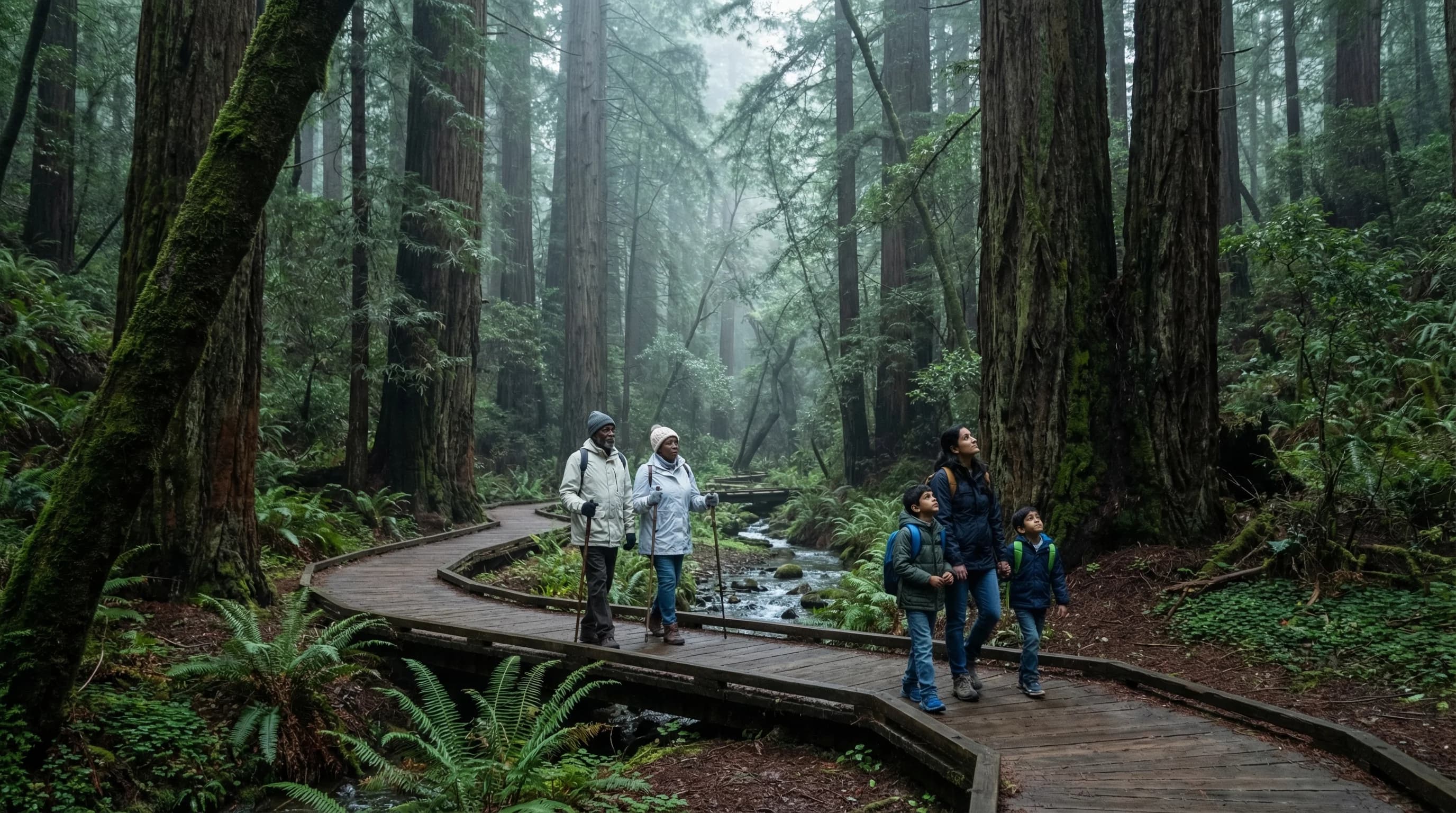
Muir Woods National Monument sits in a deep canyon on the flanks of Mount Tamalpais in Marin County, surrounded by old-growth coast redwoods that create their own microclimate within an already distinctive regional one. The canyon's orientation, the redwoods' ability to capture moisture directly from the marine layer, and the dense canopy overhead combine to produce conditions that are cooler, wetter, and darker than virtually anywhere else in the Bay Area. Visiting Muir Woods requires a different set of expectations, and clothing, than most other Bay Area destinations.
The Redwood Microclimate
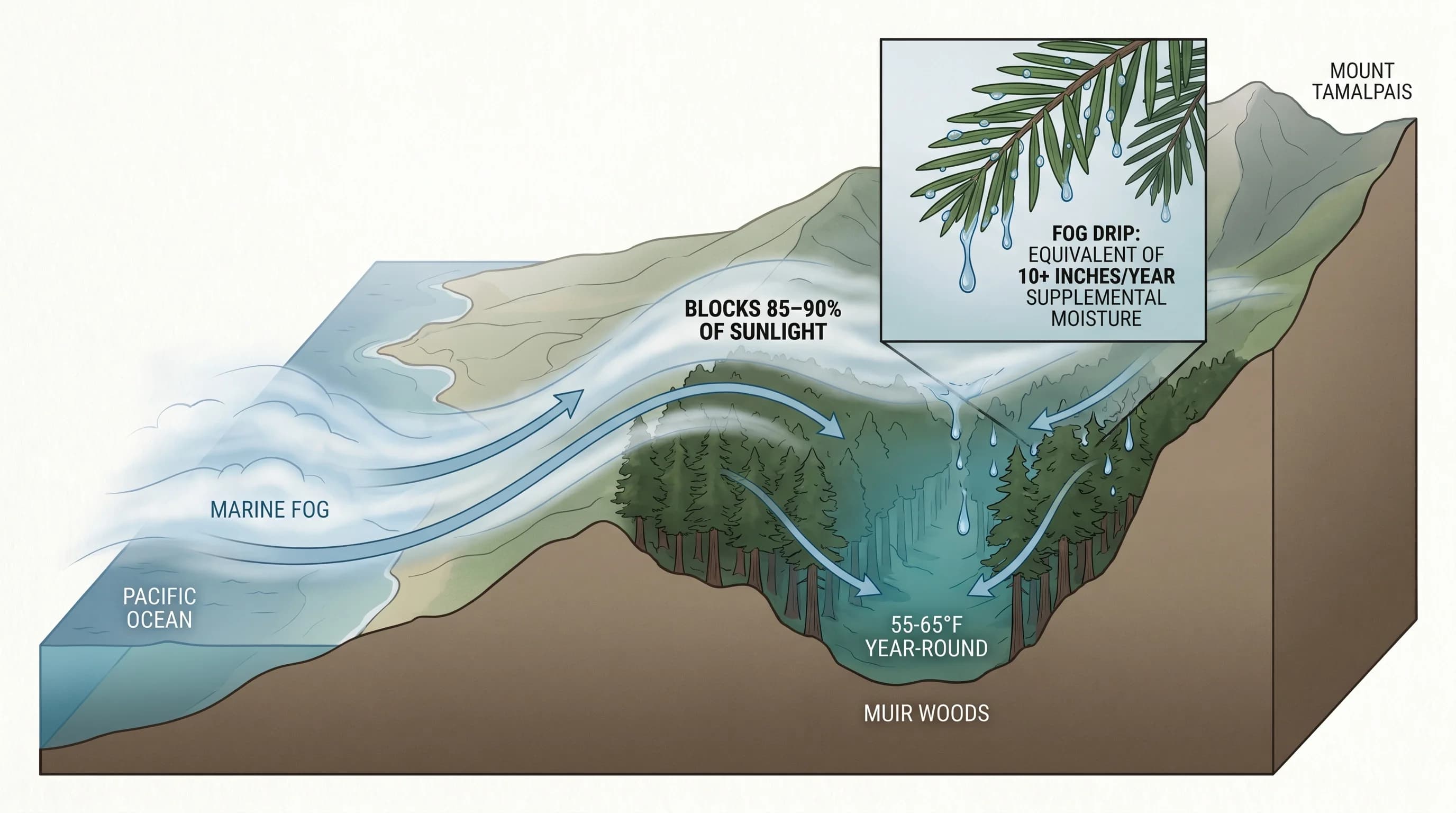
Coast redwoods are the defining biological feature of Muir Woods, and they are also active participants in the local weather. Redwoods have evolved specifically to thrive on the California coast's summer fog. Their needles and bark capture moisture directly from the marine layer through a process called fog drip, where fog droplets condense on the trees and fall to the ground, effectively functioning as a second form of precipitation. During summer, when rainfall is essentially zero, fog drip can contribute the equivalent of several inches of moisture per year to the forest floor.
The result is that Muir Woods is distinctly wet and green in summer even without rain. The forest floor stays moist, ferns and sorrel thrive under the canopy, and the overall humidity is noticeably higher than in the surrounding hills. The dense canopy itself reduces light penetration dramatically: the forest floor receives perhaps 10 to 15 percent of the sunlight that reaches the treetops. This creates an almost perpetually dim, cool environment that feels removed from the surrounding Bay Area in all seasons.
Summer: Cool and Foggy
Summer is when Muir Woods' microclimate is most pronounced and most relevant to visitors. While Marin County's inland valleys (Novato, Petaluma, Santa Rosa) reach temperatures of 85 to 95 degrees Fahrenheit on summer afternoons, Muir Woods maintains temperatures in the 55 to 65 degree range. The marine layer fills the canyon from the Pacific side, the dense redwood canopy blocks solar radiation, and the cold fog drip keeps the ground cool.
This makes Muir Woods one of the most reliably comfortable summer hiking destinations in the Bay Area during heat waves. When the rest of Marin County is sweltering at 100 degrees, the main trail through Muir Woods canyon floor will be 60 degrees and shaded. The trade-off is that the canyon can be genuinely cold for unprepared visitors. On foggy summer mornings, temperatures on the canyon floor can sit in the low 50s Fahrenheit, and the perpetual shade means they do not warm much even when the forest floor sees occasional sun patches. A fleece or light jacket is not optional in Muir Woods, not even in July.
Fall and Winter
Fall brings Muir Woods its clearest and most visually dramatic conditions. As the marine layer weakens in September and October, direct sunlight reaches the forest floor more often, filtering through the canopy in dramatic golden shafts. This is the season that produces the iconic Muir Woods photographs: rays of light cutting through fog-filtered air between giant trunks, everything amber and green. The temperature is still cool, fall highs run in the low to mid-60s Fahrenheit, but the quality of light is exceptional.
Winter brings rain rather than fog as the primary moisture source. Muir Woods receives approximately 45 to 50 inches of rainfall per year, substantially more than the Bay Area average, because the canyon faces southwest and intercepts orographic precipitation effectively. The winter forest is alive with water: streams run full, banana slugs emerge on the trail, and the combination of rain and filtered gray light through the canopy creates an atmosphere that feels distinctly different from summer. Winter hiking in Muir Woods is underrated; crowds thin, the forest shows its wettest and most primeval character, and the trails away from the main valley floor are often completely empty.
What to Expect and How to Dress
The most common visitor mistake at Muir Woods is arriving underdressed based on weather conditions elsewhere in the Bay Area. A warm, sunny Marin morning at the Marin Headlands or in downtown Mill Valley does not predict the canyon floor conditions. Subtract 10 degrees and remove most of the direct sunlight, and you have the typical Muir Woods experience. The park service recommends layers, and they are right: a light jacket and a moisture-wicking base layer will serve you in any season.
Visiting Muir Woods requires advance reservations for parking and shuttle at nearly all times of year. The park's trail system connects to the larger Mount Tamalpais State Park trail network, which climbs out of the canyon to open ridge lines where conditions are completely different, warm and sunny above the fog, with views of the Bay, the ocean, and the marine layer below. These ridge hikes offer the full range of the Marin peninsula's microclimate in a single outing: cold canyon fog at the start, warm open ridge at the top, and a dramatic view of the marine layer being pulled through the Golden Gate far below.