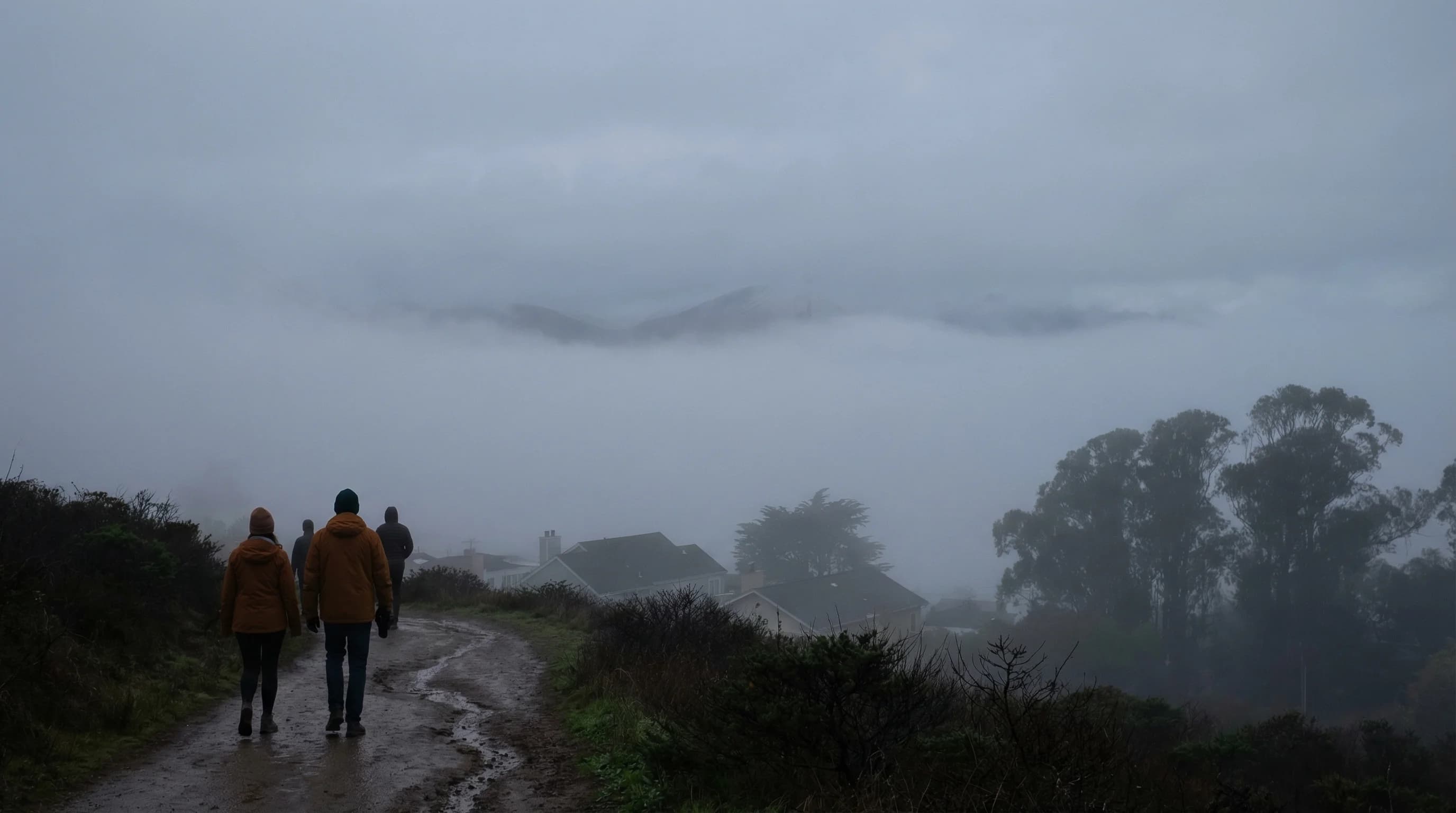
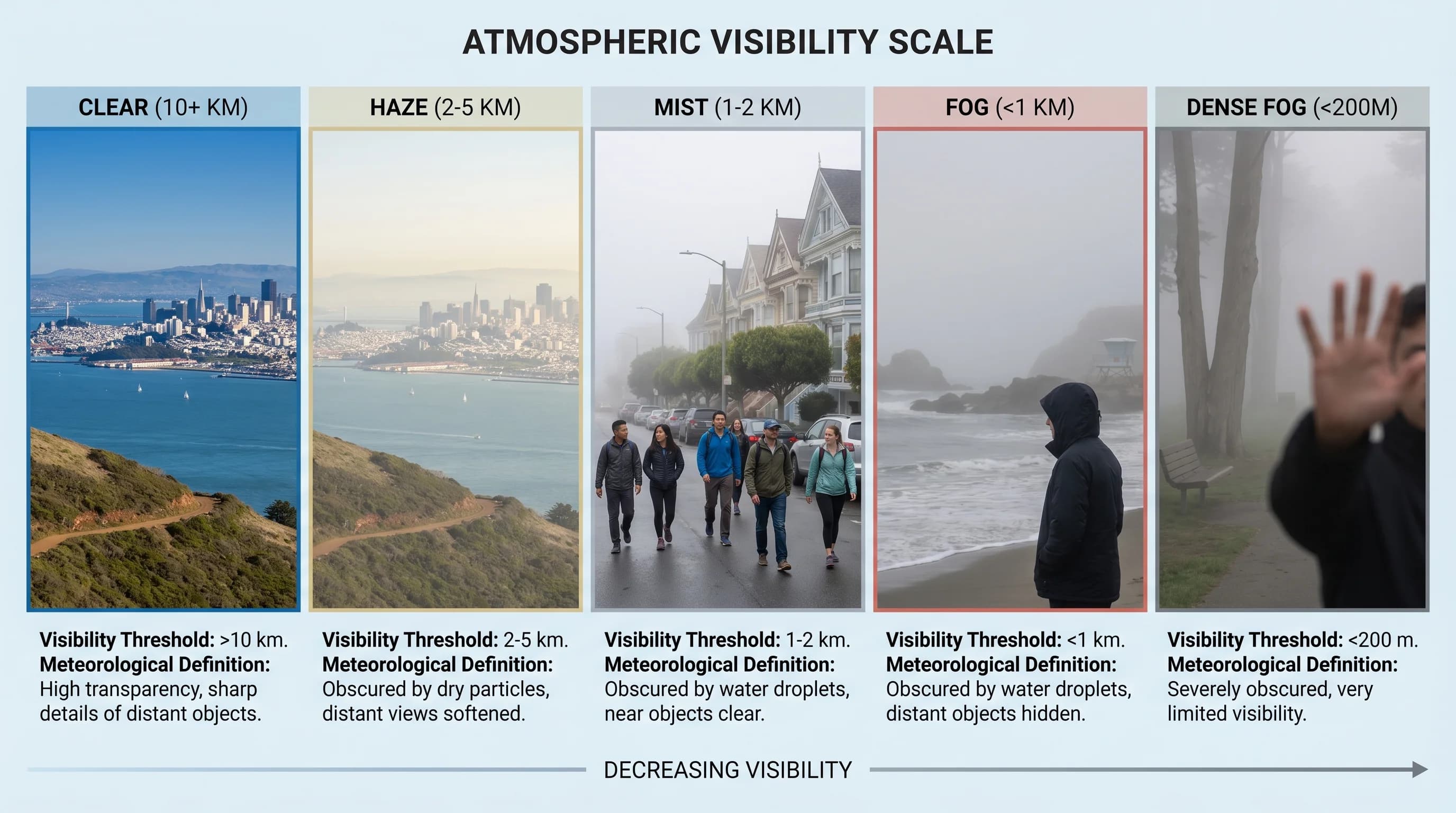
Fog and mist are the same physical phenomenon, tiny water droplets suspended in the air near the ground, distinguished by a single practical measurement: visibility. When visibility drops below 1 kilometer (roughly 0.62 miles), the condition is called fog. When visibility remains above 1 kilometer but the air is still noticeably hazy with suspended water droplets, it is called mist. That is the entire official distinction. In practice, the difference matters enormously for aviation, shipping, and driving safety, which is why meteorologists define it precisely, but in everyday experience, most people use the terms interchangeably in ways that are not technically wrong, just not precise.
The Visibility Threshold
The 1-kilometer visibility threshold that separates fog from mist is defined by the World Meteorological Organization and used consistently by weather services globally. In the United States, the National Weather Service issues dense fog advisories when visibility drops to a quarter mile or less, a much more severe threshold than the fog-vs-mist boundary. This means that not all fog triggers a weather advisory; only the densest fog that creates genuine safety hazards.
From a practical standpoint, mist is what you experience when the air feels damp and visibility is reduced but you can still see across a city block or a valley. Fog is what you experience when you cannot see more than a few hundred meters and objects appear to fade into gray. The Bay Area's summer marine layer is almost always fog by the technical definition when it rolls through the Golden Gate; visibility drops well below 1 kilometer in the dense patches of the marine layer. What people call "a little misty" on a San Francisco morning is often technically fog.
Droplet Size and Formation
Both fog and mist consist of liquid water droplets ranging from about 1 to 100 microns in diameter, far larger than individual water vapor molecules but far smaller than raindrops, which are 1,000 to 5,000 microns in diameter. The droplets are small enough to remain suspended by turbulence and air resistance rather than falling as rain. Formation requires the air to reach its dew point, the temperature at which the air becomes saturated with water vapor and cannot hold any more moisture in gaseous form. When air cools to its dew point, the excess water vapor condenses onto tiny particles (dust, sea salt, pollen) to form the droplets that make up fog or mist.
The same condensation processes that form fog and mist also form clouds. The physical difference between a cloud and fog is location: fog touches the ground, clouds do not. When you walk through fog, you are walking through a cloud at ground level.
Other Related Terms: Haze, Drizzle, and Brume
Haze is frequently confused with fog and mist but is physically distinct. Haze is caused by dry particles suspended in the air, smoke, dust, pollution, sea salt crystals, rather than water droplets. The visual effect is similar (reduced visibility, milky or brownish sky) but the cause and the health implications are different. Fog and mist are harmless to breathe; smoke haze contains particulates that can damage lungs. Bay Area residents often need to distinguish between the two: a gray morning could be either harmless marine layer or smoky air from a distant wildfire.
Drizzle is different again: it is precipitation, meaning the water droplets are large enough (between 0.1 and 0.5 mm) to fall perceptibly as tiny drops. Fog does not fall; drizzle does. The Bay Area's marine layer frequently produces what feels like drizzle, a wetness in the air that seems to land on surfaces, but is technically fog drip: fog droplets condensing on surfaces rather than falling as precipitation. True drizzle has a direction of fall and leaves obvious droplets on horizontal surfaces that accumulate over time. The marine layer's "drizzle" is the result of fog collecting on clothing, hair, and surfaces and running together.
Brume is a French term occasionally used in English meteorological contexts to describe a light atmospheric haze that reduces visibility only modestly. It encompasses both mist and light haze, used when the precise cause is not determined. You will encounter it occasionally in maritime weather reports. For most Bay Area residents, the practical vocabulary, fog when you cannot see across the street, mist when the air is damp but you can navigate normally, is accurate enough.