
destinationsmicroclimatesseasonal

Calistoga Weather: Hottest Wine Country Town

By SFBayWeather||Updated |6 min read
Calistoga Weather: Hottest Wine Country Town

Key Takeaways

  • Calistoga regularly records 100°F+ summer highs, 15-20°F hotter than Napa city, because the marine push from San Pablo Bay largely exhausts its cooling effect before reaching the valley's northern end.
  • The narrow valley walls at Calistoga trap heat and limit radiative cooling at night, so the town starts the day warmer and ends it warmer than other Napa Valley communities.
  • Volcanic soils from the Mayacamas range heat up rapidly under summer sun, contributing to intense ground-level heat in Calistoga's afternoons.
  • The Napa Valley temperature gradient from Carneros (82°F avg July) to Calistoga (98°F+ avg July) is so consistent that winemakers use it explicitly to select varietals for each sub-appellation.
  • Spring and fall are the peak seasons for Calistoga's hot springs resorts, warm pools in cool air are more comfortable than warm pools in 100°F heat.

Calistoga sits at the northern end of Napa Valley, tucked against the Mayacamas and Palisades mountains at the valley's narrowest point, and it regularly records the highest temperatures of any wine country town in Northern California. Summer highs exceeding 100 degrees Fahrenheit are common from June through September, and during heat waves the town can reach 110 or above, temperatures that feel less like wine country and more like the desert Southwest. The same geography that traps heat in Calistoga also makes it one of the most distinctive weather environments in the Bay Area, with dramatic temperature swings, volcanic soils that retain heat, and geothermal activity that has made the town famous for its hot springs and mud baths.

Why Calistoga Is the Hottest Wine Country Town

The explanation for Calistoga's extreme heat is entirely geographic. The town sits at the narrow northern end of the Napa Valley where the valley walls close in on both sides. The marine push from San Pablo Bay that provides afternoon cooling relief to the southern Napa Valley, the Carneros region and Napa city area, has exhausted much of its cooling effect by the time it travels 35 miles north to Calistoga. The same marine air that drops Napa city from 95 to 78 degrees in the late afternoon barely makes it to Calistoga, arriving as a mildly warm breeze that provides minimal relief.

The valley walls also trap heat effectively. The surrounding mountains block the horizon, limiting both the morning cool-down and the evening radiative cooling that helps more exposed valleys shed their daytime heat. Calistoga begins the day warmer than other Napa Valley communities and ends it warmer too. The town's volcanic soils, a remnant of the Mayacamas range's volcanic history, have lower thermal mass than sedimentary soils and heat up rapidly under summer sun, contributing to the ground-level heat that makes Calistoga's afternoons particularly intense.

The Temperature Gradient Down the Valley

The Napa Valley is a textbook example of a coastal temperature gradient. Drive Highway 29 from Carneros in the south to Calistoga in the north and you experience the full range. Carneros, at the bay's edge, averages July highs around 82 degrees Fahrenheit, warm and sunny, moderated by fog from San Pablo Bay. The Stags Leap District, mid-valley, runs around 90 degrees. Rutherford and Oakville, in the heart of the valley, reach 93 to 95. Calistoga, at the northern end, averages around 95 to 98; and on hot days, it regularly reads 10 to 15 degrees above Napa city, which is already hot.

This gradient is so consistent and well-documented that winemakers use it explicitly in varietal selection. The southern valley's Carneros and Los Carneros regions are planted heavily with Pinot Noir and Chardonnay, varieties that require cooler conditions. Moving north, Cabernet Sauvignon becomes dominant, thriving in the heat. Calistoga's hottest blocks produce intensely concentrated wines from Cabernet, Zinfandel, and Petite Sirah that would be unrecognizable grown in the cooler southern reaches of the same valley.

Calistoga main street on a hot summer day with the Palisades mountains rising dramatically behind the town, heat shimmer visible on the road
Calistoga regularly exceeds 100°F in summer, 15-20°F hotter than Napa city at the valley's southern end. The narrowing valley walls and distance from the marine push create the Bay Area's hottest wine country microclimate.

The Hot Springs and Geothermal Connection

Calistoga's extreme summer heat is one reason the town developed its famous hot springs culture; but the hot springs themselves are geologically independent of the surface weather. The volcanic bedrock of the Mayacamas range heats groundwater to temperatures that surface naturally as hot springs throughout the Calistoga area. The town's first resort was established around these springs in the 1850s, and the combination of hot summer climate, geothermal hot springs, and mineral-rich soils has shaped Calistoga's identity as a wellness destination since.
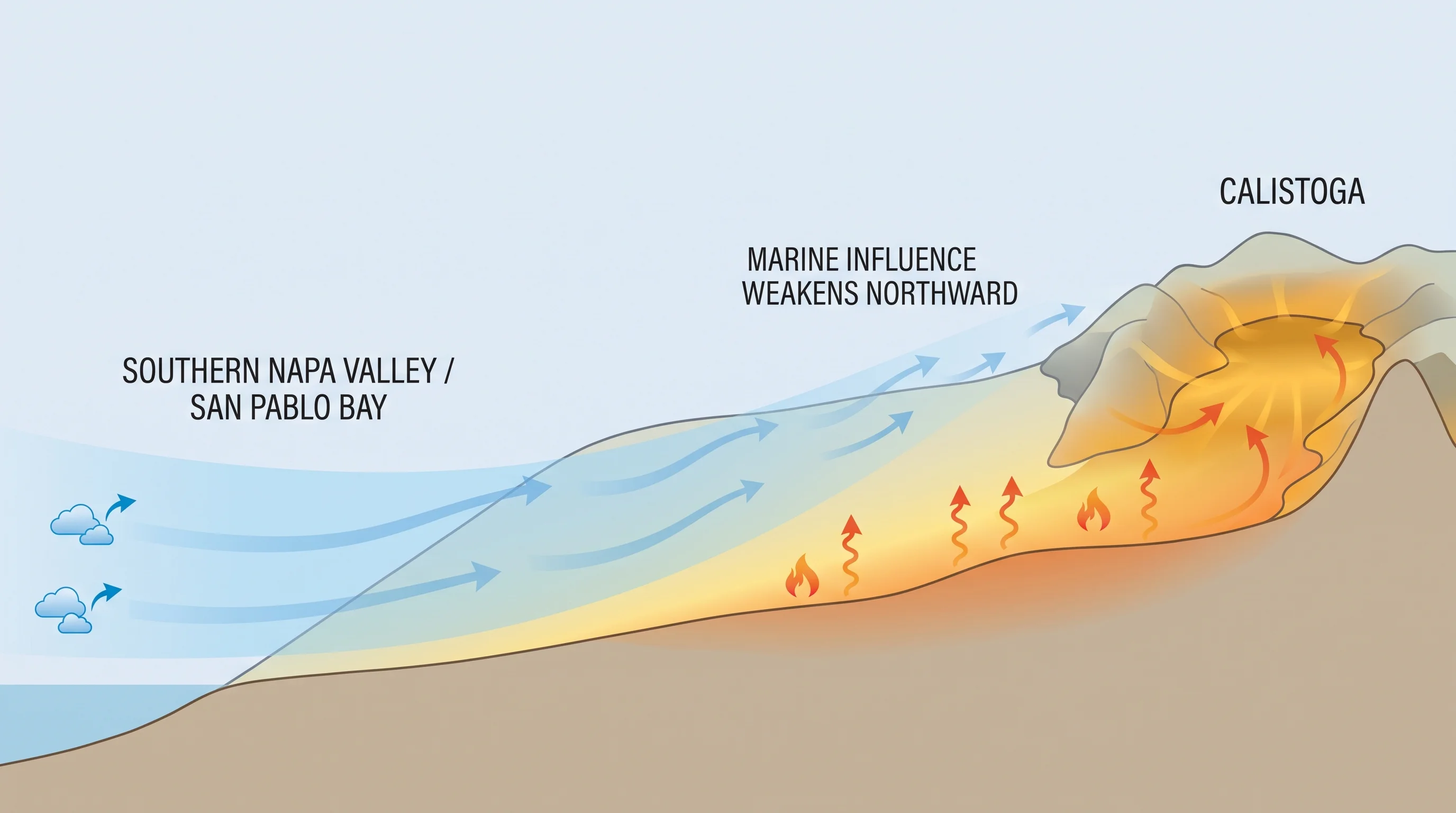
Scientific illustration explaining Calistoga Weather: Hottest Wine Country Town

The irony of visiting a hot springs resort in 100-degree summer heat is not lost on the town's operators. Most spas in Calistoga offer outdoor soaking areas with shade and cooling misters, and the geothermal pools themselves are kept at temperatures that are therapeutic but not dangerous in the heat. Spring and fall are the most popular seasons for hot springs visits, March and April for warm pools in cool air, October for warm pools in the golden warmth of Indian summer, though the town is busy year-round with visitors drawn by the wine, the geology, and the spa culture that the heat helped create.

Frequently Asked Questions

Why is Calistoga so much hotter than the rest of Napa Valley?

Calistoga sits at the narrow northern end of Napa Valley where the valley walls close in on both sides. The marine push from San Pablo Bay that cools the southern Napa Valley has exhausted most of its cooling effect by the time it travels 35 miles north. What arrives in Calistoga on hot summer afternoons is often just a warm breeze that provides minimal relief, while the valley floor has been baking in full sun since morning.

How hot does Calistoga get in summer?

Very hot. Average July highs run above 98°F, and during heat waves Calistoga regularly reaches 110°F or above. The town routinely reads 10-15°F above Napa city on hot days. High-temperature records for Napa County are frequently set in Calistoga or the northern valley. The heat begins in late May and persists through September, with June, July, and August the most intense months.

When is the best time to visit Calistoga?

March and April for spring warmth without extreme heat, green hills, and comfortable outdoor dining. October for golden Indian summer conditions and harvest season in the vineyards. Both seasons are ideal for the hot springs; warm pool soaking is most enjoyable when the air temperature is in the 60s or 70s, not 100°F. Winter visits (December-February) work well for mud bath weekends when the town is quiet and accommodation is less expensive.

Why does Calistoga have natural hot springs?

Calistoga sits at the northern end of Napa Valley near the Clear Lake volcanic field, where residual geothermal heat from past volcanic activity warms groundwater. The Old Faithful Geyser of California, just north of town, erupts roughly every 30 minutes from this same geothermal system. The combination of volcanic soils, geothermal activity, and the valley's enclosed heat trap makes Calistoga uniquely suited for hot spring resorts and mud bath spas. The town's identity has been built around these geothermal resources since the 1860s.

How does Calistoga weather compare to coastal Sonoma County?

The contrast is extreme. The Sonoma Coast 30 miles southwest can be 55°F in dense fog when Calistoga is 105°F. The same Coast Range that blocks marine cooling from Calistoga allows it to flow freely into coastal Sonoma. This gradient is so dramatic that vineyards specifically exploit it: heat-loving Cabernet grows in Calistoga, while Pinot Noir and Chardonnay suited to cool coastal fog thrive near Bodega Bay and Occidental. Driving from the Sonoma Coast to Calistoga in summer means passing through three or four distinct climate zones within 45 minutes.

Live Bay Area Conditions

Compare fog, temperature, wind, and comfort across the map.

See which microclimates are clear, cool, windy, or warming up right now.

Open the Weather Map
🔒Privacy Policy📄Terms of Service