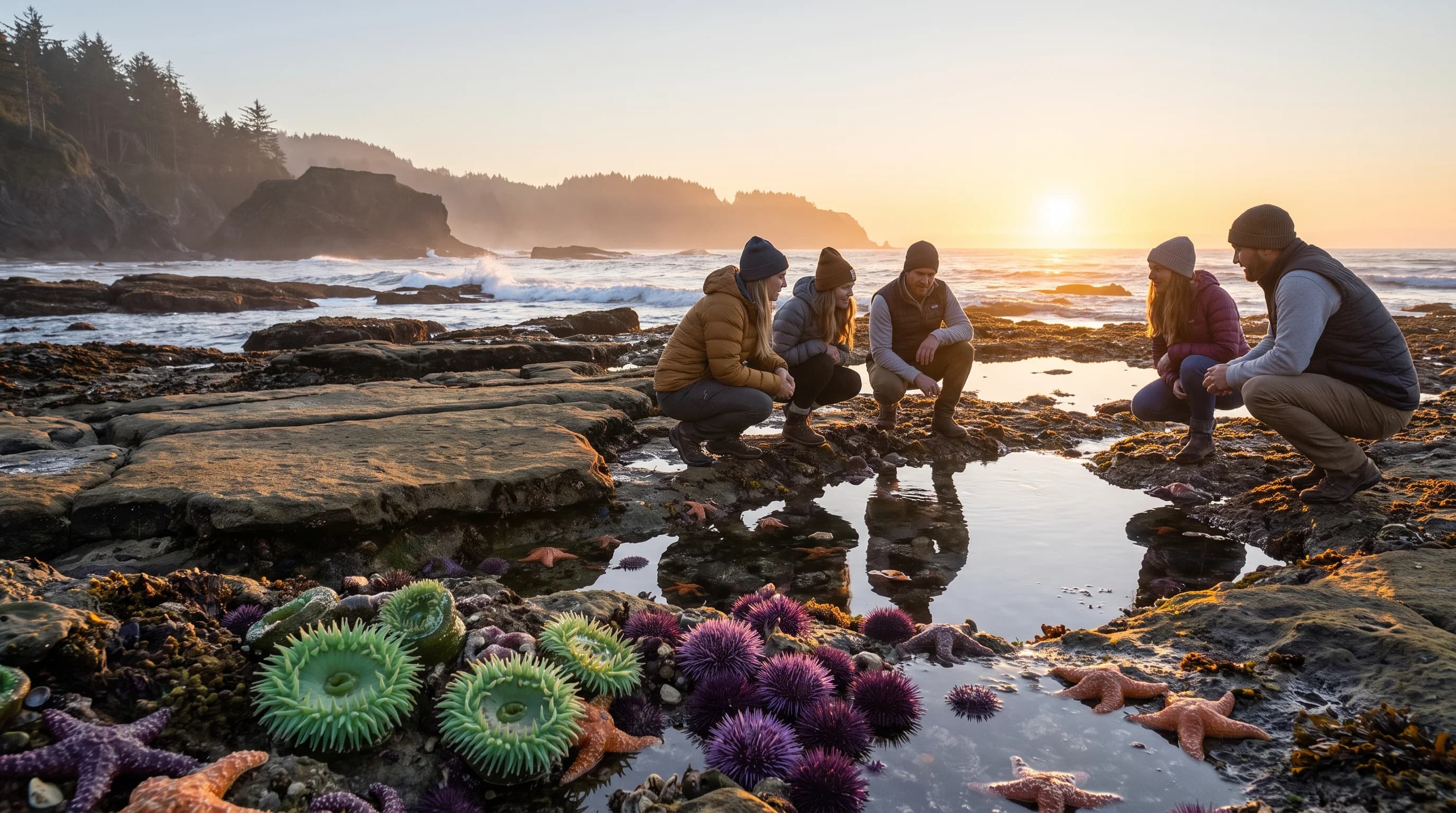
The best Bay Area tide pooling comes on minus tides, when the water drops below the average low. In 2026-27, NOAA predicts the lowest daylight tides at Pillar Point Harbor near Half Moon Bay in late afternoons from November to February and early mornings from May to July. Arrive an hour before low tide and watch the waves.
On December 23, 2026, the tide at Pillar Point drops to about 1.9 feet below the average low at 4:22 PM, with half an hour of daylight to spare. Six months later, on June 6, 2027, an equally low tide arrives at 6:49 AM. The best days need three things at once: a minus tide, daylight, and surf calm enough to be on the rocks.
When Is the Best Time to Go Tide Pooling in the Bay Area?
The best time to go tide pooling in the Bay Area is during a daylight minus tide. In the 2026-27 season, those come on winter afternoons and early summer mornings, and the lowest ones are listed below. A minus tide exposes the low tide zone, where the most colorful animals live and where you rarely get a look on an ordinary day.
| Date | Low tide | Height | Note |
|---|---|---|---|
| Nov 23, 2026 | 3:45 PM | -1.28 ft | About an hour before sunset |
| Dec 22, 2026 | 3:34 PM | -1.56 ft | |
| Dec 23, 2026 | 4:22 PM | -1.86 ft | Sunset 4:55 PM |
| Jan 20, 2027 | 3:21 PM | -1.46 ft | |
| Jan 21, 2027 | 4:07 PM | -1.63 ft | |
| Jan 22, 2027 | 4:51 PM | -1.56 ft | Sunset about 5:21 PM |
| Feb 19, 2027 | 3:45 PM | -1.08 ft | |
| May 8, 2027 | 7:00 AM | -1.48 ft | Early morning |
| Jun 6, 2027 | 6:49 AM | -1.86 ft | Lowest daylight tide of the season |
| Jun 7, 2027 | 7:38 AM | -1.68 ft | |
| Jul 5, 2027 | 6:33 AM | -1.73 ft |
NOAA tide predictions for Pillar Point Harbor (station 9414131), feet relative to mean lower low water (MLLW), local time. Only lows at least 30 minutes after sunrise and before sunset are listed. Nearby reserves run within minutes of these times.
Start with the first condition: what makes a tide a minus tide.
What Is a Minus Tide?
A minus tide is a low tide that drops below mean lower low water, the zero line on tide charts. Fitzgerald Marine Reserve recommends visiting on tides of 1 foot or lower, and the lowest lows tend to come around the new and full moon each month, when the pull of the sun and moon lines up.
Reading a tide prediction is simple once you know the zero line. A low of -1.5 feet means the water drops a foot and a half below that average lower low, uncovering rock that is normally underwater. The time listed is the moment of the lowest water, so plan to arrive before it.
The moon sets the rhythm. Around the half-moon phases, the sun and moon pull at right angles, the tide range shrinks and the lows stay higher, so those weeks are poor for tide pooling. Around new and full moon the range is largest, and that is when the deep lows in the table cluster.
On a minus tide you can usually explore for two hours or more on either side of low tide, and an hour either side on a higher low. Use the NOAA station closest to your beach, since times shift by several minutes along the coast. A minus tide only helps if it happens while the sun is up, and that is where the calendar gets interesting.
Why Do the Best Low Tides Come on Winter Afternoons and Summer Mornings?
On the Bay Area coast, the year's lowest low tides shift with the seasons: they fall in the late afternoon from November to February and in the early morning from April to August. Spring and fall have far fewer daylight minus tides.
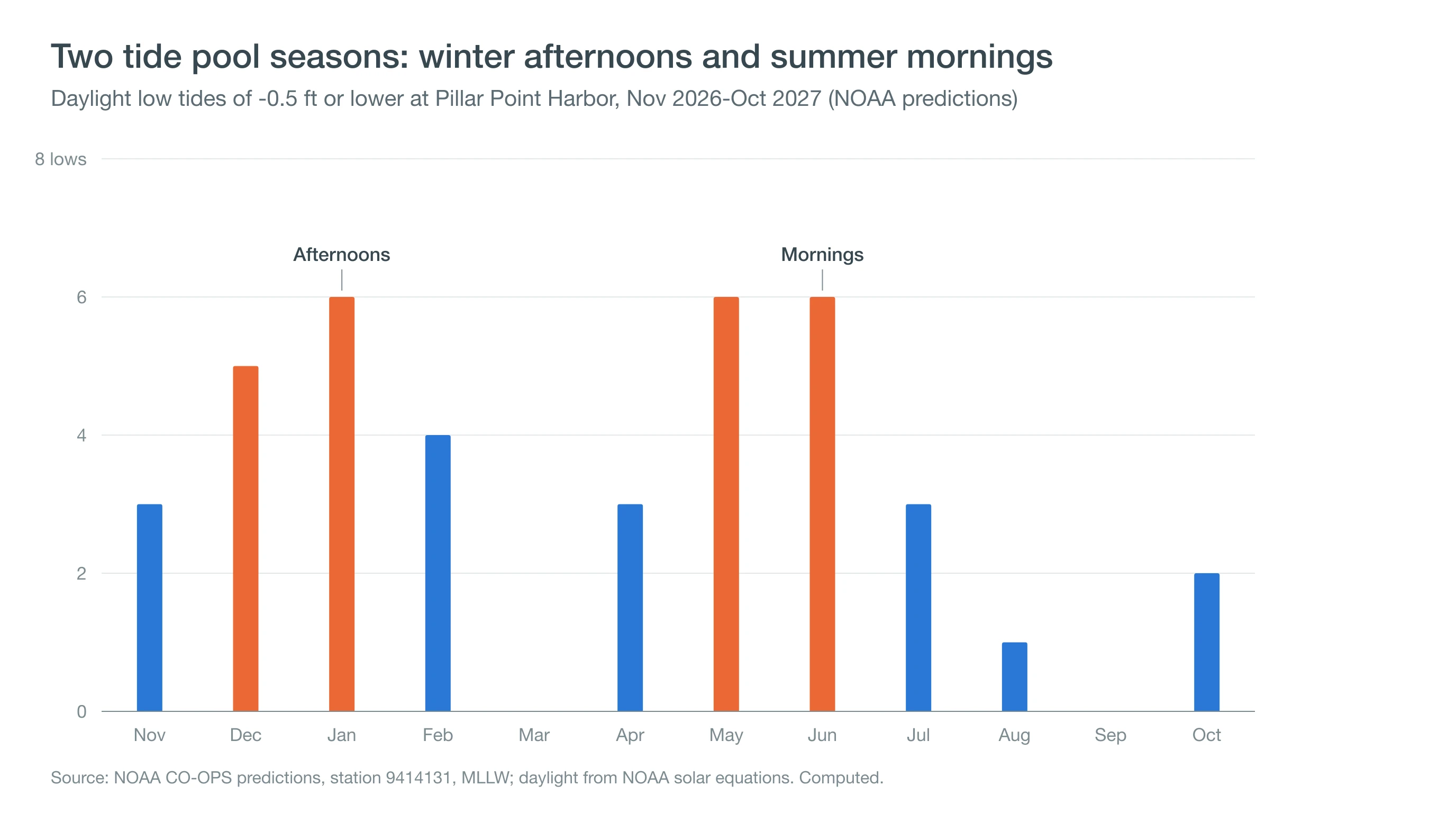
| Month | Daylight lows of -0.5 ft or lower | Time of day |
|---|---|---|
| November 2026 | 3 | Afternoon |
| December 2026 | 5 | Afternoon |
| January 2027 | 6 | Afternoon |
| February 2027 | 4 | Afternoon |
| March 2027 | 0 | None |
| April 2027 | 3 | Early morning |
| May 2027 | 6 | Early morning |
| June 2027 | 6 | Early morning |
| July 2027 | 3 | Early morning |
| August 2027 | 1 | Early morning |
| September 2027 | 0 | None |
| October 2027 | 2 | Late afternoon |
Computed from NOAA CO-OPS predictions (station 9414131, MLLW) with sunrise and sunset from NOAA solar equations.
Winter has a catch. Some of December's very lowest tides fall just after dark: on December 24, 2026, the tide bottoms out at -1.90 feet at 5:10 PM, 15 minutes after sunset. Pick the days in the table, when the low comes with daylight left, and remember that winter afternoons cool off quickly once the sun drops.
Summer has its own trade-off. The morning minus tides arrive early, often in fog, so dress warmly and expect gray light.
The biggest tide swings of the year come around the winter and summer solstices, which is why the same December days bring both extremes. The very low afternoon tides of December 22-24, 2026 arrive alongside the season's highest king tides, which come on the morning high tide. With a date in hand, the next choice is where to go.
Where Are the Best Tide Pools in the Bay Area?
The best-known Bay Area tide pools are at Fitzgerald Marine Reserve in Moss Beach, on the San Mateo coast north of Half Moon Bay, where groups of 10 or more explore with a docent. The reserve publishes its own guide to the tide zones and the animals in each, which makes it a good first stop for new tide poolers.
In Marin, Duxbury Reef near Bolinas is one of the largest shale reefs in North America, and the state protects it as a marine conservation area because of the tide pools that form on it at low tide. The California Department of Fish and Wildlife lists turban snails, anemones, sea stars, small fish such as blennies, and colorful sea slugs called nudibranchs among the reef's residents. It is a short drive from Stinson Beach.
Farther south, Natural Bridges State Beach in Santa Cruz runs guided tide pool tours at low tide, and the rocky shore at Asilomar in Pacific Grove is a state marine reserve. There, the state says low tide reveals sea stars, anemones, sculpins, bat stars, crabs, limpets and nudibranchs. Every one of these is a protected area and an exposed coast, which brings rules and risks.
What Will You See in Bay Area Tide Pools?
You will see different animals in each band of the shore, because each band spends a different share of the day out of the water. Fitzgerald Marine Reserve describes four zones, from the splash zone that is almost always dry to the low tide zone that only shows on the lowest tides.
| Zone | How often exposed | What you may see |
|---|---|---|
| Splash zone | Almost always dry | Finger limpets |
| High tide zone | Out of water 35-75% of the time | Black turban snails, aggregating anemones |
| Mid tide zone | Out of water 7-35% of the time | Ochre sea stars, California mussels, barnacles, giant green anemones |
| Low tide zone | Out of water 0-7% of the time | Brooding anemones, lined chitons, sea lemons |
Source: Fitzgerald Marine Reserve, Learn About the Tidepools.
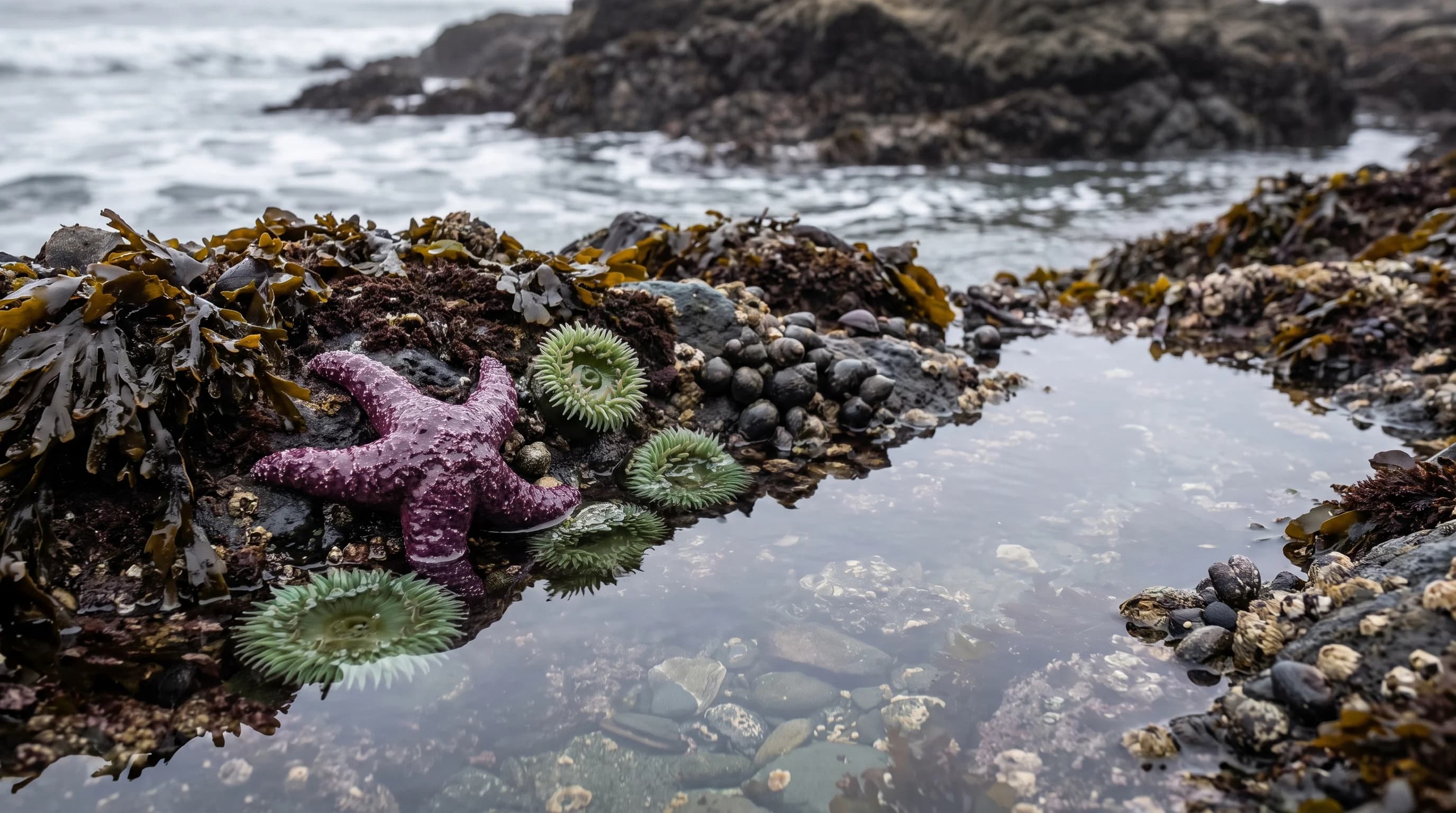
The low tide zone is why minus tides matter. It is where brooding anemones, lined chitons and sea lemons live, and only the lowest tides of the year uncover much of it. Look for ochre sea stars, which come in purple and orange, wedged into cracks in the mid tide zone, and for giant green anemones open in the pools.
Move slowly and look closely: many animals hide under ledges or blend into the rock, and the best finds often come from watching one pool for a few minutes.
Deep Dive: Why Are Bay Area Tides So Uneven?
Bay Area tides are uneven because the coast has a mixed semidiurnal tide: two highs and two lows a day, but of unequal height. NOAA classifies San Francisco's tide this way, and the gap between the two daily lows, called the diurnal inequality, is what produces a deep minus tide at one time of day and a shallow low at the other.
How Do the Sun and Moon Combine?
Tide predictions are built from dozens of harmonic constituents, each a wave tied to a cycle of the sun or moon. The largest, M2, is the principal lunar semidiurnal tide, with a period of 12.42 hours.
Diurnal constituents such as K1 and O1, with periods near 24 hours, arise because the moon and sun usually sit north or south of the equator, so the two tidal bulges pass a given latitude unevenly. On the U.S. West Coast, the diurnal constituents are strong enough relative to M2 that the two daily tides differ sharply.
Declination drives the inequality. The moon swings north and south of the equator over about 27.3 days, so the inequality peaks twice a month, and the sun's declination peaks at the solstices. When a large lunar declination coincides with a new or full moon near a solstice, one daily low drops far below the other, which is why the year's deepest minus tides cluster around the winter and summer solstices.
Why Do the Best Lows Repeat at the Same Clock Time?
At new and full moon, the sun and moon line up, so spring-tide lows arrive at roughly the same local time at a given place every two weeks. Mariners once called the steady lag between the moon's passage and high water at a harbor the establishment of the port. As the sun moves from the northern to the southern sky, the deeper of the two daily lows on this coast switches from the morning to the afternoon, which is the pattern in the tables above.
Why Do Tide Pool Animals Live in Bands?
The daily rise and fall also explains the bands of life on the rocks. Joseph Connell's classic experiments with barnacles in Scotland showed that a species' upper limit is often set by physical stress, heat and drying at low tide, while its lower limit is set by competition and predation. Robert Paine's removal of ochre sea stars on the Washington coast showed how one predator controls that lower edge: without the stars, mussels took over.
A minus tide uncovers that lowest band, where biology rather than exposure decides who lives where. Before you walk out to it, though, check the third condition: the surf.
What Should You Check Before You Step Onto the Rocks?
Before you step onto the rocks, check the surf. Winter minus tides often arrive with big swell, and sneaker waves can wash across reefs that looked dry minutes earlier. Look at the National Weather Service surf forecast and any Beach Hazards Statement, never turn your back on the ocean, and wear shoes that grip wet algae.
Then follow the reserve rules. Fitzgerald Marine Reserve asks visitors to observe animals where they are, not to pick things up or turn over rocks, and to step gently around the pools. Collecting shells, rocks or animals is prohibited, dogs are not allowed on the beach, and groups of 10 or more need a reservation with a docent.
Keep an eye on the clock as well. The tide starts rising right after the low, and on a flat reef the water can cut you off from the beach faster than you expect. Tide, daylight and surf: when all three line up, you get the reef at its best.
Pick a date from the table, confirm the NOAA prediction for your reserve, and check the NWS Bay Area surf forecast for swell. On the morning of your trip, the Moss Beach forecast shows wind and fog. For the rest of the coast, see Half Moon Bay weather, Santa Cruz weather and the year's highest tides in king tides.