
Western monarchs overwinter at Pacific Grove's Monarch Sanctuary and Natural Bridges State Beach in Santa Cruz from October to early February. They fly only when it is about 55°F or warmer, so visit on a sunny day after mid-morning. At Monterey's airport, winter days usually pass 55°F around 10 AM, but 1 in 10 January days never do.
Below that line, the monarchs stay folded in clusters that look like dead leaves, and many visitors walk right past them. Being in the right grove is half of seeing them; being there above 55°F is the other half.
When Are the Monarchs in Pacific Grove and Santa Cruz?
The monarchs are in Pacific Grove and Santa Cruz from October to early February, according to the Xerces Society. They begin arriving in October, and the Western Monarch Count, held from late November to early December, captures the peak of the season.
By February, the butterflies leave the coast and spread inland, where the next generations breed on milkweed through spring and summer. Arrival and departure dates shift with the weather each year, so check recent sightings with the sanctuary or State Parks before a late-season trip.
The monarchs choose the Central Coast because a handful of groves offer exactly the microclimate they need to survive. Conservation groups describe the ideal site as one with protection from freezing temperatures and strong wind, enough humidity, dappled sunlight, fresh water and nearby flowers for nectar.
The ocean keeps coastal winters mild, so frost is rare, and tall trees around the roost block the wind. Fog and dew also supply drinking water. The butterflies are in a resting state called diapause, so their winter is mostly spent hanging in clusters, sunning, drinking and sipping nectar on warm afternoons.
Before the weather, it helps to set expectations about numbers.
How Many Monarchs Will You See?
You will see far fewer monarchs than past visitors did. The 2025 Western Monarch Count recorded about 12,260 butterflies at 249 sites across the West, the third-lowest total since the count began in 1997, while western monarchs numbered in the low millions in the 1980s.
In 2025, Natural Bridges had the season's highest count, about 2,500 monarchs, and the Pacific Grove sanctuary counted 188. That is a big difference for two famous groves, so if you can visit only one in a low year, Natural Bridges was the better bet in 2025. With fewer butterflies, seeing them active matters more, and that comes down to temperature.
Counts also swing widely from year to year. The Xerces Society reported 233,394 monarchs in the 2023 count, then 9,119 in 2024 and about 12,260 in 2025. The all-time low, 1,901, came in 2020. A single season tells you little about the next one, so treat each winter as its own.
Why Do Monarchs Need 55°F to Fly?
Monarchs need about 55°F to fly because their flight muscles don't work well when they are cold. Below that temperature they hang in tight clusters on branch tips; above it, the Xerces Society says, they begin to flutter, bask in the sun and fly around the grove.
Clustering is part of how they ride out the winter while their bodies are in a low-energy resting state. When the air warms past 55°F, the butterflies open their wings to bask, and good groves let in patches of sunlight for exactly that. On the coast in winter, the day has to warm up past that line first.
What Time of Day Are They Flying?
Monarchs are usually flying from late morning through the afternoon. Our analysis of airport records found that from 2015 to 2025, the temperature at Monterey Regional Airport typically first reached 55°F around 10 AM from December through February, and around 8 to 9 AM in October and November.
| Month | Typical first 55°F | Days that never reach 55°F | Days that reach 60°F |
|---|---|---|---|
| October | About 8 AM | 0% | 98% |
| November | About 9 AM | 2% | 80% |
| December | About 10 AM | 8% | 57% |
| January | About 10 AM | 10% | 56% |
| February | About 10 AM | 17% | 54% |
Computed from hourly reports at Monterey Regional Airport (KMRY), 6 AM-6 PM, 2015-2025, via the Iowa Environmental Mesonet. The airport sits inland of the groves; sunny spots in a grove warm sooner and shady ones later.
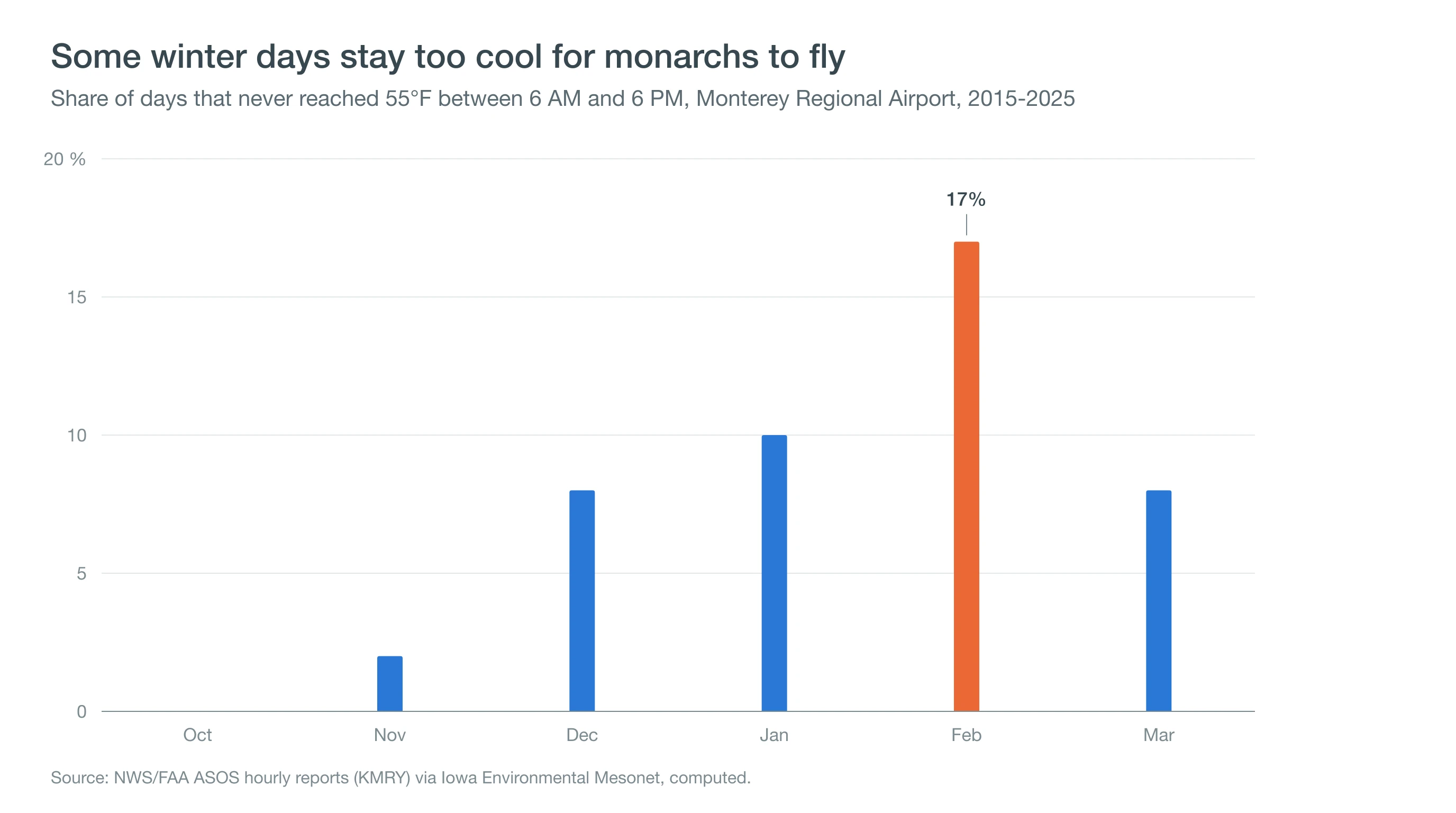
In practice, that means a short daily window. Arrive by late morning, stay into early afternoon, and you catch the warmest hours. Some days never get there at all, and the forecast tells you which.
What Weather Keeps Them in the Trees?
Cloudy, foggy, rainy and windy days keep monarchs in their clusters, because the air never warms enough to fly. At Monterey's airport, about 8% of December days, 10% of January days and 17% of February days never reached 55°F from 2015 to 2025.
Wind matters too: protection from strong wind is one of the things a good overwintering grove provides, which is why roost trees sit inside a larger stand of trees and shrubs. On a gray, breezy day, expect to see clusters rather than butterflies in flight; on a clear, calm day, expect the opposite.
Sunny, calm days are the opposite: a high near 60°F usually means plenty of flying. For the coast's winter patterns, see Monterey weather and Santa Cruz weather. Put the season, the hour and the forecast together, and the visit plans itself.
Is Santa Cruz or Pacific Grove Better for Seeing Monarchs Fly?
Santa Cruz usually has the warmer winter afternoons. Our comparison of NOAA station records from 2005 to 2025 found that the Santa Cruz station reached 60°F on 71% of February days, compared with 48% at the Monterey station near Pacific Grove. The gap shows up in every winter month.
| Month | Santa Cruz | Monterey |
|---|---|---|
| November | 88% | 76% |
| December | 54% | 44% |
| January | 63% | 50% |
| February | 71% | 48% |
Computed from daily highs at the NOAA cooperative stations in Santa Cruz (047916) and Monterey (045795), via RCC-ACIS, 2005-2025.
Combined with the 2025 count, when Natural Bridges held far more monarchs than the Pacific Grove sanctuary, Santa Cruz is the stronger choice for a single winter trip. Pacific Grove still has warm days, especially in November, and pairs well with a day in Carmel or Big Sur.
How Should You Plan and Enjoy Your Visit?
Plan your visit for a sunny day from November to January, with a forecast high near 60°F, and arrive after 10 AM. Bring binoculars, because clusters hang high in the trees. Stay on marked paths, don't touch the butterflies, keep pets leashed and keep your voice down, as the Xerces Society asks.

Look for clusters first, then watch the sunny edges of the grove, where butterflies take off once they warm up. A cluster can look like a bunch of brown leaves until one butterfly opens its orange wings.
Deep Dive: How Do Monarchs Survive a Coastal Winter?
Monarchs survive a coastal winter by shutting down reproduction and managing their body heat through behavior. The butterflies that reach Pacific Grove and Santa Cruz belong to a migratory generation, born in late summer and fall, that lives for months rather than the few weeks of a summer monarch.
What Is Reproductive Diapause?
Reproductive diapause is a hormonally controlled pause in breeding. Monarch biologists have found that shortening days, cooler and fluctuating temperatures and aging milkweed trigger it, and the key internal signal is low juvenile hormone. Without that hormone, the butterflies stay reproductively inactive, so their energy goes to flight and fat storage instead.
Longer days and warmer temperatures end the pause in late winter, when mating picks up just before the butterflies disperse inland to find milkweed. Migrating monarchs also navigate with a time-compensated sun compass, reading the sun's position and correcting for the time of day with a circadian clock. Researchers at the University of Massachusetts found that part of that clock sits in the antennae.
Why Does Temperature Matter So Much?
Insects are ectotherms, so a monarch's flight muscles run near the temperature of the surrounding air unless the butterfly warms them. Monarchs do that two ways: basking with wings spread toward the sun, and shivering, rapidly contracting the flight muscles without moving the wings. Journey North, a monarch citizen-science program, says a monarch can't fly if its body is below 55°F. Basking lets it fly in sunny air as cool as about 50°F, but on cloudy days it generally needs air near 60°F, which is why our Santa Cruz and Monterey comparison counts days that reach 60°F.
The cluster is a microclimate tool. Tightly packed butterflies are sheltered from wind and rain, and the grove canopy limits the heat lost to a clear night sky, the same loss that brings frost to open ground. Studies of overwintering monarchs in Mexico found that wet butterflies freeze at higher temperatures than dry ones, so shelter from rain and dripping fog matters as much as warmth.
Fat stored during the fall migration, topped up with nectar on warm afternoons, powers the butterflies through months of mostly sitting still. Every shiver and every flight burns some of that reserve, which is why a sheltered, mild grove is worth so much. Those same needs are the key to helping them.
How Can You Help Western Monarchs?
One of the most useful things Bay Area and Central Coast gardeners can do is surprising: don't plant milkweed near the coast. The Xerces Society advises against planting milkweed within five miles of the coast in central and northern California, where monarchs overwinter and milkweed did not grow historically.
Milkweed planted near the coast can survive the mild winter instead of dying back, and that encourages monarchs to keep breeding when they should be resting. Butterflies that skip their winter rest tend not to survive the season. Farther inland, native milkweed and nectar plants support the generations that breed in spring and summer.
Be there, and be there above 55°F. Check the Carmel-by-the-Sea forecast or the Santa Cruz forecast for a high of 60°F or more and light wind, then make a day of the coast with Carmel weather or Big Sur weather.