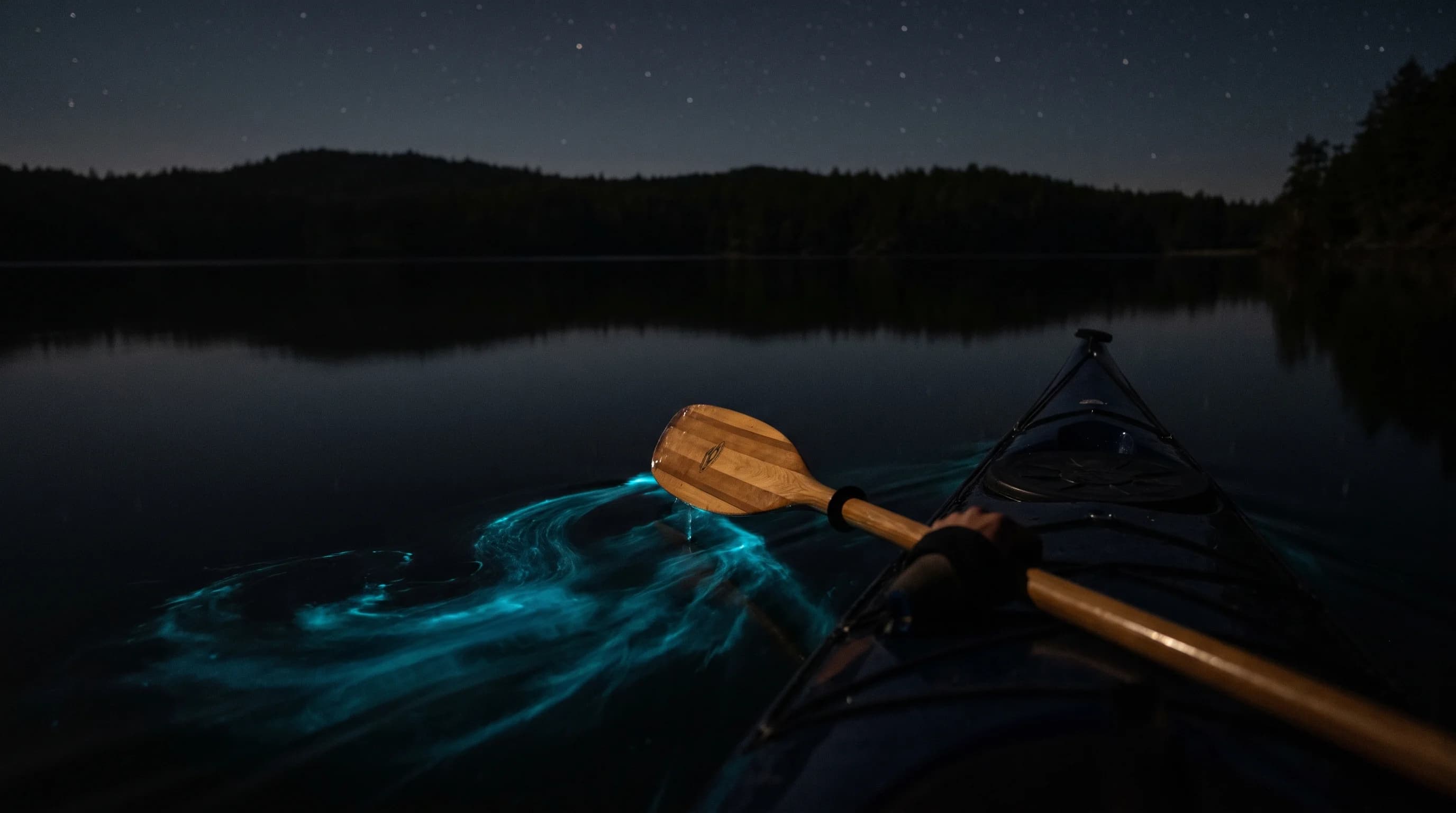
Tomales Bay glows when dinoflagellates, mostly Noctiluca scintillans, are disturbed by a paddle or a wave. The National Park Service says the best viewing is in summer and fall on dark nights before moonrise or after moonset, and guided tours run from July to early November. Go near a new moon, on a calm night, with a guide.
On the right night, every paddle stroke leaves a trail of blue-green light. On the wrong night, you see black water. The difference comes down to three things lining up: the plankton, the darkness and calm water.
What Makes Tomales Bay Glow?
Tomales Bay glows because of dinoflagellates, single-celled plankton that make light through a chemical reaction when the water around them moves, according to the National Park Service. The bay is long and narrow, about 15 miles from end to end along the San Andreas Fault, and its quiet water lets the plankton gather.
The same plankton can tint the water red or pink by day, which is why a glowing bloom is sometimes called a red tide. The first condition is the plankton itself, and that depends on the season.
How Does Bioluminescence Work?
Bioluminescence works through a chemical reaction inside the plankton. NOAA explains that an enzyme called luciferase helps a substance called luciferin combine with oxygen, and the reaction gives off light. The enzyme is reused, so a single cell can flash again and again.
Dinoflagellates glow blue-green, and they flash when something moves the water around them: a paddle, a wave, a fish or your hand. Scientists think the flash is a defense, startling would-be predators. That is why the glow appears only where the water is disturbed, and why still water looks dark even during a bloom.
Where Is Tomales Bay?
Tomales Bay is a long, narrow bay in western Marin County, about 30 miles northwest of San Francisco. It forms the eastern edge of Point Reyes National Seashore and sits on a submerged stretch of the San Andreas Fault, a flooded rift valley about 15 miles long.
The bay's shape is part of why it glows so well. The Point Reyes peninsula shelters it from open-ocean swell, and a local kayak naturalist has described the bay as concentrating the dinoflagellates with its geometry. Outfitters set their own launch points, so confirm yours when you book; the shoreline runs past Inverness and Tomales Bay State Park.
When Are the Glowing Plankton in the Bay?
The glowing plankton are usually in Tomales Bay from July to early November, with the densest blooms around the start of fall, according to local guides. Offshore water near Bodega Bay is warmest from September through December, at about 54°F to 55°F, compared with about 51°F in May.
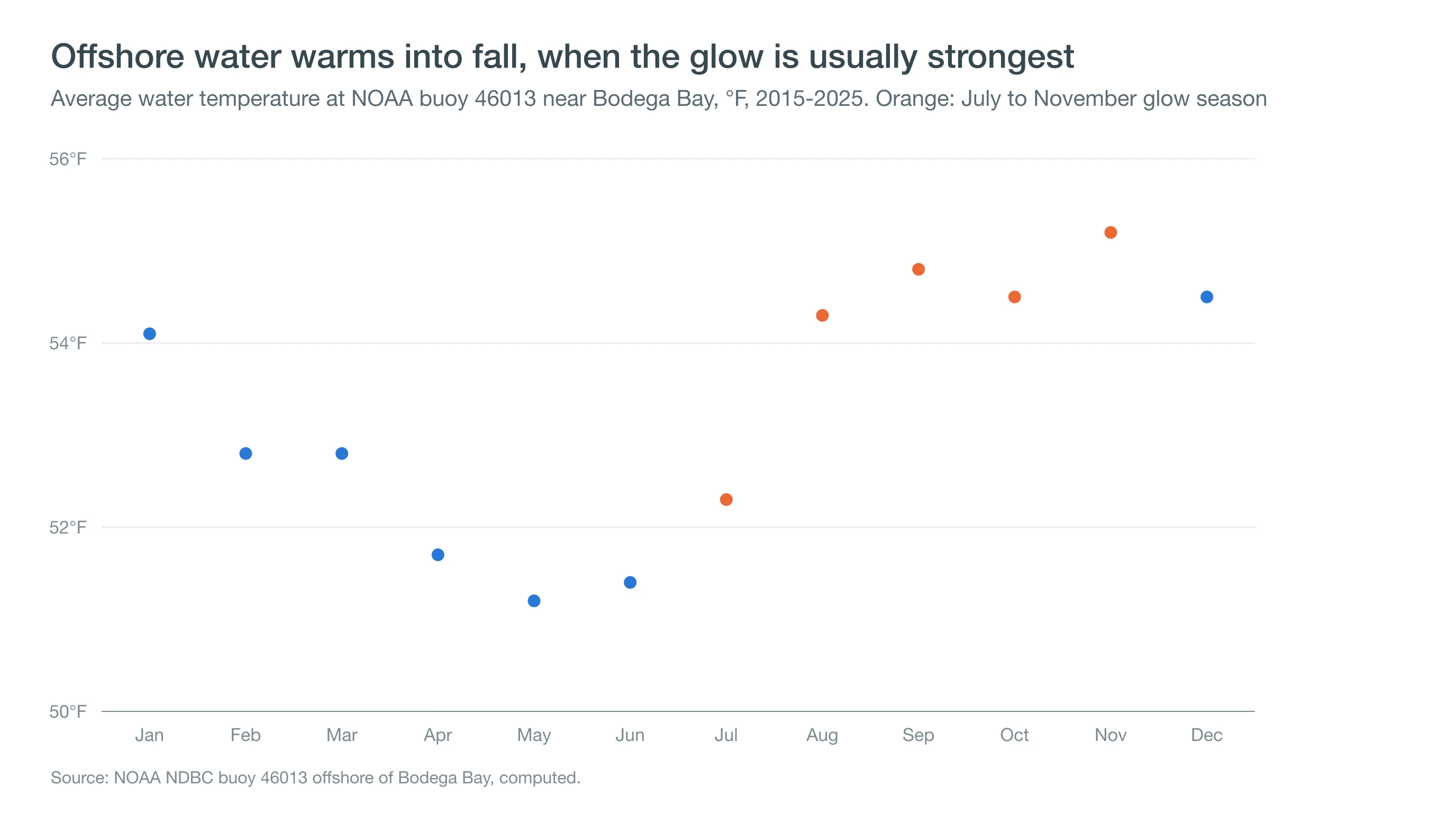
Blooms vary from year to year, so no season is guaranteed. And plankton in the water is not enough if the moon washes out the glow.
Why Do the Darkest Nights Matter?
The darkest nights matter because moonlight drowns out the faint glow. The National Park Service recommends going before the moon rises or after it sets, and the easiest way to get a dark night is to go near a new moon, when the moon sets around sunset and stays down all night.
The moon rises about 50 minutes later each day, so the dark window lasts several days on either side of the new moon. In the days just after it, a thin crescent sets soon after sunset, leaving the rest of the evening dark. In the days just before it, the crescent doesn't rise until near dawn. Once the moon passes first quarter, it hangs in the sky through the evening, and the glow fades from view.
| Season | New moon | Good window |
|---|---|---|
| 2026 | July 14 | July 11-17 |
| 2026 | August 12 | August 9-15 |
| 2026 | September 10 | September 7-13 |
| 2026 | October 10 | October 7-13 |
| 2026 | November 8 | November 5-11 |
| 2027 | July 3 | June 30-July 6 |
| 2027 | August 2 | July 30-August 5 |
| 2027 | August 31 | August 28-September 3 |
| 2027 | September 29 | September 26-October 2 |
| 2027 | October 29 | October 26-November 1 |
New-moon dates computed with standard astronomical formulas (Meeus) for Pacific time. The good window is about three nights either side. The glow varies by year, and a bloom is never guaranteed.
Even on a moonless night, the weather on the water can make or break the show.
What Weather Makes the Glow Brightest?
Calm water and cloud make the glow brightest. The National Park Service says dark, cloudy nights are best, since clouds block both moonlight and starlight, and calm water lets every paddle stroke show.
Wind is the enemy: it chops the surface and makes paddling harder. Our analysis of NOAA buoy 46013, offshore of Bodega Bay, found that evening hours with wind under 10 mph nearly double from June (21%) to November (42%). Tomales Bay is more sheltered than the open ocean, but the pattern points the same way: late summer and fall evenings are calmer than early summer ones.
Fog is fine for seeing the glow but harder to navigate in. For the bay's typical fog and wind, see Point Reyes weather and what is the marine layer. When the season, the moon and the weather line up, the last choice is how you get on the water.
| Month | Evening hours with wind under 10 mph |
|---|---|
| June | 21% |
| July | 33% |
| August | 38% |
| September | 38% |
| October | 40% |
| November | 42% |
Share of hourly readings from about 8 PM to midnight with wind under 10 mph at NOAA NDBC buoy 46013, 2015-2025, computed by SFBayWeather. The buoy is offshore; the bay itself is more sheltered.
Does Glowing Water Show Up Elsewhere in California?
Glowing water shows up elsewhere in California too, most famously in Southern California. In spring 2020, a bloom of the dinoflagellate Lingulodinium polyedra created a red tide from Ensenada to Ventura, and at night the breaking waves glowed neon blue, drawing crowds to the beaches, according to Scripps Institution of Oceanography.
The 2020 bloom also showed the other side of glowing plankton. Scripps researchers found it was a harmful algal bloom: toxins were detected at its height, and oxygen in the water fell to near zero as the bloom decayed, killing fish. A beautiful glow and a harmful bloom can be the same event, which is why it pays to check health advisories before getting in the water. For a Bay Area example, see the 2022 red tide in San Francisco Bay.
Tomales Bay's advantage is that its glow is a regular season, not a rare event: guides run trips there each summer and fall, and the bay's calm, sheltered water helps every paddle stroke show.
Deep Dive: What Happens Inside a Glowing Cell?
Inside a glowing dinoflagellate, each flash is the end of an electrical and chemical chain reaction that takes about 15 milliseconds from touch to light. The best-studied species is Lingulodinium polyedra, the organism behind Southern California's 2020 glow, and much of its machinery is shared by other glowing dinoflagellates.
What Are Scintillons?
The light comes from scintillons, tiny pockets that hang from the membrane of the cell's large internal vacuole. Each one holds luciferase and luciferin; in Lingulodinium, the luciferin is held by a luciferin-binding protein. At a pH of about 8, the enzyme is inactive and the binding protein keeps its grip.
Noctiluca, the main source of Tomales Bay's glow, uses the same chemistry in a more ancient package. A 2007 study in PNAS found that its luciferase and luciferin-binding protein are fused into a single gene, likely the ancestral arrangement that later split in two in species like Lingulodinium.
When moving water deforms the cell, the stimulus fires an action potential across the vacuole membrane. Voltage-gated channels let protons from the acidic vacuole flood into the scintillons, dropping the pH toward 6. The binding protein releases the luciferin, the luciferase switches on, and the luciferin is oxidized, giving off a flash of blue light.
Dinoflagellate luciferin is itself unusual: a linear tetrapyrrole, chemically related to chlorophyll. Some species, including Lingulodinium, also run on a circadian clock and glow far more readily at night than during the day.
Why Is the Light Blue, and Why Flash at All?
The flash peaks in the blue part of the spectrum, around 475 nanometers, close to the wavelengths that travel farthest through seawater. Biologists favor two explanations for the flash. The startle hypothesis says a sudden flash disrupts a grazing copepod. The burglar alarm hypothesis, proposed in 1943, says the flash lights up the grazer for its own predators, such as small fish, so the plankton is protected by exposing its attacker.
The chemistry explains what you see from the kayak. Because the trigger is mechanical, faster strokes and breaking ripples light up more cells, and cells can dim after being stimulated again and again, so a wake through water you just paddled may glow less brightly. Knowing that, the last step is choosing how to get out there.
How Do You See It Safely?
The safest way to see the glow is a guided kayak tour on a calm, dark night near a new moon, in late summer or fall. Outfitters provide boats, lights and a guide who knows the bay at night. From shore, you can sometimes see flashes where small waves break.
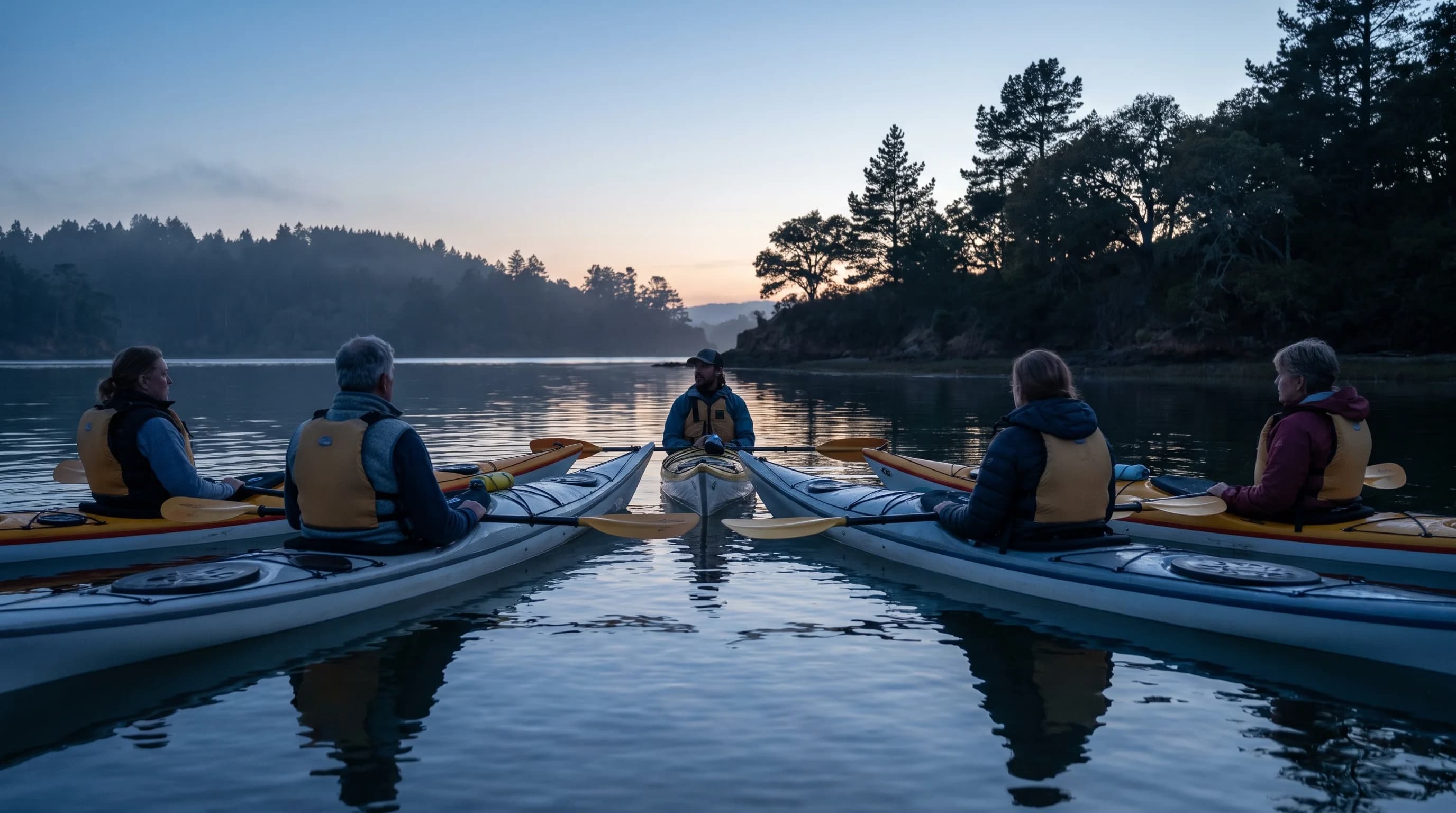
Swimming is not recommended: the water is cold, and it is dark. Plankton, darkness and calm water: pick a night from the table, check the Point Reyes forecast for light wind and the NWS marine forecast, then book with a licensed outfitter and dress for cold water. For another dark-sky trip, see northern lights in the Bay Area, and for blooms that turn harmful, see red tide in San Francisco Bay.