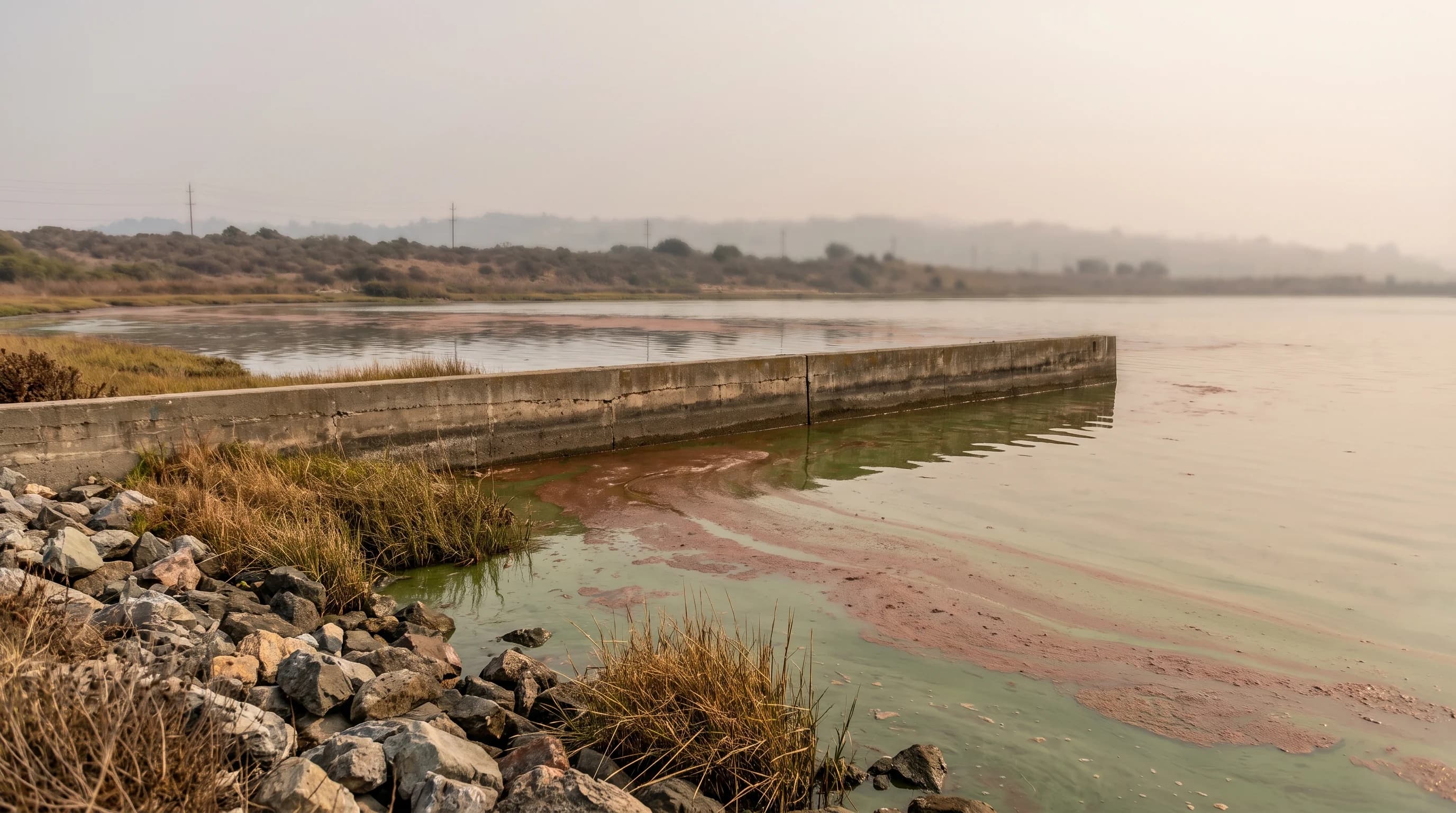
A red tide is a dense bloom of microscopic algae that tints water red or brown; some, called harmful algal blooms, kill fish or make toxins. In summer 2022, Heterosigma akashiwo caused the largest bloom in San Francisco Bay's recorded history, killing thousands of fish. Avoid discolored water and check state advisories.
In late August 2022, as many as 10,000 dead fish floated in Oakland's Lake Merritt, among them sturgeon and leopard sharks. That summer is the clearest guide to what a bay bloom can do, why it happens, and what it means for you.
What Is a Red Tide?
A red tide is a bloom of microscopic algae so dense that it colors the water red, brown or orange. Some blooms are harmless; others are harmful algal blooms that use up the oxygen fish need or make toxins. Not every red tide is toxic, and not every harmful bloom is red.
The clearest way to understand one is to follow the bay's biggest.
What Happened in San Francisco Bay in 2022?
In 2022, a bloom of Heterosigma akashiwo turned San Francisco Bay reddish-brown for weeks. It started near Alameda in late July and spread around the bay by mid-August, killing white and green sturgeon, leopard sharks, striped bass, bat rays and anchovy, according to the California Ocean Protection Council.
| When | Where | What happened |
|---|---|---|
| Late July 2022 | Alameda | First reports of red-brown water |
| Early August | Oakland Inner Harbor and Lake Merritt | The discoloration spreads |
| Mid-August | Richmond, Belvedere, San Mateo, Foster City | The bloom reaches open bay waters and the South Bay |
| Late August | Lake Merritt | As many as 10,000 fish die |
| Late August into September | Bay-wide | Over 200 fish-death reports; the bloom fades |
Sources: California Ocean Protection Council; San Francisco Estuary Institute (SFEI); San Francisco State University Estuary & Ocean Science Center.
Scientists at San Francisco State University called it the largest and longest-lasting algal bloom in the bay's recorded history. By the end of August, the bloom in the South Bay was dissipating, and early September readings from the San Francisco Estuary Institute showed a sharp drop in chlorophyll, a sign the algae were dying back.
The damage went beyond the fish counted on shore. As the bloom decayed, oxygen in parts of the bay fell to its lowest levels at the end of August, and the public's reports of dead fish came from shorelines all around the bay. The bloom raised the obvious question: why that summer?
What Is Heterosigma akashiwo?
Heterosigma akashiwo is a single-celled alga, so small it can only be seen under a microscope. Its species name, akashiwo, means "red tide" in Japanese, and scientists at San Francisco State University noted that 2022 was not the first time it had bloomed in the bay, only the most destructive.
The alga harms fish in two ways. A dense bloom uses up the oxygen in the water, and fish suffocate. Heterosigma is also associated with toxins that harm fish directly. People are a different story: the Water Board said the 2022 alga was not toxic to humans, though it could irritate skin and eyes.
What Set Off the 2022 Bloom?
The 2022 bloom came in the bay's warmest months. Our analysis of NOAA's Alameda station found it averaged 69.8°F in August 2022, a little above its usual 68.6°F, and the bay is warmest from July through September in a typical year.
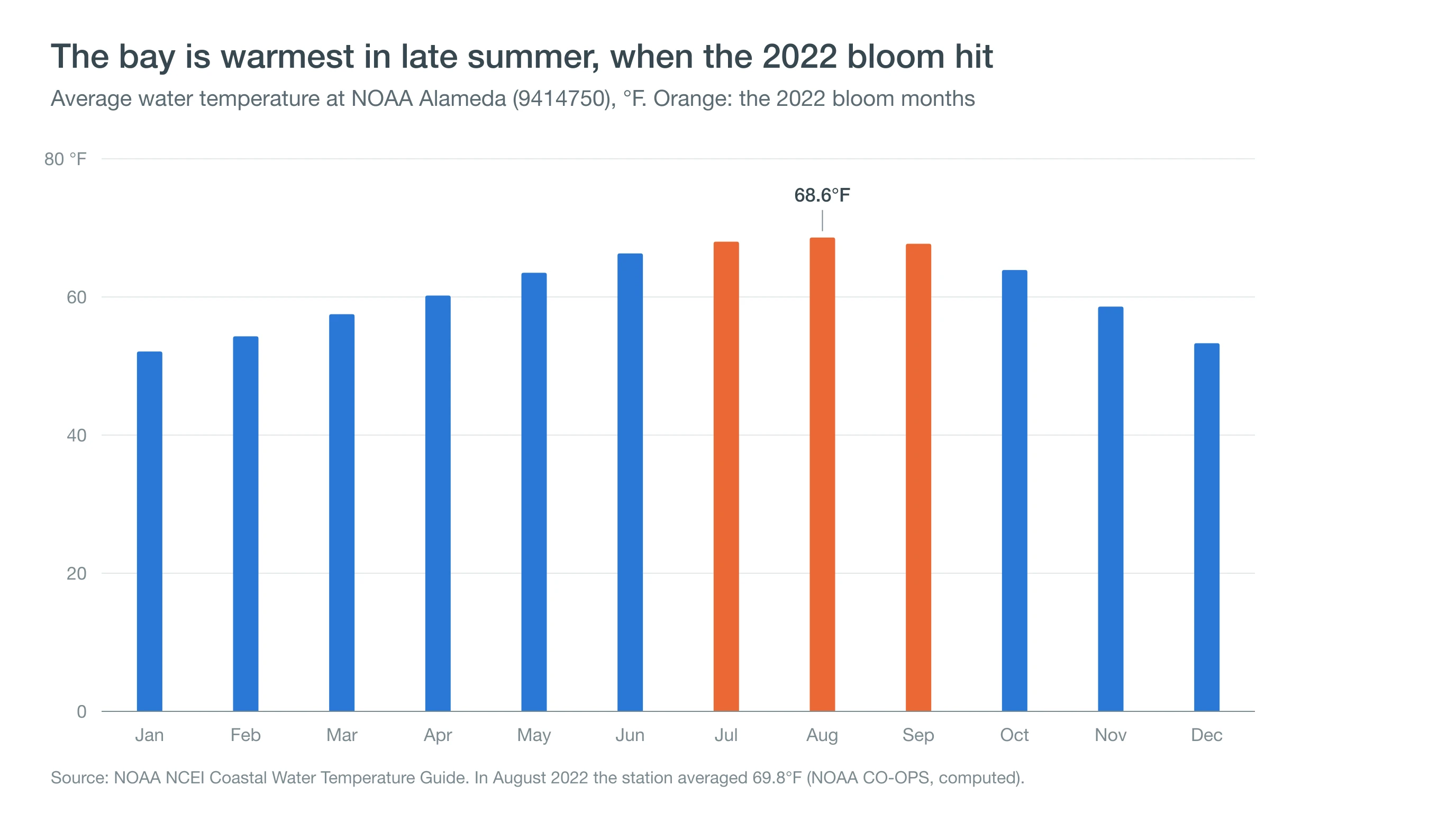
Warm water alone doesn't explain it, and the records show why. Alameda's water averaged 69.0°F in August 2021, 68.9°F in August 2024 and 69.8°F in August 2025, about the same as in 2022, and none of those summers produced a bloom on the scale of 2022.
| August | Average water temperature | Bloom |
|---|---|---|
| 2021 | 69.0°F | No bay-wide bloom on the 2022 scale |
| 2022 | 69.8°F | Largest bloom in the bay's recorded history |
| 2024 | 68.9°F | No bay-wide bloom on the 2022 scale |
| 2025 | 69.8°F | No bay-wide bloom on the 2022 scale |
Monthly means of hourly readings at NOAA CO-OPS station 9414750 (Alameda), computed by SFBayWeather. August 2023 data were not available.
Something else had to line up in 2022. The bay carries high levels of nutrients, and scientists with SFEI and the U.S. Geological Survey, funded by NOAA, studied why this alga took off that year; the exact trigger is still being researched. Bay blooms are only one kind, though; the ocean outside the Golden Gate has its own.
How Are Bay Blooms Different From Ocean Red Tides?
Ocean blooms are often a different alga, Pseudo-nitzschia, which makes domoic acid, a toxin that builds up in crab and shellfish. Those blooms close fisheries rather than fill the bay with dead fish; see why crab season gets delayed.
The biggest ocean example came in 2015, when unusually warm water helped fuel the largest domoic acid outbreak ever recorded on the West Coast, closing crab and shellfish fisheries for months. Unlike the 2022 bay bloom, domoic acid can sicken people who eat contaminated seafood, which is why the state tests crab and the California Department of Public Health issues shellfish advisories.
Some blooms are a spectacle instead: the plankton that light up Tomales Bay at night can tint the water red by day. Whatever the type, the reader's question is the same: is the water safe?
What About Algae in Bay Area Lakes and Reservoirs?
Algae in lakes and reservoirs is a separate problem from bay red tides. Freshwater harmful algal blooms, often cyanobacteria, can form in still, warm water, and the state tracks them on the same California Harmful Algal Blooms Portal it uses for estuary blooms.
The portal warns that harmful blooms can pose a health risk to people and animals and can produce toxins, odors, scums or mats. Dogs are especially at risk because they swim in and drink from lakes, so keep them out of water that looks scummy, discolored or posted with a warning, and follow any local water district or park advisory.
Is It Safe to Swim, Fish or Let Dogs in the Water During a Bloom?
Stay out of red-brown water during a bloom. The San Francisco Bay Regional Water Quality Control Board said the 2022 alga was not toxic to people but could irritate skin and eyes. Keep dogs out of discolored water, and don't collect or eat fish found dead.
Follow official advisories before swimming or fishing in the bay.
Deep Dive: Why Doesn't the Bay Bloom Every Summer?
San Francisco Bay rarely produces a summer bloom like 2022's, even though it carries nutrient levels that would fuel severe algal growth in many estuaries. Research led by USGS scientist James Cloern explained why: strong tidal mixing, light limitation from muddy water and heavy grazing by clams together keep algae in check.
What Decides Whether a Bloom Happens?
A bloom is a simple budget. Algae accumulate only when their growth outpaces losses from grazing, sinking, mixing and flushing. In the bay, light caps growth: suspended sediment keeps the water murky, and strong tides stir cells down into the dark for much of each day. On the loss side, filter-feeding clams graze through large volumes of bay water.
Tides add a two-week rhythm. USGS studies of South Bay spring blooms from 1980 to 1990 found that algae built up during neap tides, when weaker currents let the water stratify and keep cells in the sunlit surface layer, and declined during spring tides, when stronger currents mixed the water column again.
Why Might Heterosigma Have an Edge?
Heterosigma akashiwo is a raphidophyte, neither a dinoflagellate nor a diatom, and it swims with two flagella. Studies show it migrates vertically, rising toward light and sinking toward nutrients, an advantage in calm, stratified water that passive drifters lack. Researchers have also found that the alga can sense turbulence and switch its swimming direction in response.
The bay's resistance has also weakened since the late 1990s. Researchers have documented rising algal biomass, an unprecedented autumn bloom in 1999, a red tide in 2004 and new harmful species. Scientists still don't know exactly what set off the 2022 event, but the budget explains why warm water alone wasn't enough: growth had to outrun the losses for weeks.
Why Do Fish Die as a Bloom Ends?
Fish kills often peak as a bloom collapses. Dead algae feed bacteria, and bacterial respiration consumes dissolved oxygen faster than the water can replace it, especially in warm, stagnant shallows. The 2022 oxygen lows came at the end of August, as the bloom was dying back. Heterosigma may also harm gills directly, though researchers have not settled the mechanism.
Because the trigger is still uncertain, the last step is making sure the next bloom gets noticed fast.
How Do You Check for or Report a Bloom?
You can check for and report blooms on the California Harmful Algal Blooms Portal, which maps reported blooms and has an online form for new reports. Fish kills can also be reported to the San Francisco Bay Regional Water Quality Control Board.
The San Francisco Estuary Institute runs a monitoring program for nutrients and harmful algae in the bay, and its updates are a good place to follow a developing bloom. Useful details for any report are the location, the time, a photo of the water and of any dead fish, and the water's color.
The 2022 bloom showed how fast a bay bloom spreads, and the public filed more than 200 fish-death reports that helped scientists track it. In late summer, check the state map before swimming or kayaking, and see the Lake Merritt page for conditions. For how warm the bay gets month by month, see Bay Area water temperatures, and for East Bay weather, Oakland weather.