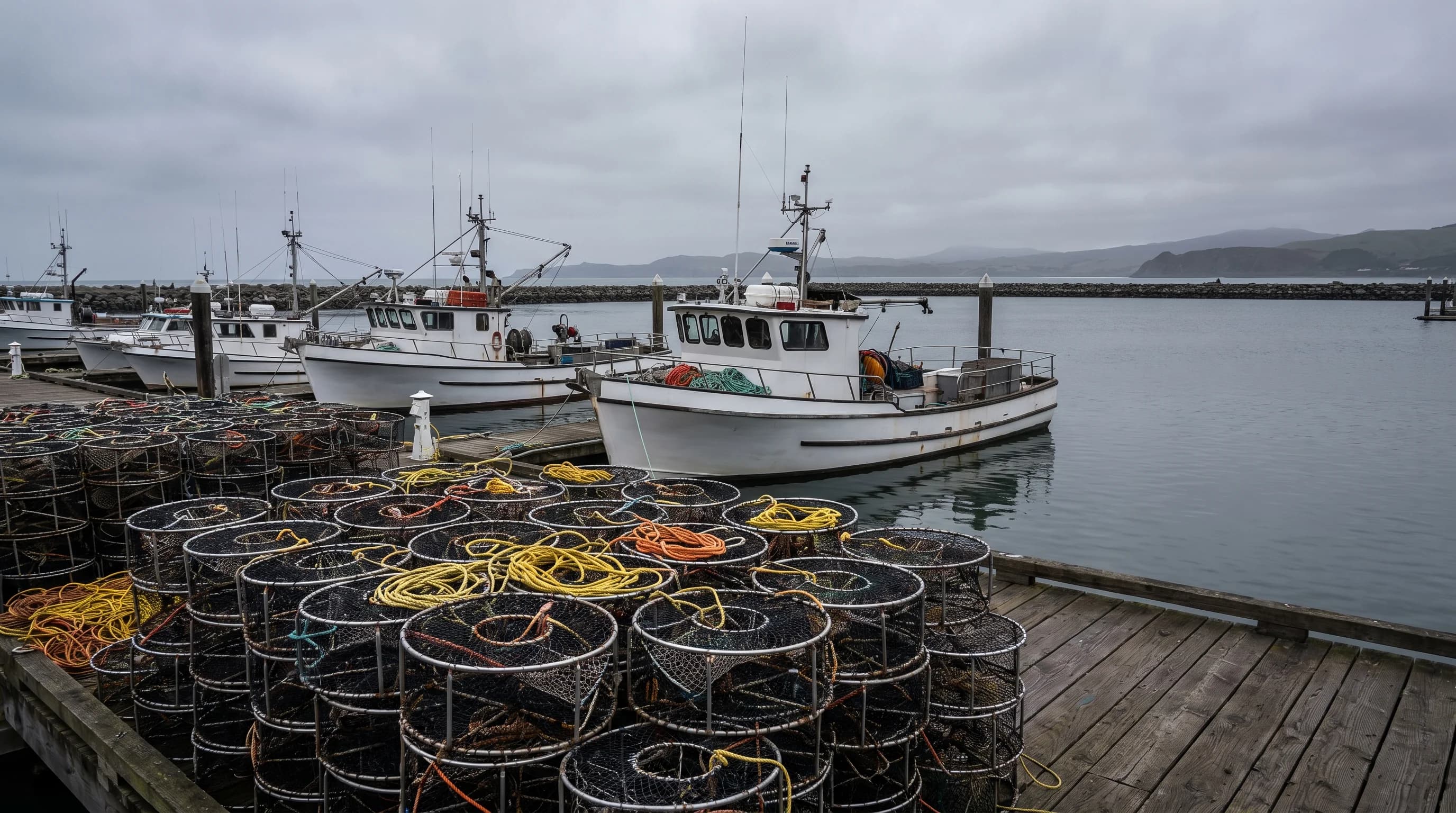
The Bay Area's commercial Dungeness crab season is scheduled for November 15, but state regulators delay it when crab carry high levels of domoic acid from toxic algae or when humpback whales are close to shore, where they can tangle in crab gear. Both depend on the ocean. In 2025-26, the Bay Area opener moved to January 5, 2026.
The worst year shows how far the ocean can push it: in 2015-16, the season opened March 26, more than four months late, after the largest toxic algae outbreak ever recorded on the West Coast. The ocean, not the calendar, sets the opener.
When Is Dungeness Crab Season Supposed to Start?
The commercial Dungeness crab season in the Bay Area is supposed to start November 15. In recent years it has been postponed again and again: by November 2024, the season had been delayed multiple times for six years in a row. Recreational crabbing has its own rules, so check the California Department of Fish and Wildlife before you set a trap.
The delays come from two ocean signals: toxic algae and whales. The first made headlines in 2015.
How Did Toxic Algae Shut Down the 2015-16 Season?
Toxic algae shut down the 2015-16 season by loading crab with domoic acid, a toxin made by a microscopic diatom, Pseudo-nitzschia, that builds up in shellfish and crab. The state tests crab before each season opens, and in 2015 the levels were too high to allow fishing.
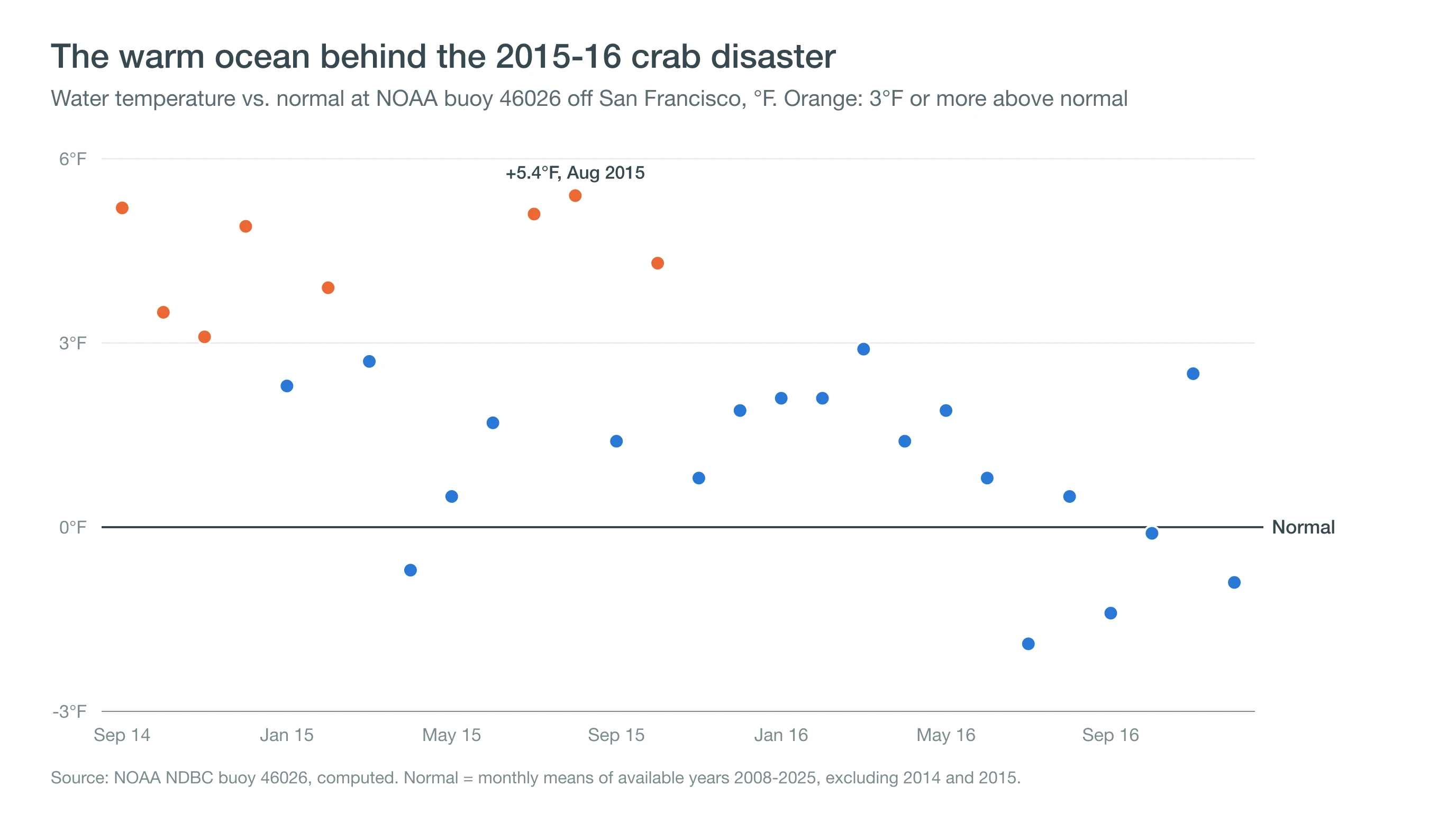
The spring of 2015 brought the largest domoic acid outbreak ever recorded on the North American west coast, and NOAA scientists traced it to unusually warm ocean water, the marine heat wave nicknamed the Blob. Our analysis of buoy data shows the warmth off San Francisco: NOAA buoy 46026 ran 5.1°F above normal in July 2015 and 5.4°F above normal in August.
NOAA scientists described how the outbreak unfolded. The warm, nutrient-poor water let Pseudo-nitzschia thrive farther north than usual, the spring shift to upwelling supplied nutrients, and spring storms pushed the bloom toward the coast. By mid-May 2015, domoic acid in Monterey Bay ran 10 to 30 times higher than levels considered high for a normal bloom.
The toxin turned up in stranded marine mammals, and the bloom led to long, widespread closures of razor clam, rock crab and Dungeness crab fisheries along the coast.
The commercial fishery south of the Sonoma-Mendocino county line, including the Bay Area, finally opened on March 26, 2016. For how warm the water normally gets, see Bay Area ocean water temperatures. Since then, the more frequent cause has been in the water too, but it breathes air.
Is Crab Safe to Eat When Domoic Acid Is High?
Crab can be unsafe when domoic acid is high, which is why the state tests crab before a season opens and the California Department of Public Health issues advisories. The toxin builds up mostly in the crab's internal organs, called the viscera or "crab butter," and CDPH warns that cooking does not destroy or reduce it.
Domoic acid causes amnesic shellfish poisoning. CDPH says symptoms can begin 30 minutes to 24 hours after eating toxic seafood, starting with vomiting, diarrhea, cramps, headache and dizziness in mild cases. Severe cases can bring confusion, trouble breathing, seizures, permanent loss of short-term memory, coma or death.
When a CDPH advisory is in effect, follow it exactly, including any warning against eating the viscera. Crab sold through a legally open commercial fishery has come from areas cleared by state testing.
Why Do Humpback Whales Delay the Season Now?
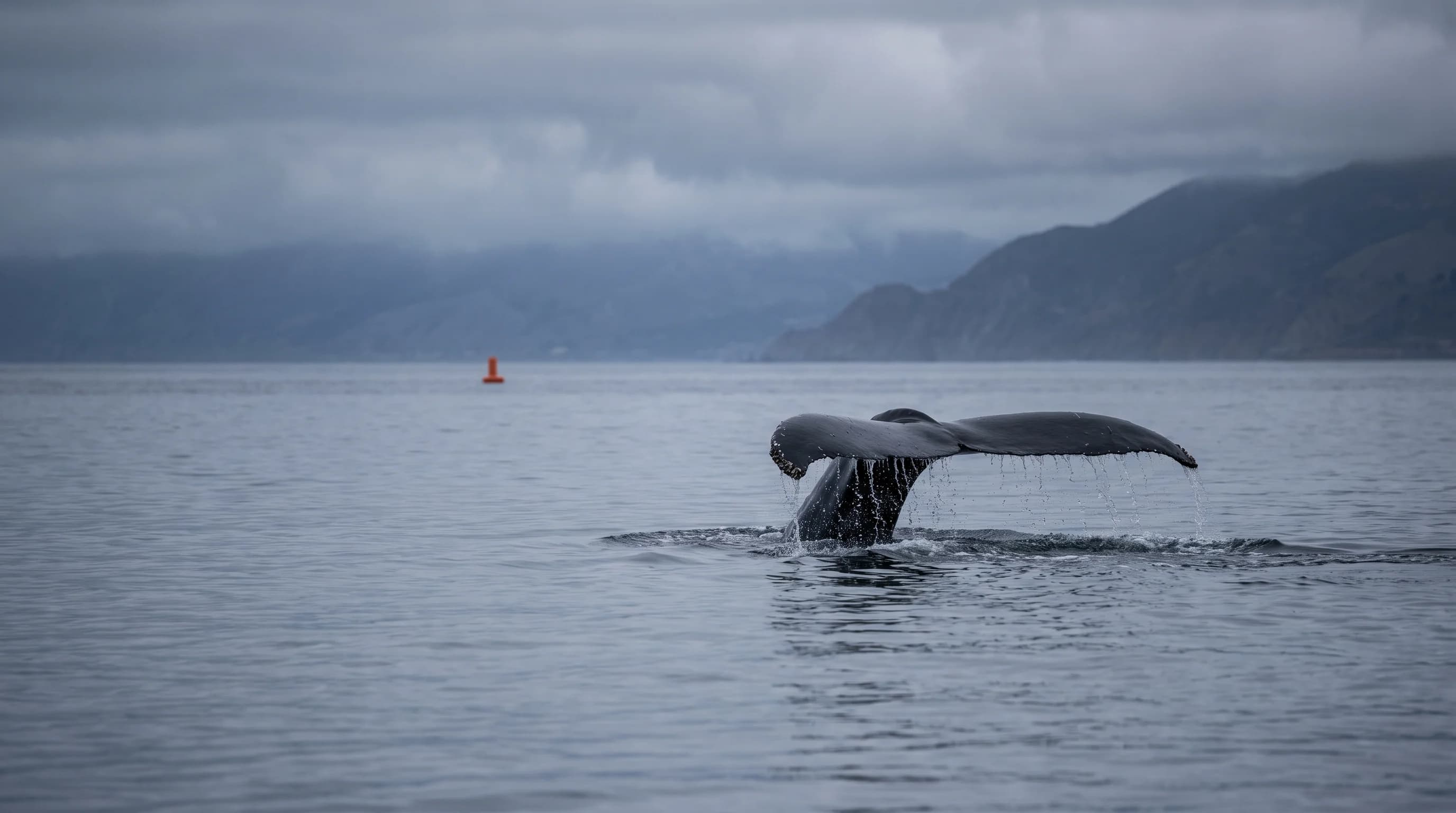
Humpback whales delay the season because they are still migrating along the coast in late fall, when crab traps and their buoy lines go into the water. The California Department of Fish and Wildlife delays the opener or limits traps until enough whales have moved on. Entanglements once killed as many as 20 of the protected whales in a season.
In 2025-26, the Bay Area season opened January 5 with 40% fewer traps than usual. For when and where whales pass the coast, see whale-watching weather. How the state weighs that risk is set out in a formal program.
How Does the State Decide When Whales Are Too Close?
The state decides through a program called the Risk Assessment and Mitigation Program, or RAMP, which has governed the commercial Dungeness crab fishery since 2020. It grew out of a working group of fishermen, scientists and regulators that the California Department of Fish and Wildlife formed in 2015, after entanglements began killing and injuring endangered whales.
Under RAMP, the department surveys for humpback whales and leatherback sea turtles and weighs the risk of entanglement in each fishing zone. Its tools range from delaying the opener and cutting the number of traps to keeping boats in shallower water, restricting recreational crab traps, and closing areas early. Confirmed entanglements count too, and they can trigger new restrictions within a season.
RAMP is why openers now arrive in steps, often with trap limits, rather than all at once on November 15. The record of recent seasons shows the pattern.
What Have Recent Crab Openers Looked Like?
Recent Bay Area crab openers have come between late December and mid-January, all under trap limits to protect whales. Northern California zones can stay closed longer when crab there test high for domoic acid, as they did until January 15 in 2025-26.
| Season | Bay Area opener | Main reason for the delay |
|---|---|---|
| 2015-16 | March 26, 2016 | Domoic acid from the 2015 toxic algae bloom |
| 2022-23 | December 31, 2022 | Humpback whales; half the usual traps |
| 2023-24 | January 18, 2024 | Humpback whales; half the usual traps |
| 2024-25 | January 5, 2025 | Humpback whales; half the usual traps |
| 2025-26 | January 5, 2026 | Humpback whales; 40% fewer traps |
Scheduled opener: November 15. Openers for the Central Management Area (south of the Sonoma-Mendocino county line) from CDFW announcements and news reports: California Legislature 2015-16 timeline; CBS (2022); CDFW (2024); ABC7 (2024, 2025).
Will There Be Local Crab for Thanksgiving and Christmas?
Recent seasons suggest you shouldn't count on local commercial crab for the holidays. In each of the last four seasons, the Bay Area commercial opener came after Christmas: December 31 in 2022, January 18 in 2024, and January 5 in both 2025 and 2026.
The traditional November 15 start once put local Dungeness crab on Thanksgiving and Christmas tables, which is why delays make headlines every fall. When the local season is closed, any Dungeness crab you find was caught somewhere else or earlier, so ask where it came from if local matters to you.
A late opener doesn't mean a short season: the commercial season runs into spring unless the state closes it early to protect whales.
Deep Dive: How Does Domoic Acid Get Into Crab and Into People?
Domoic acid moves up the food chain from a microscopic diatom to the crab to the person who eats it. Each step involves different biology, and each one explains a rule in how California manages the fishery.
Why Do Diatoms Make the Toxin?
Diatoms in the genus Pseudo-nitzschia are common, chain-forming phytoplankton with glassy silica shells. Only some species make domoic acid, and laboratory studies show that toxic species often produce more of it when they are stressed, for example when silicate or phosphate runs short late in a bloom. A bloom can become more dangerous as it ages, not less.
Why Does It Build Up in Crab?
Filter feeders such as mussels and clams take in the diatoms directly, and Dungeness crab eat clams and other small prey that have fed on the bloom. The crab itself is not harmed, and the toxin concentrates in its viscera rather than its meat. Crab clear the toxin slowly once a bloom ends, which is why a season can stay closed for weeks or months after the water looks normal again.
California's testing reflects that biology. Under CDPH rules, crab viscera above 30 parts per million fails, each sample set includes six crab tested individually, and a closed area reopens only after crab from two consecutive sample sets, taken at least seven days apart, all pass. In effect, the rule requires a sustained pass, not one clean sample.
What Does Domoic Acid Do to the Brain?
Domoic acid is a structural mimic of glutamate, the brain's main excitatory messenger. The toxin binds to glutamate receptors, especially the kainate and AMPA types, and overstimulates neurons until they are damaged or die, a process called excitotoxicity. The hippocampus, central to forming new memories, is especially vulnerable, which is why severe poisoning can cause permanent short-term memory loss.
Amnesic shellfish poisoning was first identified after a 1987 outbreak in eastern Canada linked to cultivated mussels from Prince Edward Island. California sea lions suffer the same kind of brain damage after toxic blooms, and stranded sea lions are often an early sign along the coast that a bloom has turned toxic. For crab lovers, the practical question every November is still when.
How Can You Tell When Crab Season Will Open?
You can tell when crab season will open by following the California Department of Fish and Wildlife's Dungeness crab announcements, which report whale surveys and the next decision date. For whether crab is safe to eat, follow the California Department of Public Health's crab and shellfish advisories.
The calendar says November 15; the ocean has the final say. Bay blooms are a separate problem from these ocean toxins; see red tide in San Francisco Bay and how El Niño warms the coast. For a day at the harbor when the boats come in, check the Half Moon Bay forecast for wind and swell, and see Half Moon Bay weather.