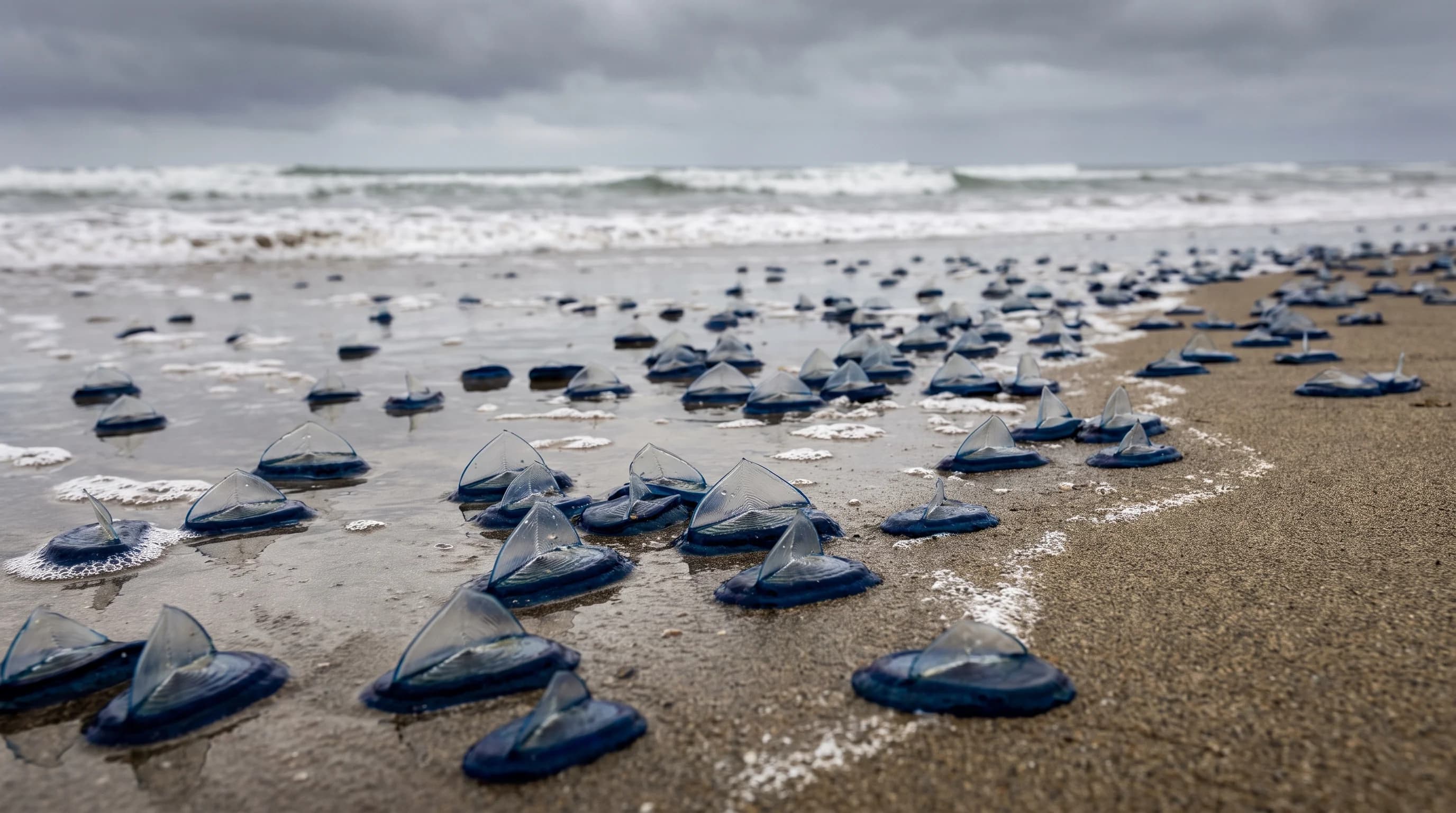
By-the-wind sailors (Velella velella) are small blue ocean drifters, related to jellyfish, with a stiff sail that catches the wind. When spring winds shift onshore, they strand on Bay Area beaches in huge numbers. Their tentacles carry a mild sting, so look but don't handle live ones, and keep dogs away.
In late April 2026, beaches from Bodega Bay to Pescadero looked blue from a distance. These animals live far offshore and can't swim, so the wind decides where they go.
What Are the Blue Creatures on Bay Area Beaches?
The blue creatures are by-the-wind sailors, colonies of hydrozoans that are relatives of jellyfish and sea anemones. Each has a gas-filled blue float, short tentacles underneath to catch plankton, and a clear sail on top that catches the wind. They are not true jellyfish, and they are far milder than the Portuguese man o' war.
| What are they? | Velella velella, colonies of tiny animals related to jellyfish |
|---|---|
| What do they look like? | A small blue float with a clear, stiff sail on top |
| Where do they live? | Floating on the surface of the open ocean |
| When do they strand here? | Mostly in spring, when winds turn onshore |
| Do they sting? | Live ones have a mild sting; dried ones pose little risk |
| What should I do? | Look, don't handle live ones, and keep dogs away |
Sources: KQED (April 2026), National Park Service Point Reyes. Health questions about stings should go to a doctor or veterinarian.
How Big Are By-the-Wind Sailors, and What Do They Eat?
By-the-wind sailors are about three to four inches long, with a flexible triangular sail about two inches high, according to the National Park Service at Point Reyes. They are bluish to purple, and the color helps them blend into the open ocean from above.
By-the-wind sailors live on the surface far offshore and feed on tiny drifting animals, mainly copepods, which their short tentacles catch as they sail. When they strand and dry out, they turn brittle and transparent, and the Park Service compares the empty floats to cellophane candy wrappers.
Each "individual" is really a colony of specialized parts working together, which is why scientists group them with other hydrozoans rather than with true jellyfish. They have no way to swim. Everything depends on that small sail.
How Does a By-the-Wind Sailor's Sail Steer It?
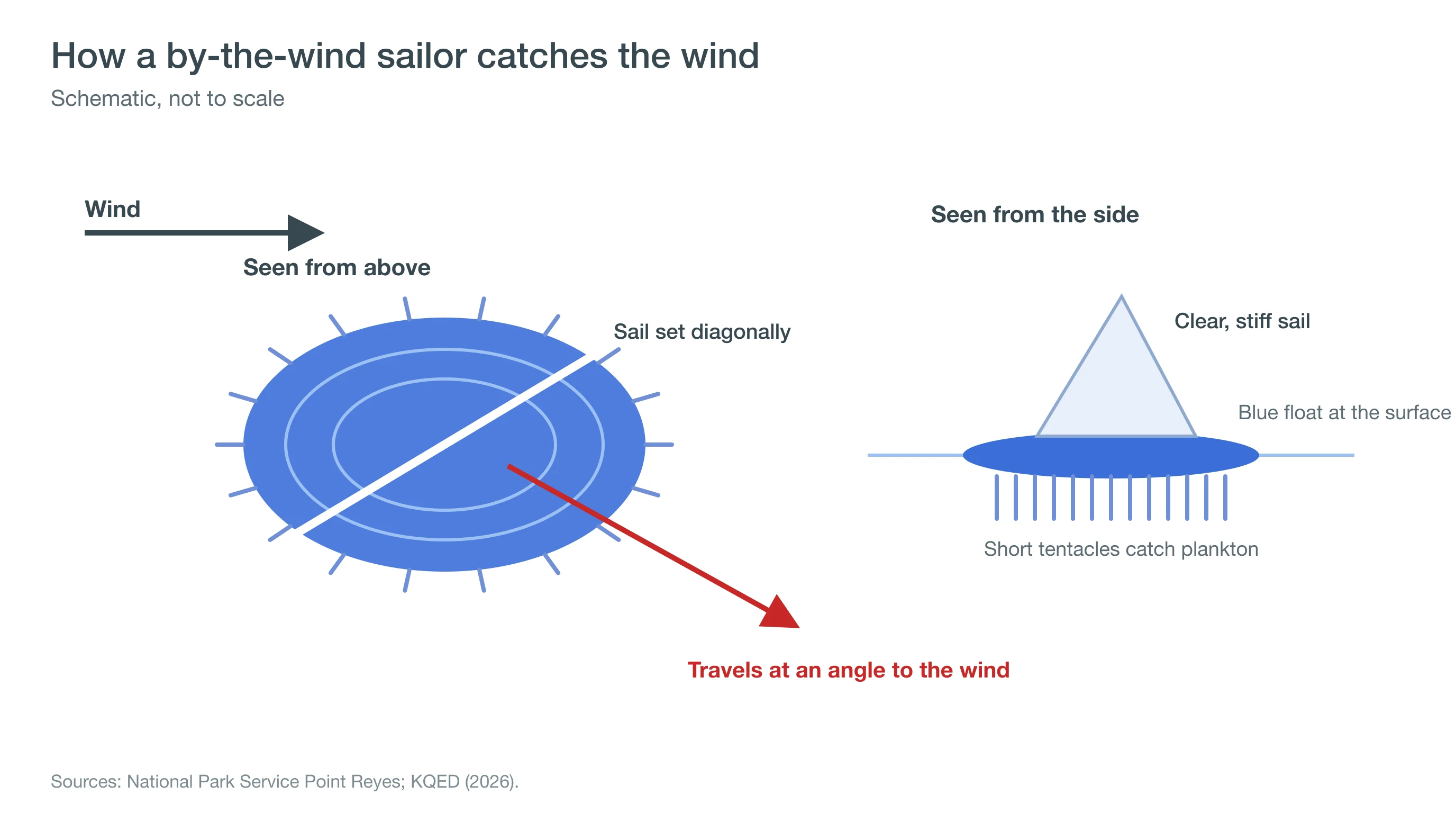
A by-the-wind sailor's sail sits diagonally across its float, so the wind pushes it at an angle rather than straight downwind. The National Park Service notes that some sails angle to the left and send the animal left of downwind, while others angle to the right.
The wind direction decides where a whole fleet ends up. A steady northwest wind pushes by-the-wind sailors roughly parallel to the Bay Area coast, so most stay at sea.
When the wind swings around to blow from the southwest or west, it pushes them toward the beach instead, and they arrive in crowds because they drift together.
Most of the year, that sail keeps them offshore. In spring, both the wind and their numbers change.
Why Do They Wash Ashore in Spring?
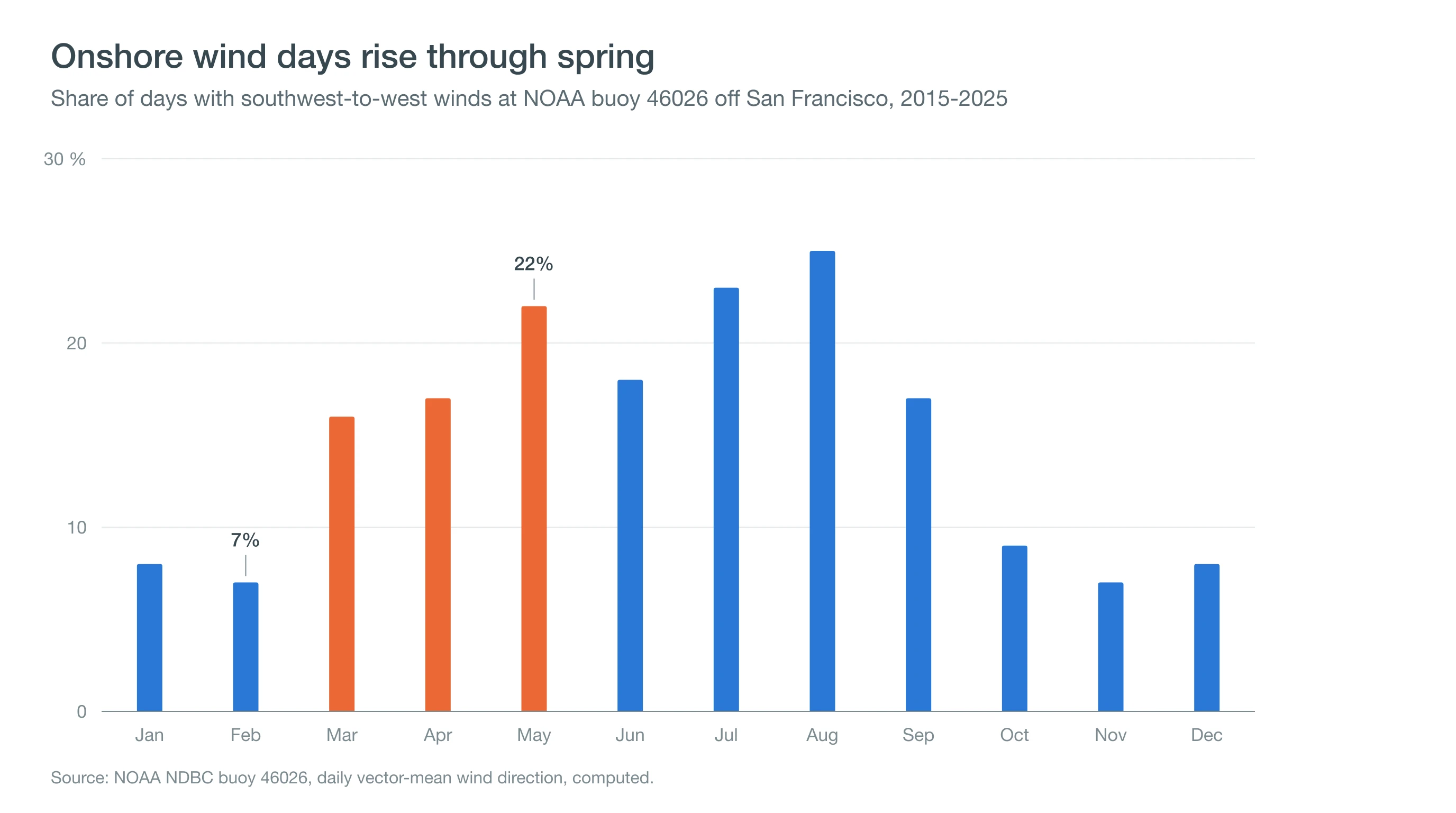
By-the-wind sailors wash ashore in spring because two things change at once. Spring upwelling feeds the plankton they eat, so more of them gather near the coast, and the wind starts to blow onshore more often. Our analysis of NOAA buoy 46026 off San Francisco found that days with winds from the southwest or west rose from 7% in February to 22% in May from 2015 to 2025.
| Month | Onshore days (southwest to west) | Typical days (west-northwest to north-northwest) |
|---|---|---|
| January | 8% | 33% |
| February | 7% | 65% |
| March | 16% | 57% |
| April | 17% | 71% |
| May | 22% | 70% |
| June | 18% | 68% |
| July | 23% | 62% |
| August | 25% | 59% |
| September | 17% | 70% |
| October | 9% | 69% |
| November | 7% | 55% |
| December | 8% | 32% |
Share of days by daily vector-mean wind direction at NOAA NDBC buoy 46026, 2015-2025, computed by SFBayWeather. The rest of the days had winds from other directions.
Big strandings come when a large fleet near the coast meets a stretch of onshore wind. The Park Service says they wash ashore in spring or early summer, typically when the prevailing winds shift, such as during a storm.
Strandings need more than one onshore day; they need a stretch of them. Our analysis found 14 runs of three or more straight onshore days that began in March, April or May from 2015 to 2025, compared with 3 that began in December, January or February.
Onshore wind days actually peak in late summer, at 25% of August days, which is a reminder that wind is only half the story. The animals also have to be gathered near the coast, and the Park Service and KQED both point to spring and early summer as the time that happens. For why spring winds change, see spring winds and the North Pacific High and how ocean currents shape the coast. Where they land depends on which way each beach faces.
Where Do They Land in the Bay Area?
By-the-wind sailors land mostly on beaches that face the open ocean, but they can drift inside the Golden Gate too. In April 2026 they were reported at Baker Beach, Crissy Field and Ocean Beach in San Francisco, and in Santa Cruz, Pescadero and Bodega Bay.
If you want to see them, timing beats location. Watch for a few days in a row of southwest or west wind in spring or early summer, then walk a west-facing beach at low tide, when the tideline is widest. Strandings can be uneven, so walk the length of the beach rather than judging it from the parking lot.
Local outlets such as KQED have covered recent strandings, so watch for reports in spring. Because strandings last days to weeks, there is often still time to see one after the first reports appear. Once a fleet is on the sand, the questions turn to safety.
Do By-the-Wind Sailors Sting People or Pets?
By-the-wind sailors can sting, but mildly. Their blue tentacles carry stinging cells, and the National Park Service says they are rarely harmful to humans. Reactions vary from person to person, and sensitive skin, the face and the eyes are another matter, so it is best not to handle live ones at all.
Pets are the bigger concern. KQED reported that a dog putting one in its mouth could get hurt, and a beach full of strange, salty objects is irresistible to many dogs. Keep dogs leashed near the tideline while a stranding is underway, and wash your hands after picking up even a dried float.
Deep Dive: How Does a By-the-Wind Sailor Live?
A by-the-wind sailor, Velella velella, is a hydrozoan in the family Porpitidae, built for a life spent entirely where air meets sea. Biologists call organisms that float partly above the surface pleuston, and almost every feature of Velella is an adaptation to that boundary.
How Is the Body Built?
The float is a flattened disc of concentric, gas-filled chambers made of chitin, with the stiff sail rising diagonally across it. Hanging below is a single large feeding polyp at the center, surrounded by rings of reproductive polyps and, at the edge, the short tentacles armed with stinging cells. Biologists have long debated whether Velella is a colony of many individuals or one highly modified polyp, and the National Park Service still describes it as a colony.
The tissues also hold symbiotic algae, a dinoflagellate that researchers have described as Scrippsiella velellae, though how much the algae feed their host is still uncertain. The reproductive polyps bud off tiny medusae, which carry the next generation away from the float.
How Does the Sail Work?
The sail works like a rigid wing locked in place. Because it sits at an angle to the long axis of the float, wind striking it produces a sideways force as well as drag, so the animal moves at an angle to the wind rather than straight downwind. Mirror-image forms exist, with sails set to the left or the right, and the same wind sends each form on a different track.
The wind also moves the water beneath them. Along the California coast, steady northwest winds push surface water offshore through Ekman transport, the tendency of wind-driven surface water in the Northern Hemisphere to move to the right of the wind. That offshore transport fuels the spring upwelling that feeds the copepods Velella eats, and when the winds relax or turn southwesterly, both the water and the fleet can drift shoreward.
What Eats By-the-Wind Sailors?
Several predators target floating hydrozoans. Violet snails in the genus Janthina raft on bubble floats and feed on them, the nudibranch Fiona pinnata has been observed eating one in about an hour, and ocean sunfish eat them too. Once a fleet reaches the sand, though, the biology gives way to a few practical choices.
What Should You Do When You Find Them?
When you find by-the-wind sailors, look closely but leave live ones where they are. Crouch near a fresh one and you can see the blue float, the clear sail set at an angle and the short fringe of tentacles underneath.
A stranding is worth recording. Photograph a few animals with a coin or key for scale, note the beach and the date, and log the sighting on a community science app such as iNaturalist. Mass strandings come and go with the wind, so a dated photo helps show which springs brought the big fleets.
Strandings usually last days to weeks. The animals dry out on the sand and leave clear, papery floats behind, and no cleanup is needed. The wind brought them, and the tides will take them away.
After a spring wind shift, check the Baker Beach forecast for onshore southwest or west winds. If you find a fleet on the sand, photograph it, leave it, and keep your dog leashed. On the same beaches, watch the water for sneaker waves.