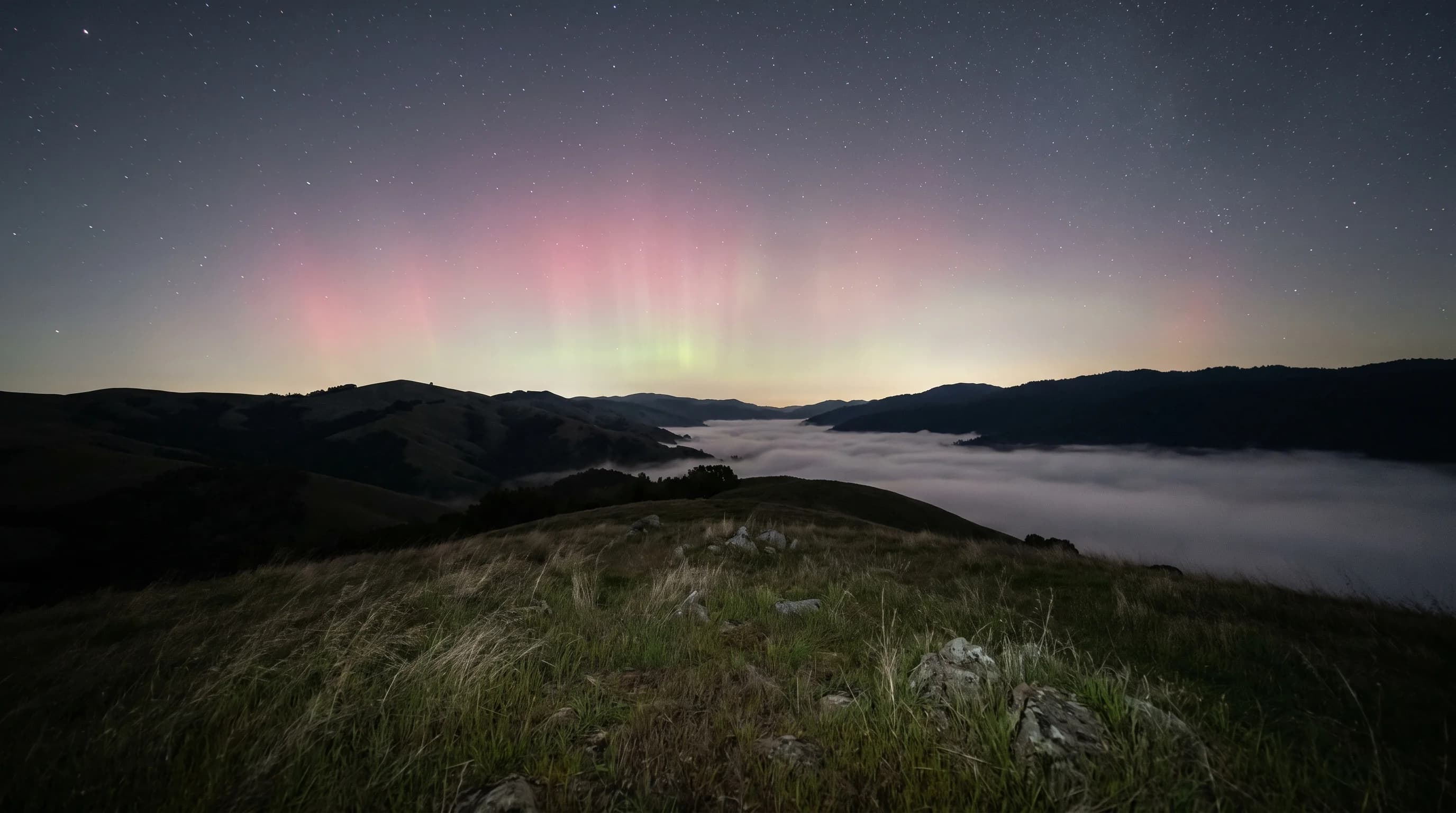
You can see the northern lights from the Bay Area only during rare, severe geomagnetic storms, like the G5 storm of May 10, 2024 and the G4 storm of October 10, 2024. Look low on the northern horizon from a dark, clear spot away from the coast; inland nights are clear far more often than foggy coastal ones.
On the night of May 10, 2024, the aurora glowed pink over the Bay Bridge. In October, people in Marin saw it again while much of San Francisco sat under fog. Two gates have to open: the sun has to send a big storm, and the fog has to stay away.
Can You See the Northern Lights From the Bay Area?
Yes, you can see the northern lights from the Bay Area, but only during rare, strong geomagnetic storms. Even then, the aurora is usually a low glow on the northern horizon, not curtains overhead. The first gate is a storm strong enough to push it this far south.
How Strong Does a Storm Need to Be?
Both recent Bay Area sightings came during severe or extreme storms on NOAA's geomagnetic storm scale. The May 10-11, 2024 storm reached G5, the top of the scale and the first G5 since October 2003, and the October 10, 2024 storm reached G4.
NOAA rates geomagnetic storms from G1 to G5. Its own scale notes that G4 storms have pushed the aurora as far south as northern California, and G5 storms as far as Florida and southern Texas. Storms that strong are rare: NOAA puts them at about 100 G4 storms and 4 G5 storms per 11-year solar cycle.
| NOAA level | Kp index | How often | Aurora has been seen |
|---|---|---|---|
| G4 (Severe) | Kp 8 | About 100 per cycle (60 days) | As far south as Alabama and northern California |
| G5 (Extreme) | Kp 9 | About 4 per cycle (4 days) | As far south as Florida and southern Texas |
Source: NOAA Space Weather Prediction Center, Space Weather Scales. Frequencies are averages per 11-year solar cycle.
Watch the NOAA Space Weather Prediction Center for G4 or G5 watches and warnings. In 2024, that first gate opened twice. The second gate decided who saw it.
Is the Sun Still Active Enough for More Auroras?
The sun is in an active phase. On October 15, 2024, NASA and NOAA announced that the sun had reached the solar maximum period of Solar Cycle 25, the stretch of roughly 11-year cycle when sunspots, flares and storms are most common.
Big storms can still happen on the way down from a maximum, but none can be forecast more than a few days ahead. The practical approach is to know the warning signs and be ready to go on short notice rather than to plan around a date.
What Did 2024 Show About Fog?
In May 2024, people saw the aurora over the Bay Bridge and photographed it from China Camp in San Rafael, Pacifica, Dublin and Milpitas, mostly where city lights were dim. In October 2024, it showed up over Marin and in Pacific Grove, while fog hid it from much of San Francisco.
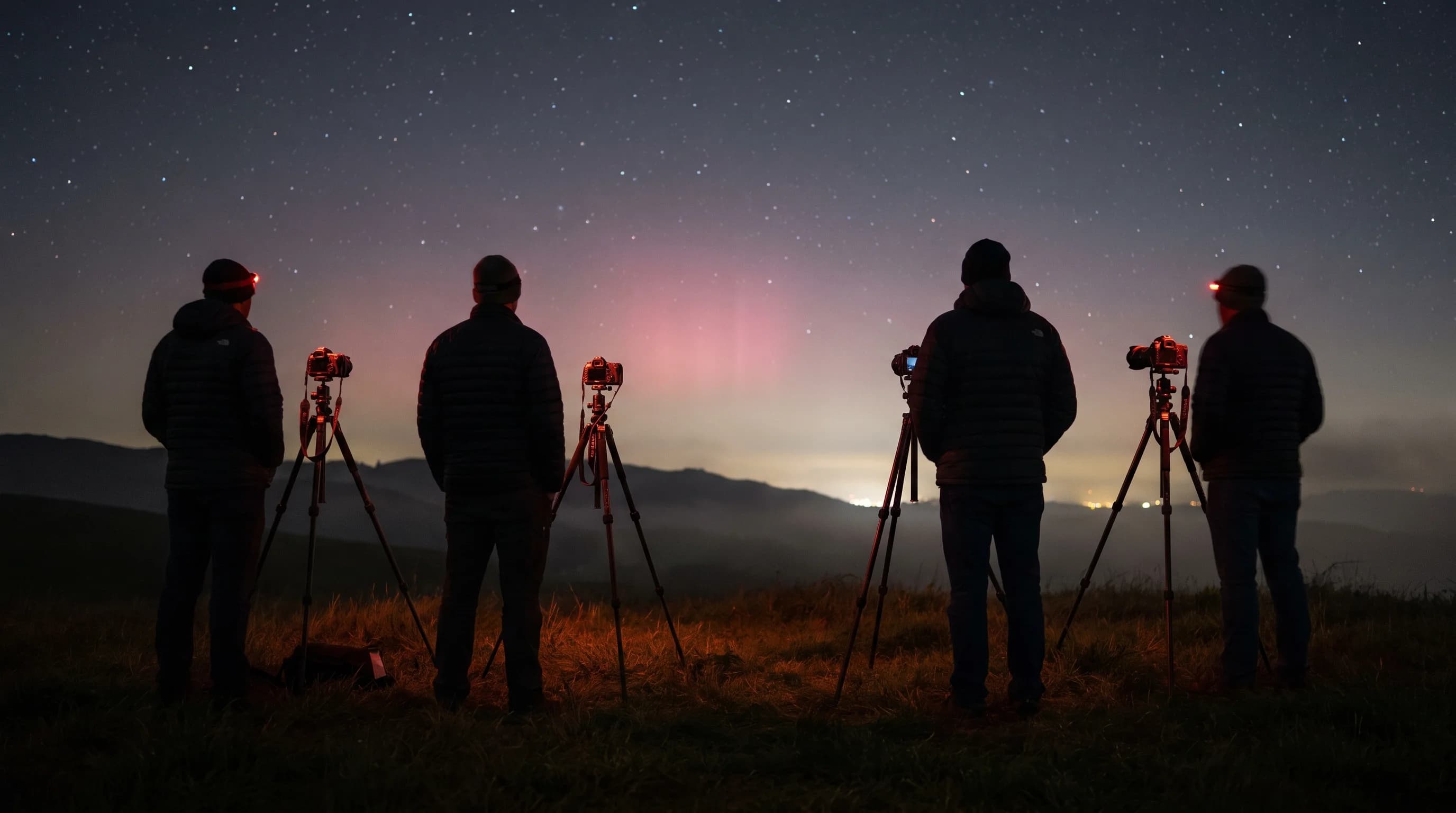
The pattern is not luck. Airport records show where the sky is usually clear at night.
Why Does the Aurora Look Pink and Red From California?
The aurora looks pink and red from California because we see only the top of it. Oxygen high in the atmosphere, around 250 miles up, glows red, while the green light comes from lower down. From a latitude as far south as the Bay Area, the lower green part sits below the northern horizon, so the red upper glow dominates.
Where red and green mix, the sky can look pink, which matches what Bay Area viewers reported in 2024. That color is also faint, which is why cameras often pick it up better than eyes do.
Where Are Bay Area Skies Clearest at Night?
Bay Area skies are clearest at night inland. Our analysis of airport records found that from 2015 to 2025, Livermore's airport reported clear skies from 10 PM to 2 AM on about 86% of July nights, while Half Moon Bay, on the foggy coast, was clear on about 6%. San Francisco International and Santa Rosa fell in between.
The coast and the inland valleys trade places through the year. Summer is the inland valleys' clearest season, when the marine layer stays near the coast and Livermore is clear on most nights. On the coast, summer is the foggiest season, and Half Moon Bay's clearest nights come in winter, between storms. A winter storm can still cover everything, so no spot is a sure bet.
| Station | Winter | Spring | Summer | Fall |
|---|---|---|---|---|
| Livermore | 54-65% | 58-70% | 84-87% | 72-81% |
| Santa Rosa | 54-64% | 56-66% | 56-67% | 65-69% |
| San Francisco International (SFO) | 41-54% | 46-56% | 57-62% | 55-67% |
| Half Moon Bay | 31-35% | 11-20% | 6-15% | 19-36% |
Share of nights when every routine airport report from 10 PM to 2 AM showed no broken, overcast or obscured cloud layer, 2015-2025, computed from ASOS reports via the Iowa Environmental Mesonet. Ranges span the months in each season. An aurora also needs a G4 or G5 storm.
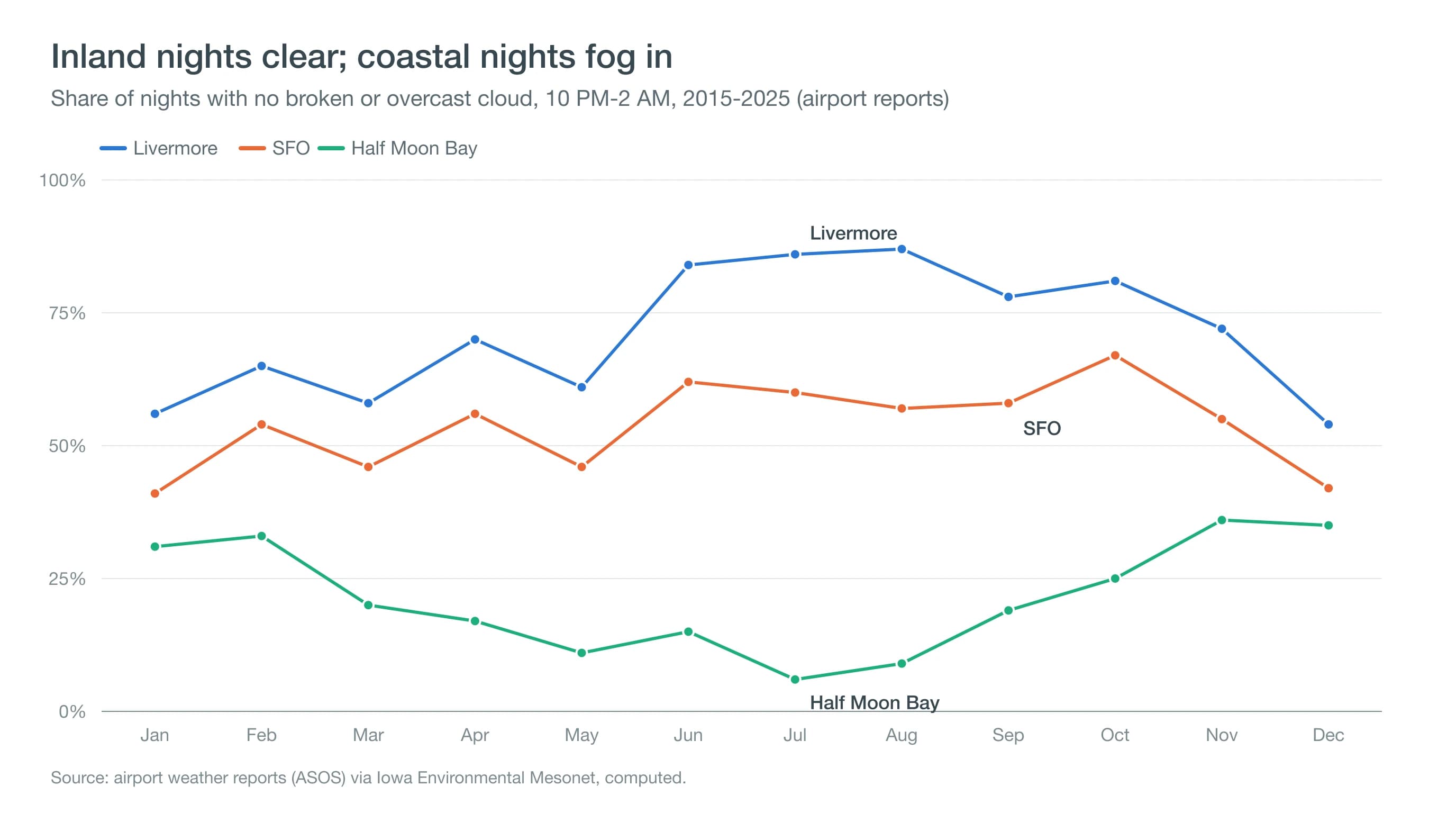
The marine layer is why; see why San Francisco fogs in and why the East Bay is warmer than the coast. Clear skies narrow the map; darkness and a northern view pick the spot.
Where Should You Go to Watch?
Go to a dark spot with a low, open view to the north, inland or above the marine layer. In 2024, people photographed the aurora from China Camp State Park in Marin; ridgetops and open spaces in the East Bay and the summit of Mount Diablo rise above the fog. Check park hours first, since many parks close at sunset.
See Mount Diablo weather and Point Reyes weather for what the night will feel like.
Deep Dive: How Does a Solar Storm Light Up the Sky?
A solar storm lights up the sky by loading energy into Earth's magnetic field and then releasing it as a rain of charged particles into the upper atmosphere. The chain usually starts with a coronal mass ejection, billions of tons of magnetized plasma that can reach Earth in roughly one to three days.
Why Does the Direction of the Magnetic Field Matter?
The direction of the magnetic field inside the cloud matters most. When that field points south, opposite to Earth's field on the side facing the sun, the two fields can reconnect, opening a path for solar wind energy to pour into the magnetosphere. Forecasters track the north-south direction of that field, called Bz, from spacecraft about a million miles upstream, which typically gives 15 to 60 minutes of warning before the cloud arrives.
Energy stored in Earth's magnetic tail is released in bursts called substorms. Electrons accelerated along field lines plunge into the atmosphere in a ring around each magnetic pole called the auroral oval, and in a severe storm the oval expands toward the equator. By our calculation, the Bay Area sits at roughly 43 degrees magnetic latitude, about 5 degrees farther north magnetically than geographically, which helps explain why strong storms can reach it at all.
Why Do the Colors Form at Different Heights?
The colors come from excited oxygen and nitrogen, and altitude decides which can glow. Oxygen's green line at 557.7 nanometers has a radiative lifetime of about 0.7 seconds, short enough to emit between about 100 and 150 kilometers up. Oxygen's red line at 630.0 nanometers takes about 110 seconds, so it survives only in the thin air above about 150 kilometers, where collisions are rare; lower down, a collision steals the energy first. Ionized nitrogen adds blue and violet at the lowest edges.
Geometry does the rest. A glow 300 kilometers up can, in principle, be seen above the horizon from nearly 2,000 kilometers (about 1,200 miles) away, so the red top of an aurora over the Pacific Northwest can appear low in the Bay Area's northern sky. Your eyes add a final filter: in dim light, vision relies on rod cells, which are most sensitive near 500 nanometers and nearly blind to deep red, while a camera sensor records the 630-nanometer glow easily.
None of that physics can be scheduled. When both gates open, a few minutes of preparation make the night.
What Should You Do When an Aurora Alert Goes Out?
When an aurora alert goes out, confirm a G4 or G5 watch or warning with NOAA, check fog and cloud cover, and drive to your dark spot before full dark. Look north, give your eyes time to adjust to the dark, and use your phone or camera on a tripod: NOAA forecasters say a phone's night mode can capture aurora colors the human eye can't see.
A few details make a big difference. Get away from streetlights and city glow, since the aurora seen from the Bay Area is faint and low. A bright moon also washes out faint light, so the same storm can look better on a moonless night. And be patient: storms rise and fade over hours, and the best displays can come in short bursts, so plan to stay a while rather than glance and leave.
For phone photos, turn off the flash, rest the phone on something solid, and let night mode run its longest exposure while pointing at the northern horizon. Check the photo, even if you see little with your eyes; that is how many Bay Area viewers discovered the color in 2024.
The sun opens the door; you just have to beat the fog. When NOAA issues a G4 or G5 watch, check the Bay Area fog forecast for the coast and the Mount Diablo forecast for clear skies inland, then head somewhere dark with a view to the north. For another dark-night trip, see bioluminescence in Tomales Bay.