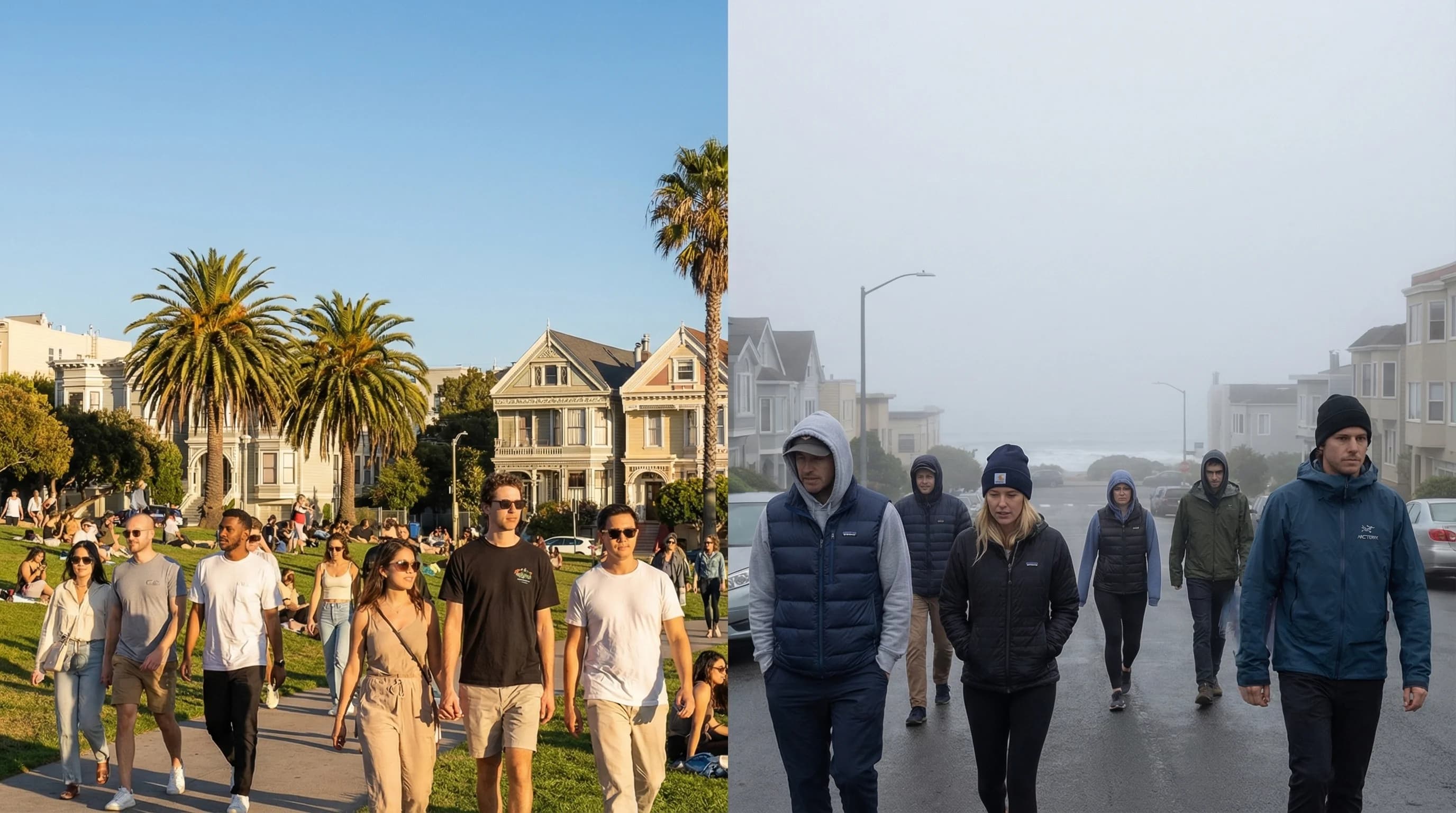
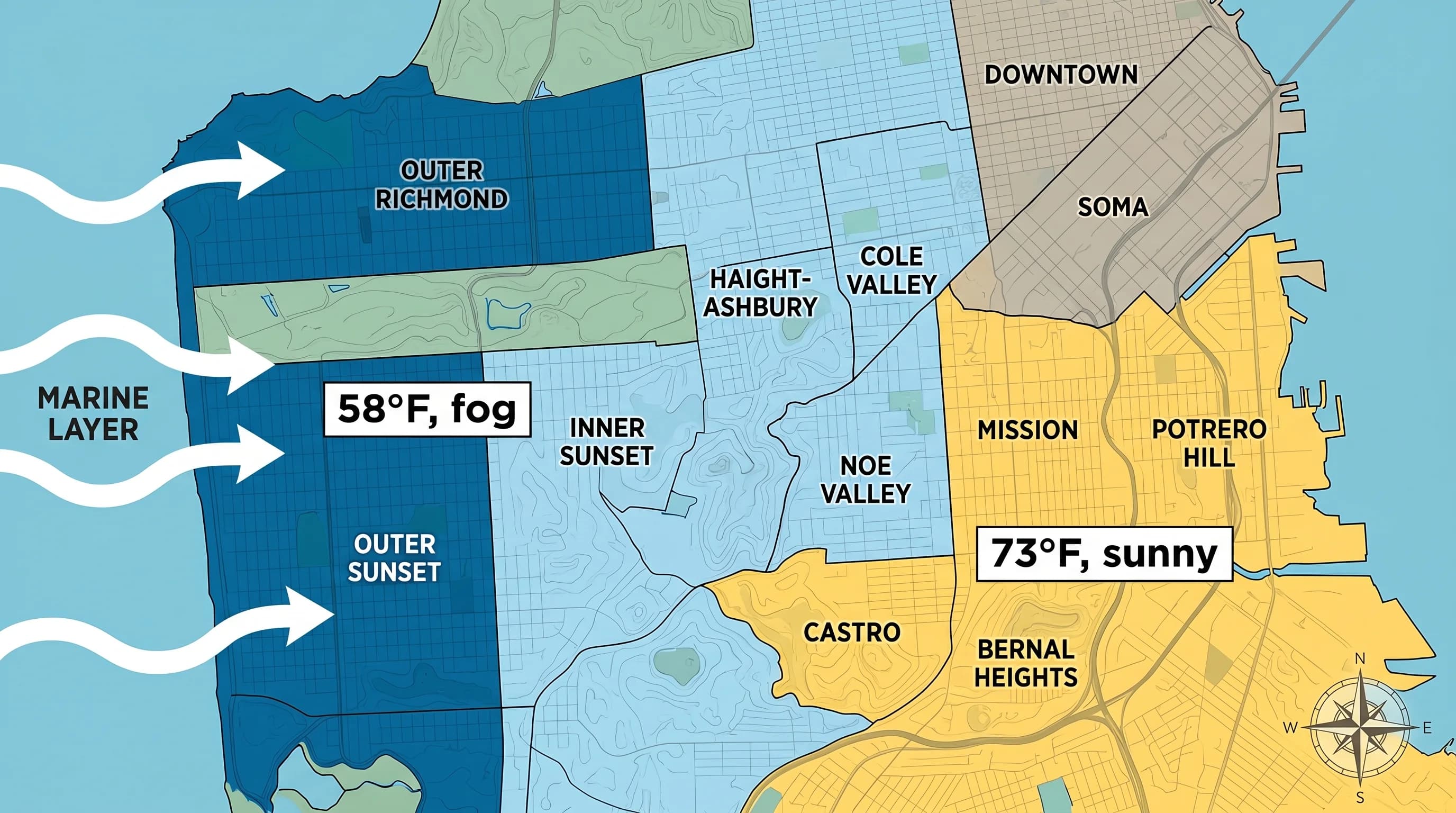
San Francisco microclimates are extreme because the city sits between cold Pacific water, San Francisco Bay, steep hills, and a summer marine layer that enters through the Golden Gate. A forecast for "San Francisco" can be technically correct while still missing the conditions on your block. The Outer Richmond can be 56°F and foggy while SoMa, the East Cut, or the Mission is sunny and ten to twenty degrees warmer.
The pattern is not random. Western neighborhoods face the Pacific directly. Central hills block and redirect fog. Eastern neighborhoods get more sun but also feel the bay breeze. Once you understand the geography, the city's weather becomes much easier to predict neighborhood by neighborhood.
Why San Francisco Has So Many Microclimates
The engine is the summer temperature contrast between the cold Pacific Ocean and hot inland California. Cold water from the California Current chills the air near the coast, while inland valleys heat rapidly. That contrast pulls marine air through the Golden Gate and across the city. The marine layer arrives first in the Sunset and Richmond, then spills through low gaps and around hills toward the eastern side of town.
Twin Peaks, Mount Sutro, Buena Vista, Bernal Heights, Potrero Hill, and the ridgelines around Noe Valley all matter. They do not stop fog completely, but they slow it, split it, and create sharp gradients. That is why the weather by neighborhood can change over just a few blocks.
Outer Richmond, Outer Sunset, and Inner Sunset
The Outer Richmond and Outer Sunset are the city's purest coastal microclimates. They face the Pacific with minimal protection, so summer afternoons are often cold, windy, and gray. Ocean Beach, the Great Highway, and the blocks nearest the water are usually the first places fog arrives and the last places it clears.
The Inner Sunset is still fog-prone, but it sits slightly farther from the ocean and benefits from more shelter near Golden Gate Park and the eastern slope of the city's central high ground. On many summer days, the Inner Sunset clears before the Outer Sunset. The difference can be modest, but it is enough that a walk from 19th Avenue to Ocean Beach can feel like moving from fall into winter.
Noe Valley, Pacific Heights, Cow Hollow, and the Central Hills
Noe Valley is a transition-zone microclimate. It is protected from the strongest ocean wind by Twin Peaks and the western hills, but fog can still spill over on deeper marine layer days. It is usually warmer than the Sunset and Richmond, slightly cooler than the Mission, and less windy than many exposed hilltop neighborhoods.
Pacific Heights and Cow Hollow sit closer to the northern marine pathway through the Golden Gate, so they often feel breezy even when skies are bright. Pacific Heights has elevation and exposure: sunny moments can be pleasant, but wind makes the felt temperature lower. Cow Hollow and the Marina are flatter and lower, with more direct influence from bay and Golden Gate wind. They are rarely as foggy as the Outer Richmond, but they are not as reliably warm as the Mission or Potrero Hill.
SoMa, the East Cut, Mission Bay, and the Eastern Waterfront
SoMa and the East Cut sit on the warmer, sunnier side of the city's fog divide, but they are not wind-free. Their microclimate is shaped by building canyons, the Bay breeze, and afternoon flow through downtown streets. A calm sunny plaza can sit one block from a wind tunnel.
Mission Bay and the eastern waterfront are usually brighter than the western half of the city, with less persistent fog. They still cool quickly in the evening as marine air and bay breezes strengthen. For outdoor dining, ballgames, or waterfront walks, assume sun is possible but bring a layer for wind after late afternoon.
Mission, Castro, Potrero Hill, and Bernal Heights
The Mission is San Francisco's most famous warm microclimate because it sits in the lee of Twin Peaks and Noe Valley. The hills block enough marine air that the neighborhood can stay sunny while the west side remains fully gray. Dolores Park is a practical weather station for this pattern: if the Mission is packed and sunny, Ocean Beach may still require a jacket.
Castro, Potrero Hill, and Bernal Heights share parts of that warm-side advantage. Potrero Hill and Bernal Heights are especially sunny because their south and east-facing slopes catch more direct light and sit away from the main fog corridor. They can still turn windy, but they are among the better neighborhoods for reliable afternoon warmth.
Downtown, North Beach, Chinatown, and Nob Hill
Downtown San Francisco lands in the middle of the microclimate spectrum. It clears more often than the Outer Richmond but cools faster than the Mission. Tall buildings amplify wind at street level, so the difference between sun and shade can feel sharp.
North Beach and Chinatown are somewhat sheltered and often pleasant, especially when the wind is not funneling through streets. Nob Hill and Russian Hill add elevation and exposure, which can mean better sun breaks but stronger wind. In these neighborhoods, microclimate is often block-scale rather than district-scale.
How to Use San Francisco Microclimates When Planning
In summer, assume the west side is colder than the forecast, the east side is warmer than the forecast, and hilltops are windier than they look. If you want warmth, start with the Mission, Potrero Hill, Bernal Heights, SoMa, or Mission Bay. If you want fog, head to the Outer Sunset, Outer Richmond, Ocean Beach, or Twin Peaks.
The safest clothing rule is simple: bring one more layer than the sky suggests. San Francisco can make a sunny afternoon feel cold with wind, and a foggy morning can turn warm by lunch if you move a mile east. The city is small, but its microclimates make it behave like a much larger place.