
"Earthquake weather" is a myth. The U.S. Geological Survey says earthquakes begin miles underground, beyond the reach of surface weather, and occur about equally in hot, cold and rainy weather. Bay Area records agree: the 1989 Loma Prieta quake came on an 83°F day in San Francisco, but the 1906 quake came on a normal 62°F day.
On October 17, 1989, fans were sitting in the warm evening at Candlestick Park when the ground started to shake. That day ran 13 degrees above normal downtown, and it fit an old belief that earthquakes come on hot, still days. The weather on quake day is whatever you remember.
Is Earthquake Weather Real?
No, earthquake weather is not real. The USGS says there is no such thing, because earthquakes start along faults many miles below the ground, where weather can't reach, and they happen at about the same rate in every kind of weather. The belief is older than California, so start there.
Where Did the Idea of Earthquake Weather Come From?
The idea of earthquake weather goes back to ancient Greece. In the 4th century B.C., Aristotle proposed that earthquakes were caused by winds trapped in underground caves, and that led to a belief that the air would turn hot and still before a quake, the USGS explains.
In California, the saying usually means a hot, still day. A belief like that can be tested against the records.
What Was the Weather on the Bay Area's Biggest Quake Days?
The weather on the Bay Area's notable quake days followed no pattern. Our check of NOAA station records for eight quakes from 1906 to 2014 found two days warmer than normal and six at or below normal, including two that ran 8°F to 10°F cooler than usual.
| Date | Earthquake | Station | High / low | Normal | High vs. normal |
|---|---|---|---|---|---|
| Apr 18, 1906 | San Francisco, M7.9 | SF Downtown | 62 / 51°F | 63 / 50°F | -1°F |
| Mar 22, 1957 | Daly City, M5.3 | SF Downtown | 58 / 46°F | 62 / 49°F | -4°F |
| Jan 24, 1980 | Livermore, M5.8 | Livermore | 60 / 31°F | 57 / 39°F | +3°F |
| Apr 24, 1984 | Morgan Hill, M6.2 | San Jose | 67 / 44°F | 70 / 49°F | -3°F |
| Oct 17, 1989 | Loma Prieta, M6.9 | SF Downtown | 83 / 53°F | 70 / 54°F | +13°F |
| Sep 3, 2000 | Yountville, M4.9 | Napa State Hospital | 75 / 46°F | 85 / 54°F | -10°F |
| Oct 30, 2007 | Alum Rock, M5.6 | San Jose | 64 / 55°F | 72 / 50°F | -8°F |
| Aug 24, 2014 | South Napa, M6.0 | Napa State Hospital | 83 / 56°F | 84 / 55°F | -1°F |
Daily observations and 1991-2020 normals for each station via RCC-ACIS. No rain fell at these stations on any of the eight days. Magnitudes from the USGS.
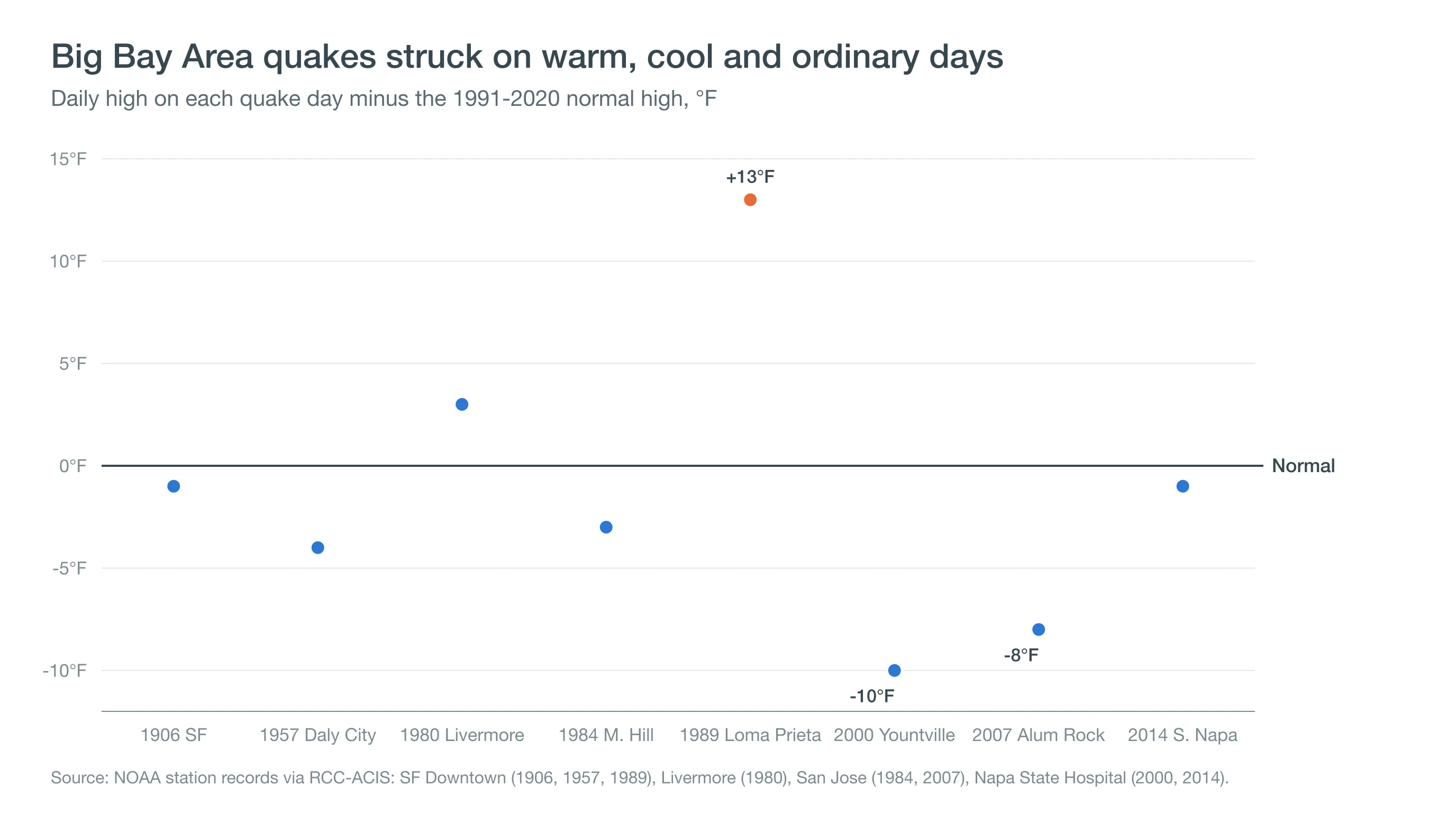
The 2014 South Napa quake came on an 83°F August day, but that is typical for Napa in August, just 1°F below normal. The 2000 Yountville quake, nearby, came on a day 10°F cooler than usual. If anything, this small set of quake days leans cool, the opposite of the myth, and it shows how little one memorable day can tell you.
The calendar shows no pattern either. The eight quakes in our table struck in January, March, April, August, September and October, in the rainy season and the dry season alike, and in both fog season and warm season. Four of the eight came between January and April, before the Bay Area's warm season begins. Morning, afternoon and evening are all represented too: 1906 struck before dawn, Loma Prieta at dinnertime.
If the records show no pattern, why does the myth feel true here?
Why Did Loma Prieta Make the Myth Stick?
Loma Prieta made the myth stick because so many people watched it happen. The quake struck at 5:04 PM on a warm, still October evening, just before Game 3 of the World Series at Candlestick Park, with cameras rolling. September and October are San Francisco's warmest months; see Bay Area Indian summer.

The USGS puts it simply: people remember the weather from their most memorable earthquake and forget the rest.
Loma Prieta also landed in the city's warm season. October is one of San Francisco's warmest months, with a normal high near 70°F downtown, so a warm, still evening that week was unusual but not freakish. Had the quake struck on a foggy July afternoon, the Bay Area might remember "earthquake weather" as cool and gray. That doesn't mean weather and quakes never touch at all.
Can Weather Affect Earthquakes at All?
Weather can affect earthquakes only in a very limited way. The USGS says very large drops in air pressure from major storms, like typhoons and hurricanes, can trigger slow, gentle fault slip, and may play a role in some damaging quakes, but the numbers are small and not statistically significant.
Heat waves, rain and fog do not cause earthquakes. So the sky tells you nothing, but your phone can tell you something.
Can Animals or Other Signs Predict Earthquakes?
Animals can't reliably predict earthquakes either, as far as scientists can tell. Stories of strange animal behavior before quakes go back to ancient Greece, where, in 373 B.C., rats, weasels, snakes and centipedes were said to have fled days before a destructive earthquake.
The USGS says a reproducible link between any specific animal behavior and an upcoming quake has never been shown. Animals may sense the first, faster shaking of a quake seconds before people notice the stronger shaking that follows, but that is a reaction to an earthquake already underway, not a forecast. The same goes for weather, clouds and odd feelings: no sign tells you a quake is coming days or hours ahead.
What Is the Bay Area's Real Earthquake Risk?
The Bay Area's real earthquake risk is high and has nothing to do with the weather. The U.S. Geological Survey estimates a 72% chance of at least one earthquake of magnitude 6.7 or larger somewhere in the San Francisco Bay region between 2014 and 2043.
The USGS forecast, from the 2014 Working Group on California Earthquake Probabilities, covers the major plate-boundary faults like the San Andreas and Hayward, plus lesser-known and undiscovered faults. A magnitude 6.7 is larger than the 2014 South Napa quake and close to the size of Loma Prieta, which is why preparation matters more than any forecast of the sky.
Deep Dive: Why Can't Weather Reach a Fault?
Weather can't meaningfully reach a fault because of two numbers: depth and stress. Bay Area earthquakes start miles down, and the stresses weather applies are tiny next to the stresses a fault stores and releases. A little physics shows the gap.
How Deep Does Surface Heat Go?
Heat moves into rock by conduction, and it moves slowly. For a temperature cycle with period P, the depth at which the swing shrinks to about a third of its surface size is the square root of κP/π, where κ, the rock's thermal diffusivity, is roughly one millionth of a square meter per second. By our calculation, the daily swing of a heat wave fades within about 7 inches of the surface, and even the yearly cycle of seasons fades within about 10 feet.
Bay Area quakes begin far deeper. The USGS put the Loma Prieta hypocenter about 18 kilometers (11 miles) down, and the 2014 South Napa quake started about 11 kilometers deep. Surface heat would have to reach thousands of times deeper than the seasons do to touch either one.
How Big Are Weather's Stresses?
Stress is measured in pascals. A deep storm might drop air pressure by about 50 hectopascals, or 5 kilopascals, and the solid-Earth tides raised by the sun and moon change fault stresses by a few kilopascals twice a day. Earthquakes release stress drops of about 1 to 10 megapascals, at least 200 times what a strong storm applies. Studies of aftershocks suggest that stress changes as small as about 10 kilopascals can nudge nearby faults that are already close to failure.
The 10-kilopascal threshold is why weather's effect is small rather than zero. A fault on the verge of slipping can be tipped a little earlier by a small push, which is how researchers found that typhoons can trigger slow, silent fault slip in Taiwan. In 2017, UC Berkeley researchers writing in Science used GPS to measure the crust flexing under winter rain and snow, and found that small California earthquakes were modestly more frequent when those seasonal stresses favored slip.
The effect is statistical: it nudges the timing of small quakes across a season and can't be felt as hot, still "earthquake weather" on any given afternoon. The stress that matters is the slow tectonic loading of the San Andreas and Hayward faults, and it builds whatever the sky is doing.
What Should You Do Instead of Watching the Weather?
Instead of watching the weather, turn on earthquake early warnings. California's system, built with UC Berkeley and the USGS, sends alerts through the free MyShake app and Wireless Emergency Alerts, which can give seconds of warning before shaking arrives: enough time to drop, cover and hold on.
Early warning is not prediction. The system detects an earthquake that has already started and races the alert ahead of the shaking, so the closer you are to the epicenter, the shorter the warning. That is still enough time to get under a sturdy table, step away from windows or pull a car over.
Secure heavy furniture, keep a kit, and if you live near the shore, check the tsunami hazard maps in can a tsunami hit San Francisco. The weather on quake day is just what you remember; use the San Francisco forecast for the weather that matters today. For how hot Bay Area days really get, see the hottest temperatures on record and San Francisco weather in October.