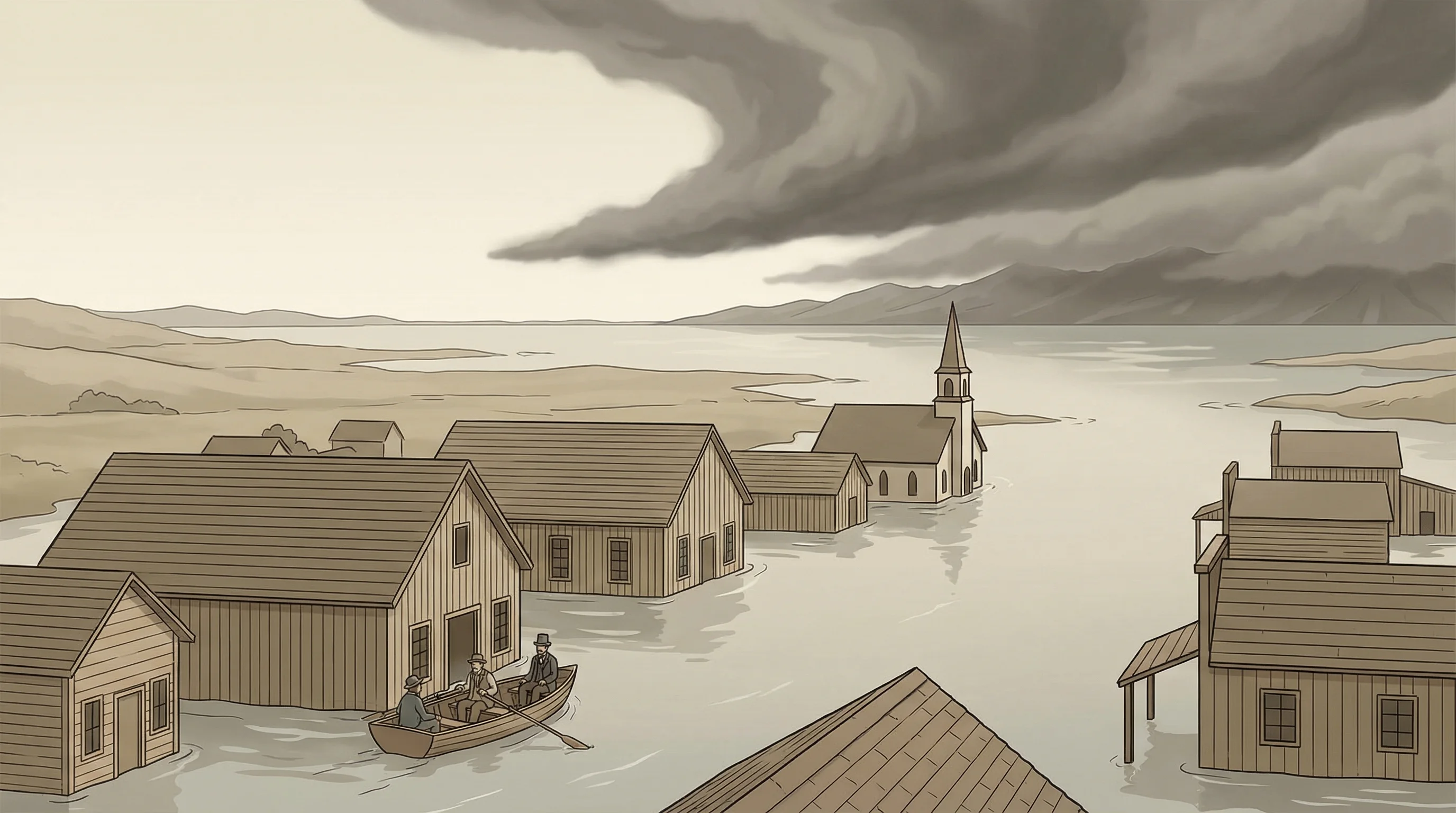
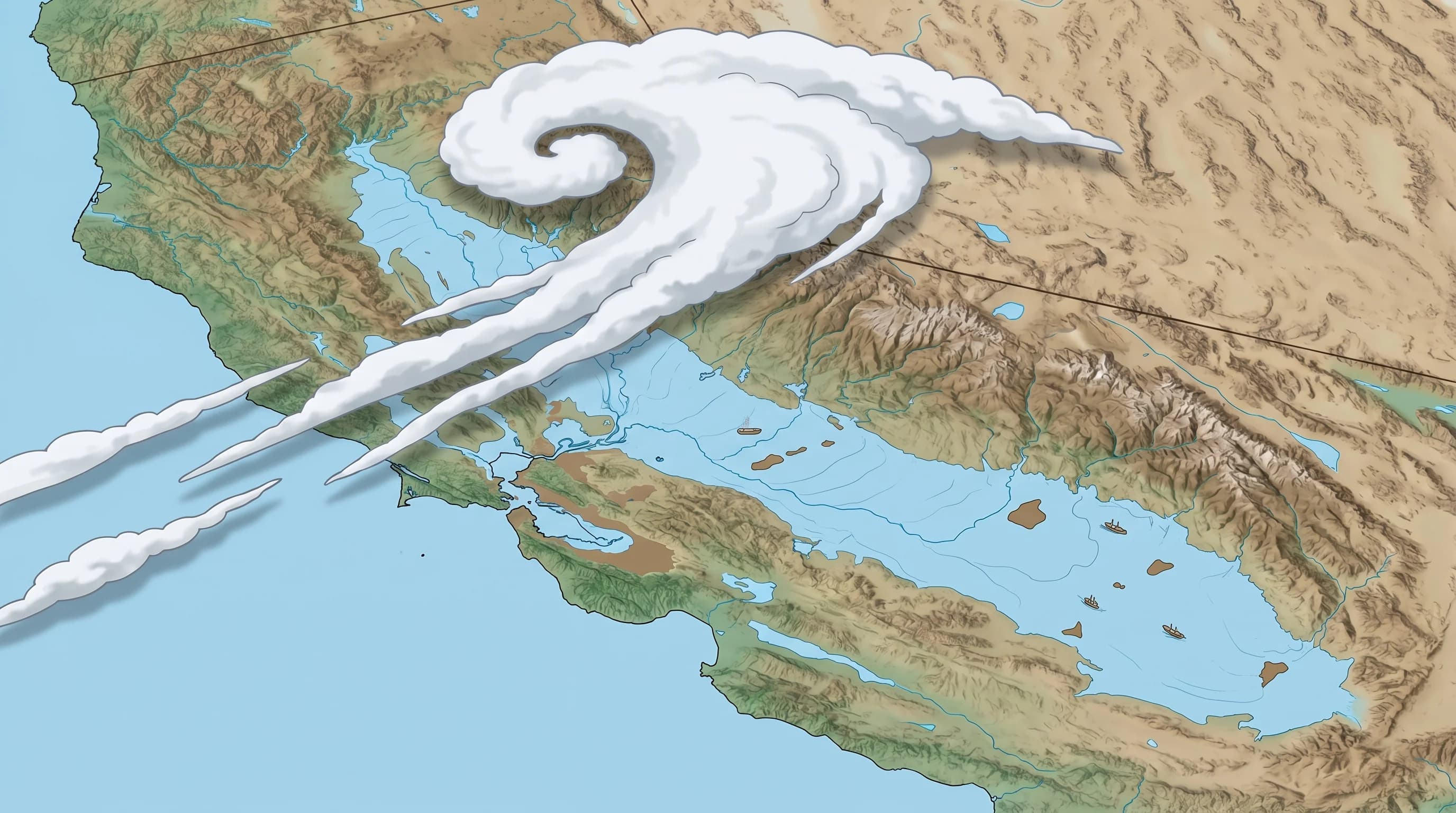
The winter of 1861 to 1862 brought California a storm sequence that has no modern equivalent. Beginning in late December 1861 and extending through January 1862, a series of atmospheric river events struck the state in rapid succession, each one depositing enormous rainfall totals before the previous flood had fully receded. The Sacramento Valley became an inland sea 300 miles long and 20 miles wide. The state capital had to be evacuated by boat. One-quarter of California's cattle died. The state government went bankrupt. In the Bay Area, the lowlands were under water for weeks, and the damage was severe enough that it reoriented California's entire approach to water management and infrastructure. The event is often called the Great Flood of 1862, and it remains the benchmark for catastrophic rainfall in California history.
The Storms That Caused the Great Flood
The 1861-62 flood was caused by what modern meteorologists would classify as an exceptionally active atmospheric river season. Atmospheric rivers, narrow bands of concentrated water vapor that transport tropical moisture northward from the Pacific, are the primary mechanism for California's major rainstorms. In a normal wet year, the Bay Area might experience four or five significant atmospheric river events between November and March. In the winter of 1861-62, the events came in rapid succession with little recovery time between storms.
Contemporary accounts describe rain beginning in the Sierra Nevada in late November 1861 and continuing nearly continuously through January. The Sierra Nevada snowpack, which had been building through early winter, was then hit by a warm atmospheric river event that converted existing snow to water simultaneously with the rain. This combination, heavy rainfall plus rapid snowmelt, is one of the most flood-producing scenarios possible, and it delivered an enormous volume of water to California's rivers in a very short period.
The Flood in the Bay Area
In the Bay Area, the flooding was extensive and prolonged. The low-lying areas around San Jose and the Santa Clara Valley floor were submerged for weeks. The creeks that drain the Santa Cruz Mountains and the Diablo Range overflowed into the flatlands, and the normal tidal zone of the Bay expanded dramatically. What is now downtown San Jose was under several feet of water. Farms and ranches throughout the South Bay were destroyed, and the cattle losses were catastrophic for an economy that was still largely ranching-based.
San Francisco, on its peninsula, was more protected from the worst flooding by its topography, but the surrounding lowlands were severely affected. The Coyote Valley, the Napa Valley, and the Sonoma Valley all flooded extensively. The town of Napa was inundated. Throughout the Bay Area, roads became impassable, mail stopped running, and communication with the rest of California was severed for days at a time. The flooding lasted far longer than modern floods because there were no flood control channels, levees, or reservoirs to manage the water.
The ARkStorm Scenario: Could It Happen Again?
The 1861-62 event has become the basis for USGS and other agencies' planning for what they call the ARkStorm scenario, a hypothetical modern recurrence of a 1862-scale event. The analysis is sobering. The Central Valley is now home to millions of people rather than thousands. The Bay Area has been developed over the lowlands that were completely flooded in 1862. Modern flood control infrastructure would be overwhelmed. Estimates suggest that a modern recurrence could cause over $700 billion in total damages and displace millions of people.
The 1861-62 flood is not a one-in-a-million event. Geological evidence from lake sediments and tree rings suggests that comparable floods occurred roughly every 100 to 200 years in California's pre-settlement history. The last event of this magnitude happened before significant European settlement. The question for California is not whether such a storm sequence will recur, but whether the state will be adequately prepared when it does.