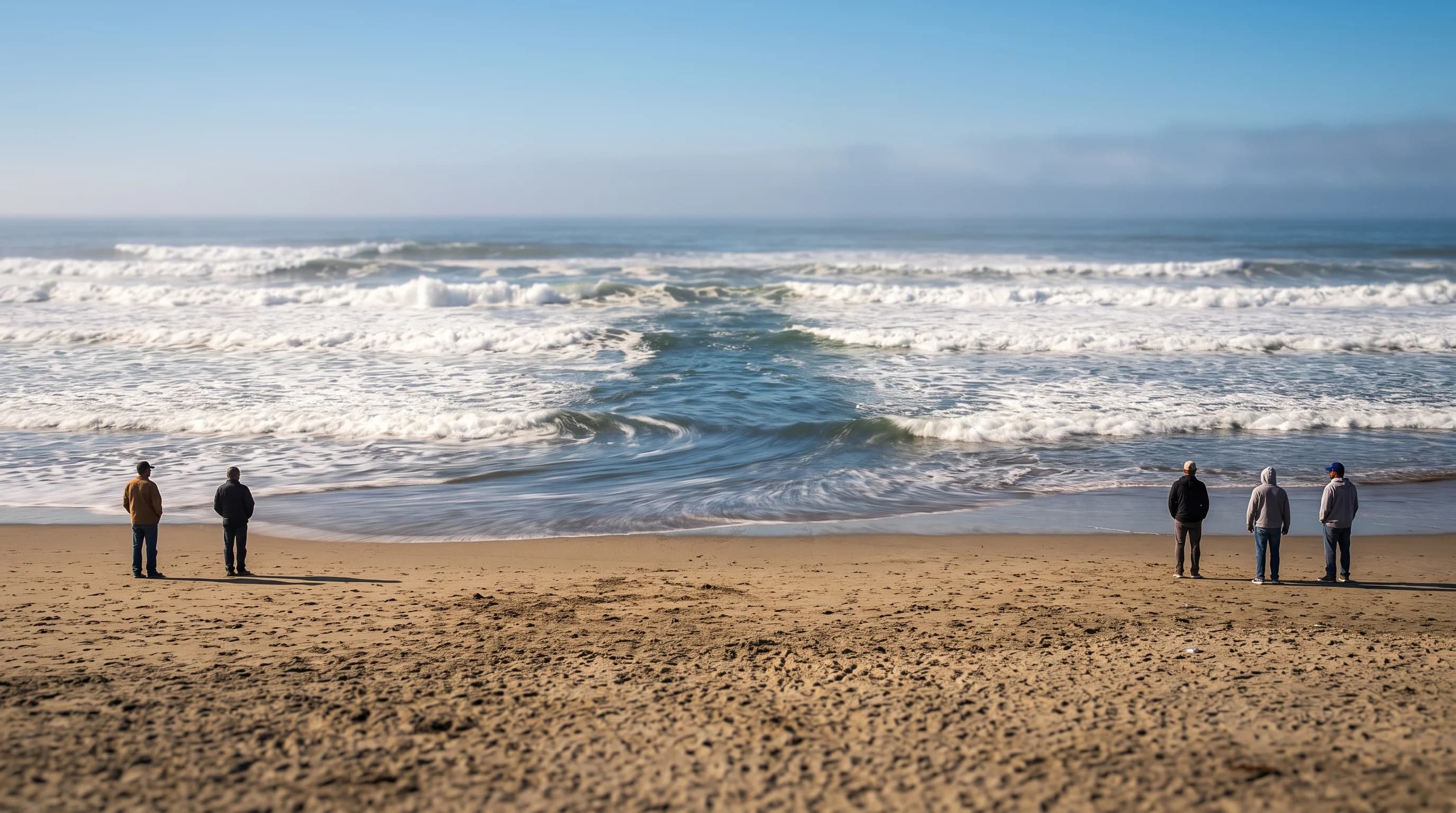
A rip current is a narrow channel of water flowing away from shore, and Ocean Beach in San Francisco has them every day because open-ocean surf breaks over shifting sandbars. The National Park Service says people have been swept out in as little as 3 feet of water. Stay out of the water, even on calm-looking warm days.
The San Francisco Fire Department answers an average of about 45 Ocean Beach rescue calls a year. At Ocean Beach, the calmest-looking water is the most dangerous, and that is true in two ways: the rip itself looks like a smooth gap in the surf, and the warm, sunny days that look safest usually still bring big waves.
Can You Swim at Ocean Beach?
Swimming at Ocean Beach is legal but strongly discouraged. Signs at the stairways warn that people swimming and wading have drowned there, and the beach has a Golden Gate National Recreation Area patrol but no lifeguard towers. A record seven people drowned at Ocean Beach in 1998.
The National Weather Service's first rule for rip currents is to swim only at beaches with lifeguards, where it says the chance of drowning is 1 in 18 million. Ocean Beach doesn't meet that test, which is why locals treat it as a place to walk, surf with experience, or watch the waves, not a place to swim.
The danger fools people because it looks calm. To see why calm water lies, start with what a rip current is.
What Is a Rip Current?
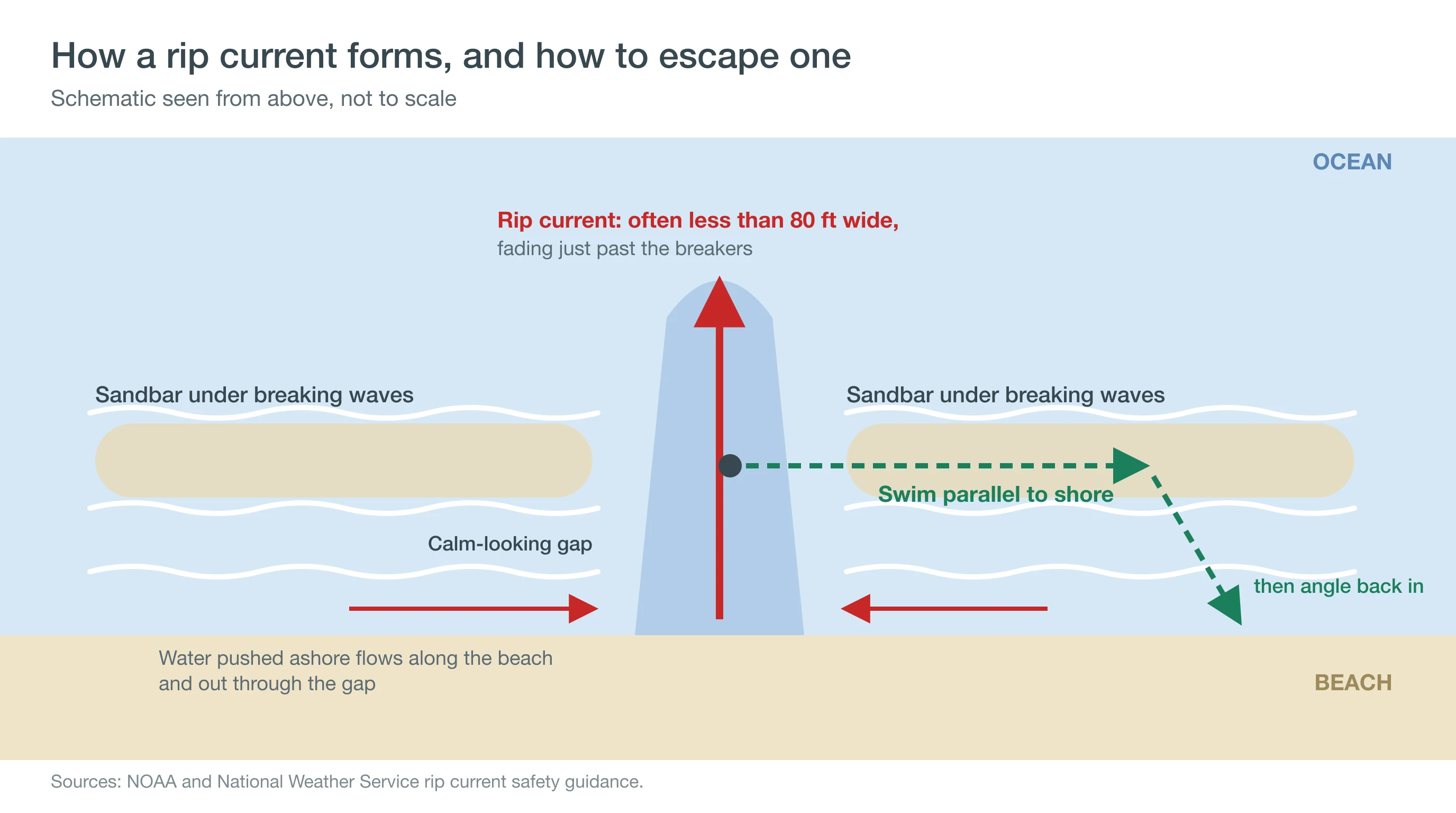
A rip current is a fast, narrow channel of water flowing straight out from the beach. NOAA says most are less than 80 feet wide and fade just beyond the line of breaking waves. A rip pulls you out, not under: people get into trouble when they tire themselves out swimming against it.
Here is the trap. Waves push water up onto the beach, and that water has to drain back out to sea. It returns through the low spots, and because the outgoing channel flattens the incoming waves, fewer waves break over it. From the sand, a rip often looks like a calm gap between breaking waves, the very spot a swimmer would pick.
Most beaches have rip currents sometimes. Ocean Beach has them every day.
Why Does Ocean Beach Have So Many Rip Currents?
Ocean Beach has so many rip currents because it faces the open Pacific with nothing to shelter it. There is no headland or reef to break up incoming swell, so powerful surf rolls in over sandbars that shift with every storm. The gaps between those sandbars are where the piled-up water rushes back out.
The beach's north end adds another force: tidal currents flowing in and out of the Golden Gate. Researchers writing in the Journal of Coastal Research measured currents above 1.5 meters per second (about 3.4 mph) at the extreme north end of Ocean Beach, compared with about 0.5 meters per second at the south end. That is faster than most people can swim.
The beach looks most inviting on a warm, sunny day, and that is when the second illusion kicks in.
Why Are Warm, Sunny Days Still Dangerous?
Warm days at Ocean Beach usually still have big surf. Our analysis of NOAA records found that from 2015 to 2025, 57% of the days when downtown San Francisco reached 75°F or warmer also had offshore waves averaging 5 feet or more at NOAA buoy 46026. In April it was 82% of warm days, and in May it was 95%.
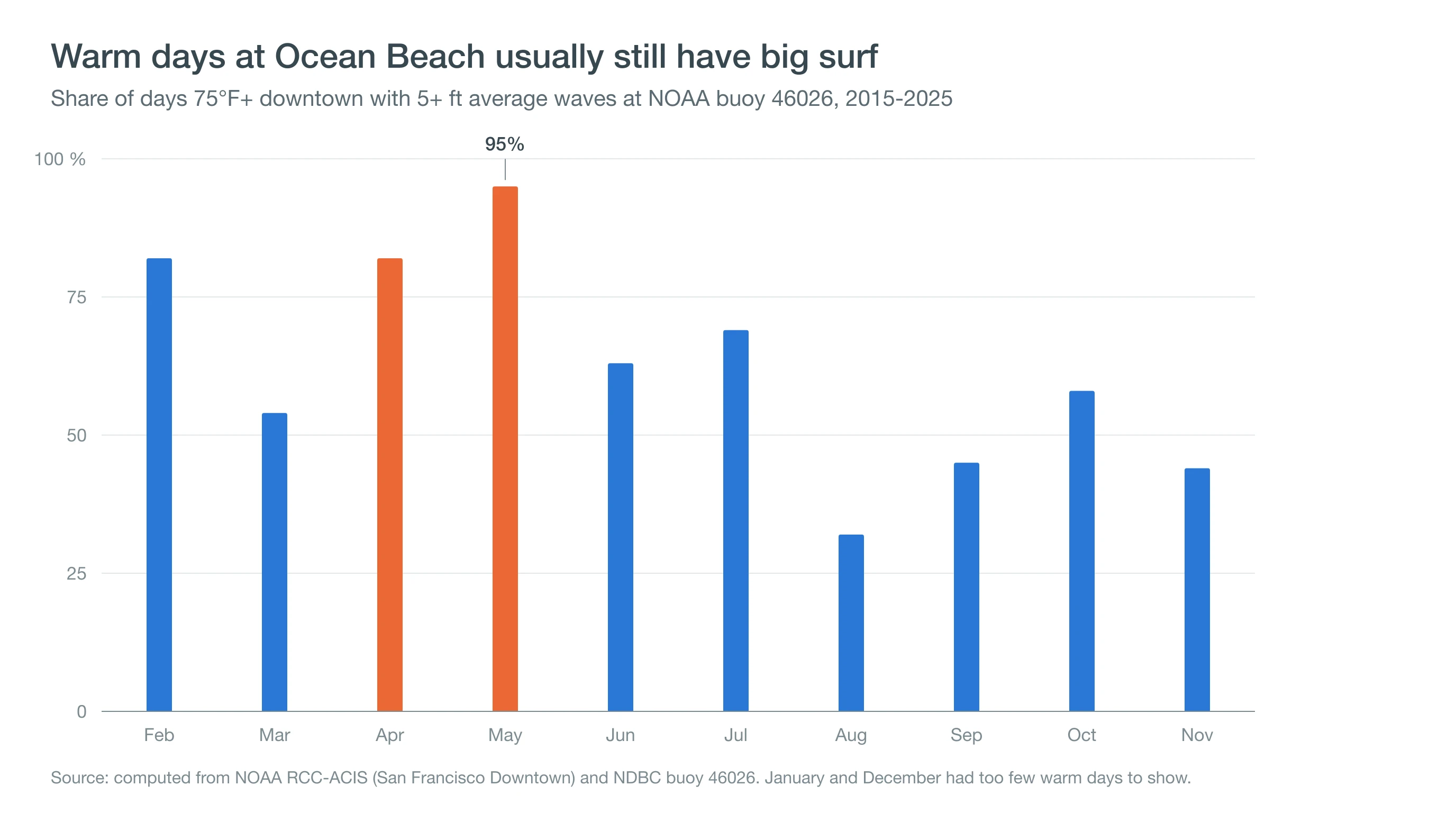
The buoy sits 18 nautical miles offshore, so breakers at the beach can be bigger or smaller, but it shows when the ocean is energetic. An NPS official has called spring the worst season, because spring winds build choppy surf and strong rips.
Fall is the other risk window, for a different reason: it simply has the most warm days. September and October together brought 144 of the 294 warm days we counted, and these are the days crowds head to the beach.
| Month | Warm days, 2015-2025 | Share with 5+ ft waves offshore |
|---|---|---|
| April | 17 | 82% |
| May | 19 | 95% |
| June | 30 | 63% |
| July | 16 | 69% |
| August | 34 | 32% |
| September | 65 | 45% |
| October | 79 | 58% |
Warm days are days of 75°F or more at the San Francisco Downtown station (RCC-ACIS), compared with that day's average wave height at NOAA buoy 46026. Months with fewer than 15 warm days are left out.
| Season | Typical offshore waves | Warm days with 5+ ft waves | What to expect |
|---|---|---|---|
| Winter (Dec-Feb) | 6.9-7.4 ft | Few warm days | Big swell, strong rips, cold water |
| Spring (Mar-May) | 5.8-6.5 ft | 54-95% | Windy, choppy surf; the riskiest warm days |
| Summer (Jun-Aug) | 4.1-5.5 ft | 32-69% | Fog and cold water; rips still form |
| Fall (Sep-Nov) | 4.6-6.2 ft | 44-58% | The warmest days draw the biggest crowds |
Monthly median wave height at NOAA buoy 46026, 2014-2025. Rip currents occur in every season.
The surf is only half of the danger. The other half is the temperature of the water.
Why Does the Cold Water Make Rip Currents Deadlier?
Cold water makes rip currents deadlier because it attacks your breathing before you can think. The ocean off San Francisco stays between about 52°F and 58°F all year, and the National Weather Service says cold shock from water of 50°F to 60°F can be as severe as from water near freezing.
Sudden immersion triggers an involuntary gasp and rapid breathing, which can make a strong swimmer inhale water in calm conditions, let alone in surf. Within minutes, cold muscles weaken and swimming becomes much harder. Add a current flowing faster than you can swim, and a wade can turn into a rescue quickly; see Bay Area ocean water temperatures.
If the danger hides in calm-looking water, the next skill is knowing what that water looks like.
How Can You Spot a Rip Current?
You can spot many rip currents by looking for the calm-looking gap: a strip of darker, smoother water between breaking waves. Other signs are foam, seaweed or debris moving steadily out to sea, a choppy channel cutting through the surf, and a break in the line of advancing waves.
Many rips are hard to see from the sand, and they move as the sandbars shift, so a gap that was safe-looking in the morning may be gone by afternoon. That is why staying out of the water matters more than spotting. Watching from a higher vantage point, like the seawall or the stairs, makes the pattern easier to see.
If you or someone else ends up in a rip anyway, a few rules decide the outcome.
What Should You Do if You or Someone Else Is Caught?
If you are caught in a rip current, don't swim against it. The National Weather Service says to stay calm, float, and swim parallel to the shore until you are out of the current, then angle back to the beach. If you can't escape, float or tread water and wave and yell for help.
Swimming toward breaking waves can help too, because the waves push water back toward the beach. The goal is to get out of the channel sideways and let the surf carry you in, not to win a race against the current. Rips often weaken just past the breakers, so floating calmly and signaling is better than exhausting yourself.
If someone else is swept out, call 911, keep them in sight and throw them something that floats. Never go in after a person or a dog. Fire crews and the park patrol handle Ocean Beach rescues, and going in after someone puts a second person in the same current.
Deep Dive: What Physics Drives a Rip Current?
A rip current is driven by the momentum that breaking waves deliver to the shore. Oceanographers describe that momentum with a quantity called radiation stress, the excess flow of momentum carried by waves, worked out by Michael Longuet-Higgins and Robert Stewart in the early 1960s. As waves break and lose height, the lost momentum pushes water shoreward.
The result is wave setup: the mean water level inside the surf zone stands slightly higher than the sea outside it.
Why Does Uneven Breaking Create a Jet?
Setup is not uniform along the beach. Over a sandbar, waves break hard and setup is high; over the deeper channel beside it, fewer waves break and setup is lower. Water flows down that alongshore pressure gradient, from the bars toward the channel, then turns seaward as a narrow jet. Scientists call these bathymetrically controlled rips, and Ocean Beach's shifting bars make them a near-constant feature.
Not every rip needs a channel. Transient, or flash, rips form when groups of waves break unevenly along a straight beach, spinning up eddies that drift and collapse within minutes. Boundary rips form where a structure or headland turns the alongshore current seaward. NOAA notes that rips can flow as fast as 8 feet per second, and their speed pulses over several minutes as sets of waves arrive.
Where Does a Rip Actually Take You?
The textbook picture shows a rip carrying swimmers far out to sea, but field studies near the Bay Area tell a more nuanced story. Naval Postgraduate School researchers released fleets of GPS-tracked drifters into rip currents on an open beach in southern Monterey Bay and found that the flow formed large, semi-enclosed eddies. On average, only about 19% of the drifters left the surf zone per hour; most circled back toward the breakers.
The eddies are the physical basis for the advice to float and signal rather than fight: a swimmer who stays afloat is often carried back toward shallower water. Ocean Beach adds a caveat at its north end, where strong tidal currents from the Golden Gate flow regardless of the surf. Combined with cold shock, the margin for error here is smaller than on warmer, more sheltered beaches.
The physics can't be seen from the parking lot, but the forecast inputs can.
How Do You Check the Risk Before You Go?
You check the risk with the National Weather Service Bay Area surf zone forecast, which rates the rip current risk, and with any Beach Hazards Statement, issued for dangerous rip currents and sneaker waves. Rip currents pull you out from the water; sneaker waves knock you down from the sand. Both are worst on steep, open beaches like this one.
The National Weather Service Bay Area office issues Beach Hazards Statements for the coast from Sonoma County to Big Sur, and they often come with long-period swell arriving on sunny, calm-looking days. Those are exactly the days people are tempted to wade in, so treat the statement as a reason to stay on the sand.
Calm on the forecast and calm on the water are not the same thing at Ocean Beach. For more on the coast, see Bay Area surf by season and tsunami risk in San Francisco.
At Ocean Beach, calm-looking water is the warning, not the invitation. Before a visit, check the NWS Bay Area forecast for the rip current risk, then the Ocean Beach forecast for wind and wave height. Enjoy the beach from dry sand.