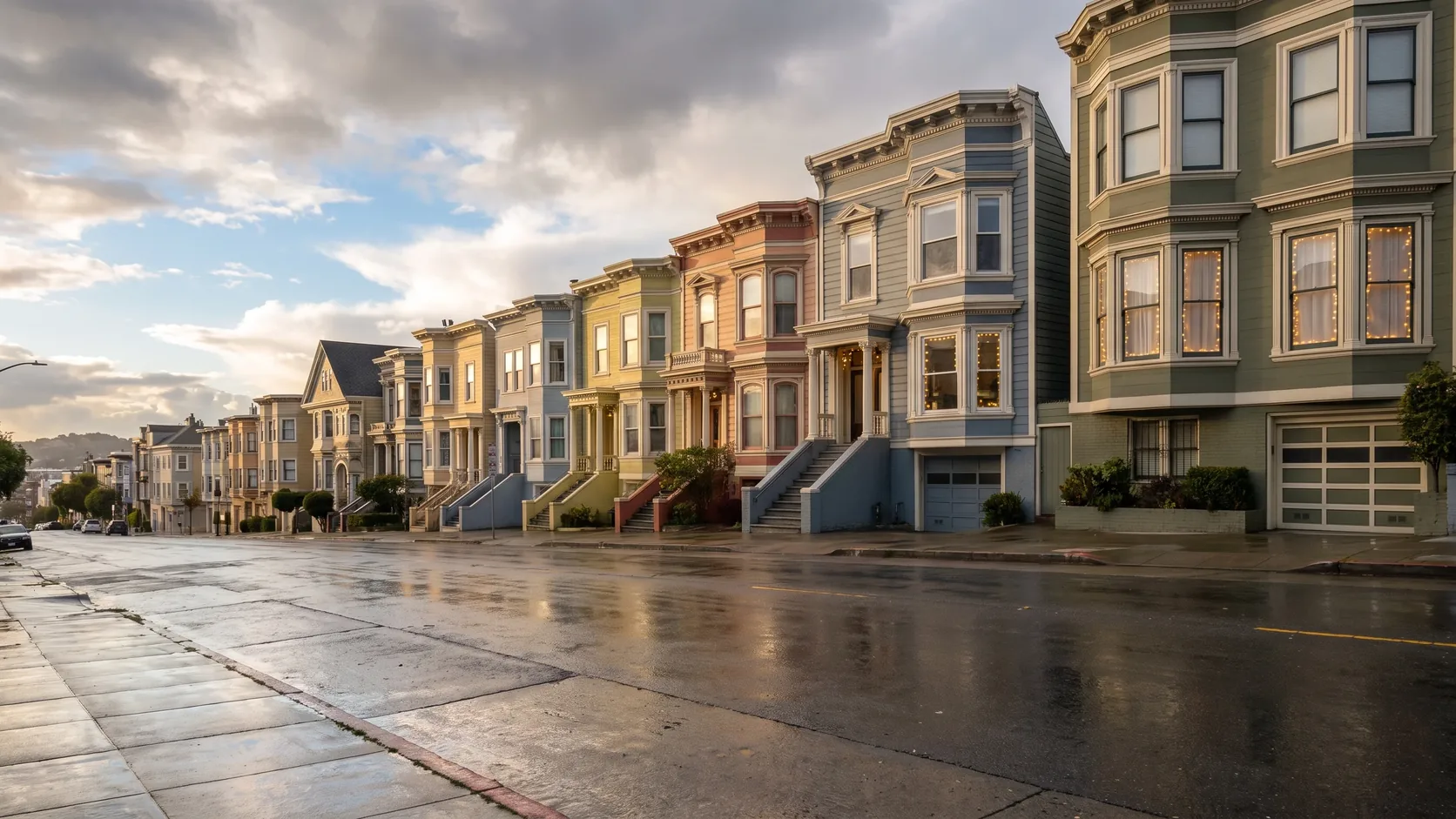
The full Christmas weather guide
When is Christmas, and which days does this forecast cover?
Christmas Eve is Thursday, December 24, 2026, and Christmas Day is Friday, December 25. This page covers both days, using the hours people are usually outside. The Christmas Eve forecast runs from late morning to late evening, for errands, the lights and getting to dinner or a service. On Christmas Day, it runs from morning through evening, when many people take a walk or visit family.
The forecast is for downtown San Francisco, near Union Square and the eastern waterfront. The west side of the city usually gets a storm’s rain and wind first and is a little cooler. Inland afternoons are similar to the city’s, but clear nights there get much colder.
Will it rain on Christmas in San Francisco?
Most Christmases in San Francisco are dry, and NOAA’s downtown records show rain on about 25% of Christmas Days. Rain is a little less common on Christmas Eve, and in about 40% of years at least one of the two days was wet.
December is the wettest month of the year in San Francisco, and its storms can be big. The wettest Christmas since 1875 came in 2012, with more than an inch of rain downtown. Last year was wet too, with about 1.4 inches over Christmas Eve and Christmas Day.
Many of December’s biggest storms are atmospheric rivers, long plumes of moisture from the Pacific that can bring a full day of heavy rain and strong south winds. Downtown San Francisco gets an inch or more of rain in a day more often in December than in any other month. A few days of clear, cold and very clean air usually follow.
As Christmas gets closer, watch the timing of any storm in the forecast. A storm that clears out early on Christmas Eve often leaves a bright, clear Christmas Day. A front, the leading edge of a storm, arriving at 9 a.m. on Christmas Day changes the holiday far more than a degree or two of temperature does.
How cold is San Francisco at Christmas?
Christmas Day in downtown San Francisco averages a high near 57°F and a low near 45°F. Temperatures on Christmas Eve are about a degree warmer, and both days are as short as they get all year. It is cool rather than cold, but an evening outside looking at lights gets chilly quickly.
The sun sets at about 4:56 p.m. on Christmas Eve and 4:57 p.m. on Christmas Day. By the time the lights look their best, the temperature is in the upper 40s and falling.
The warmest Christmas in the downtown record reached 67°F in 1967. The coldest Christmas morning was 35°F in 1990, during a hard freeze that month. Most years fall in between, with mornings in the mid-40s and afternoons in the mid-to-upper 50s.
On Christmas, clear nights are usually colder than cloudy ones. Without clouds to hold in the day’s warmth, the city can drop into the low 40s, and the inland valleys fall into the 30s with frost by morning. A cloudy, damp night stays milder, but a gray, breezy 52 on the Embarcadero can feel much colder than the number suggests.
Will the Christmas Eve king tide flood the San Francisco waterfront?
The Christmas king tides are the highest tides predicted this winter, and low spots along the shoreline may get some water. The risk is highest if a storm arrives near high tide.
A king tide is one of the highest tides of the year, and California’s King Tides Project lists December 23 to 25 as king tide days. NOAA predicts a high tide of about 7.2 feet near the Golden Gate around 10:40 a.m. on Christmas Eve. That is more than a foot above an average high tide, and the Christmas Day tide is only slightly lower.
The bay has also been higher than the predictions this fall. In the first week of November, NOAA’s water level readings near the Golden Gate averaged about a foot above the predicted tide. If that continues into December, the Christmas Eve tide could reach about 8 feet. Our guide to El Niño and Bay Area sea level explains why the bay is higher than usual.
A storm makes high water much more likely to flood. Low air pressure and south winds push water higher, which forecasters call storm surge. Heavy rain also cannot drain when the outlets of storm drains are underwater. Low parts of the Embarcadero and the bay shoreline can then flood for an hour or two around high tide.
If a storm is forecast for Christmas Eve or Christmas Day, compare its timing with the late-morning high tide. Watch for a coastal flood advisory from the National Weather Service, which means minor flooding is expected along the shore. Afternoon and evening plans are not affected, because the tide is going out by mid-afternoon. Our king tide guide has the full winter schedule.
Is transit running in San Francisco on Christmas Day, and what is closed?
Transit runs on reduced holiday schedules on Christmas Day. Muni runs a weekend schedule, BART runs Sunday service from 8 a.m. to midnight, and Caltrain runs a weekend schedule. The SF Bay Ferry and the Golden Gate Ferry do not run at all.
Most transit runs close to a normal weekday schedule on Christmas Eve, though Caltrain runs a modified schedule. Check each agency’s holiday page before you travel, because holiday schedules can change.
Several big indoor attractions close on Christmas Day, which matters if a museum was your rainy-day plan. Alcatraz, the de Young, the Legion of Honor and the Exploratorium are all closed, and the Exploratorium also closes at 3 p.m. on Christmas Eve. The San Francisco Zoo is open every day of the year, and the California Academy of Sciences has opened with holiday hours in past years.
Where can I see San Francisco’s holiday lights if it rains?
All of the city’s outdoor holiday displays are up by Christmas, and you can see them in any weather. They include the trees at Ghirardelli Square and Pier 39 and the outline lights on the Embarcadero Center towers. The Illuminate SF light art trail, dozens of free outdoor light installations around the city, runs through January 31.
The Union Square Holiday Ice Rink is open daily from 10 a.m. to 11 p.m. through January 18. San Francisco Travel lists it as open on Christmas Day.
Lights look best right after dark, which is also when the evening chill sets in. Union Square and the downtown streets are sheltered, but Pier 39, Ghirardelli Square and the Embarcadero face the wind off the bay. On a breezy night, those waterfront spots feel several degrees colder than downtown.
Steady rain makes a long walk between displays unpleasant and a session at an outdoor rink wet, so look at the rink’s calendar before you go. If rain is forecast for Christmas Eve evening, look for a dry stretch in the late afternoon, since the lights are on by about 5:30.
Will weather delay Christmas flights at SFO or drives out of town?
Weather can delay flights at SFO at Christmas, mostly when a December storm brings low clouds and strong wind. SFO’s two main arrival runways sit very close together, so the FAA does not allow planes to land on them side by side. SFO says it can handle about 45 arrivals an hour in fair weather and about 36 when low clouds hide the approach.
Strong storm winds can also force SFO to use a slower runway setup. SFO has had very low clouds or poor visibility at some point on about 25% of Christmas Days. When arrivals fall behind, the FAA holds San Francisco flights at their departure airports, which is called a ground delay program. Before you leave, check your airline and the FAA’s airport status page.
Around the bay, wind is the main road hazard. Gusts ahead of a December storm hit hardest on the bridges and along the coast. When the ground is already soaked, they can also bring down branches and power lines.
Driving to the Sierra for Christmas means planning for snow. December storms often bring snow to Interstate 80 over Donner Summit and Highway 50 over Echo Summit. When they do, Caltrans sets chain controls, rules about which vehicles need tire chains.
The first level lets cars and light trucks with snow tires on the drive wheels go without chains, as long as they carry them. Under the second level, four-wheel and all-wheel drive vehicles can skip chains only with snow tires on all four wheels, and they must still carry them. The strictest level requires chains on every vehicle, and Caltrans often closes the highway before it gets that far. Before you leave, look up chain controls and closures on Caltrans QuickMap.
In the Central Valley, tule fog is a thick ground fog that forms on calm, cold nights after rain. December and January are its peak months, and Stockton and Sacramento each average about a week of dense fog mornings in December. It can cut visibility on Interstate 5, Highway 99 and Interstate 80 toward Sacramento to almost nothing. The fog usually thins by late morning, so leaving later is the easiest way around it.
What should I wear for Christmas in San Francisco?
Dress for the upper 40s and wind, even on a clear afternoon. A warm middle layer under a jacket that blocks wind covers most Christmas days. If rain is in the forecast, wear a waterproof jacket with a hood, which works better than an umbrella in a crowd or a gusty storm.
For an evening at the lights, add a hat and gloves, especially for children, who get cold waiting in line for a rink or a tree. Wear shoes that grip wet pavement, because cable car steps, steep sidewalks and painted crosswalks get slippery after rain.
If you head to the beach or the Marin Headlands on a clear Christmas Day, bring a layer to add when the sun goes down. Late December is also sneaker wave season, when a much bigger wave can rush far up the beach with little warning. Stay well back from the water at Ocean Beach and along the coast. Be especially careful if the National Weather Service has issued a beach hazards statement, its alert for dangerous surf.
Can I use my fireplace in the Bay Area on Christmas?
You can use a fireplace on Christmas unless the Bay Area Air District has called a Spare the Air alert. The district calls an alert when smoke and other fine particles are expected to build up to unhealthy levels. During an alert, it is illegal to burn wood in a fireplace, wood stove or pellet stove. The rule applies to alerts in every season, not just winter.
Christmas week often brings the conditions that trap smoke. After a storm, calm and clear weather often settles in, the ground cools quickly, and cold air collects near the surface. Smoke from chimneys then stays in the neighborhood instead of rising away. With many holiday fires burning, the air in some Bay Area neighborhoods can become unhealthy overnight.
Before you light a fire on Christmas Eve or Christmas Day, check the alerts at Spare the Air. If you have asthma or another lung condition, keep your windows closed on calm, clear nights.
FAQ
Christmas weather questions
Does it rain on Christmas in San Francisco?
It rains on about 25% of Christmas Days in downtown San Francisco, according to NOAA records. Counting Christmas Eve too, at least one of the two days was wet in about 40% of years. Last year was one of them, with about 1.4 inches of rain over the two days.
How cold is San Francisco at Christmas?
Christmas Day in downtown San Francisco averages a high near 57°F and a low near 45°F. The coldest Christmas morning on record, in 1990, dropped to 35°F. Inland valleys get much colder at night, often with frost.
What time is sunset on Christmas in San Francisco?
The sun sets at about 4:56 p.m. on Christmas Eve and 4:57 p.m. on Christmas Day. It is fully dark by about 5:30, which is when holiday lights look best and the temperature drops into the 40s.
Is there a king tide on Christmas Eve 2026?
Yes, Christmas Eve has the highest tide of the winter, a king tide of about 7.2 feet around 10:40 a.m. That is more than a foot above an average high tide near the Golden Gate. A storm at the same time can flood low spots on the Embarcadero and around the bay.
How windy does it get on Christmas?
Christmas is usually calm, with an average daytime wind of about 8 mph at SFO. When a December storm arrives, gusts can top 35 mph, which happens in about 25% of years. On Christmas Day 2025, gusts at SFO reached 55 mph.
Can weather delay flights at SFO at Christmas?
Yes, mostly when a December storm brings low clouds and strong wind. SFO’s two main arrival runways are very close together, so arrivals must be spaced farther apart when clouds hide the approach. SFO says that drops its arrival rate from about 45 planes an hour to about 36. Check your airline and the FAA’s airport status page before you leave.
Is transit running on Christmas Day, and what is closed?
Muni runs a weekend schedule, BART runs Sunday service from 8 a.m. to midnight, and Caltrain runs a weekend schedule. The SF Bay Ferry and the Golden Gate Ferry do not run at all. Alcatraz, the de Young, the Legion of Honor and the Exploratorium are closed, but the San Francisco Zoo is open every day of the year.
Do I need chains to drive to Tahoe for Christmas?
You often do when a winter storm is passing over the Sierra. Caltrans sets chain controls on Interstate 80 and Highway 50 when snow falls, which are rules about which vehicles need tire chains. At the strictest level, every vehicle on the road needs chains. Check Caltrans QuickMap before you leave, and carry chains either way.
Can I use my fireplace on Christmas?
You can unless a Spare the Air alert is in effect. The Bay Area Air District calls one when smoke and other fine particles are expected to reach unhealthy levels, and burning wood is then illegal. These alerts are most likely on cold, calm, clear nights after a storm, so check Spare the Air before you light a fire.
What should I wear to see the holiday lights in San Francisco?
Wear a warm middle layer under a jacket that blocks wind, plus a hat and gloves for a long evening outside. Add a hooded rain jacket if rain is in the forecast, and wear shoes that grip wet pavement. The waterfront displays feel colder than Union Square because of the wind off the bay.
Sources and methodology
- NOAA daily records for San Francisco Downtown (USW00023272), via SC-ACIS — Holiday highs, lows and rainfall for every year on record, and the 1991 to 2020 averages
- Iowa Environmental Mesonet ASOS archive, SFO — Hourly SFO wind, gusts, cloud ceiling and visibility on each holiday from 2000 to 2025
- NOAA tide predictions and water levels, San Francisco (station 9414290) — King tide heights and times, and observed water levels compared with the predictions
- California King Tides Project — Official king tide dates for the winter
- NOAA Climate Prediction Center ENSO diagnostic discussion — The El Niño Advisory for the winter
- U.S. Naval Observatory sun and moon data — Sunrise and sunset times in San Francisco on each holiday
- National Weather Service San Francisco Bay Area — Storm forecasts, wind and coastal flood advisories, and beach hazards statements
- San Francisco Chronicle: A major SFO runway is reopening early — The FAA limit on side-by-side landings and SFO’s fair-weather and low-visibility arrival rates
- FAA National Airspace System status — Live ground delay programs and airport status for SFO
- Caltrans QuickMap — Live chain controls, closures and road conditions on Sierra and Central Valley routes
- Caltrans chain controls — What each chain control level requires
- SFMTA Muni holiday schedules — Muni service levels on Thanksgiving and Christmas
- BART holiday schedules — Sunday service from 8 a.m. to midnight on both holidays
- Caltrain holiday service — Weekend and modified schedules around both holidays
- San Francisco Bay Ferry holiday schedule — No service on Thanksgiving or Christmas Day
- Golden Gate Ferry holiday calendar — No service on Thanksgiving or Christmas Day
- Alcatraz Island operating hours (National Park Service) — Closed on Thanksgiving, Christmas and New Year’s Day
- Exploratorium hours — Holiday closures and Christmas Eve hours
- San Francisco Zoo visitor information — Open every day of the year, including holidays
- Union Square Holiday Ice Rink — Season dates and daily hours
- PIER 39 holiday season — Tree lighting on December 3, 2026, and holiday season dates
- San Francisco Travel: Illuminate SF light art trail — Light art trail dates, from November 27, 2026, through January 31, 2027
- Spare the Air — Current Spare the Air alerts and alert sign-up
- Bay Area Air District wood smoke rule (Regulation 6, Rule 3) — The ban on burning wood during a Spare the Air alert, which applies at any time of year
- San Francisco Travel: Christmas Day in San Francisco — Christmas Day events and visitor planning