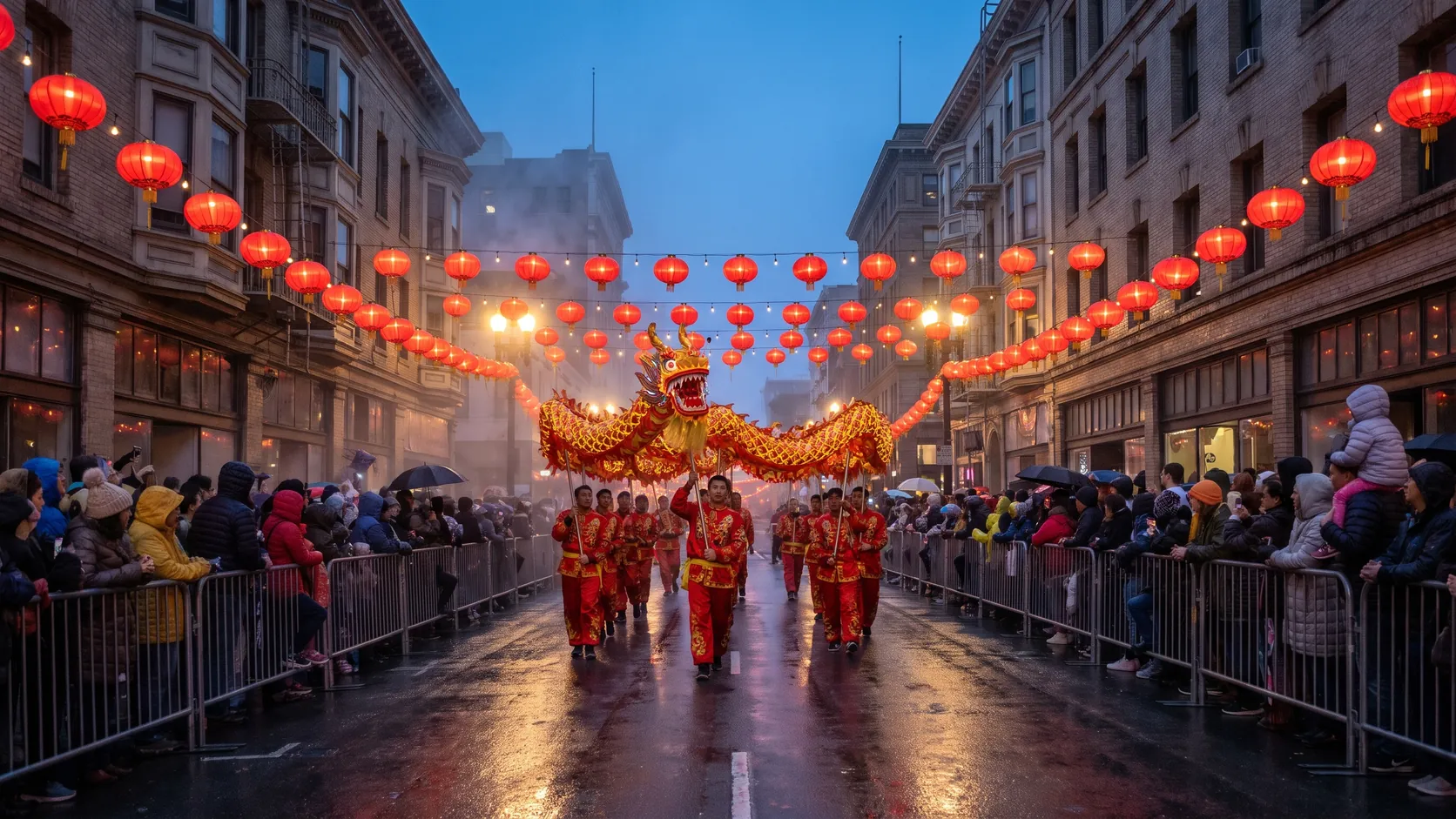
The full Chinese New Year Parade weather guide
When does the San Francisco Chinese New Year Parade start, and where does it go?
The San Francisco Chinese New Year Parade is one of the few night parades left in North America. The organizer calls it the biggest Lunar New Year parade outside Asia. Chinese San Franciscans began holding it in the 1860s, and the Chinese Chamber of Commerce has run it since 1958. It falls in late winter, when storms still reach San Francisco often. Because the parade starts shortly before sunset, rain and the evening chill matter far more than the afternoon high.
The parade starts at Second and Market Streets, passes Union Square and finishes on Kearny Street at Columbus Avenue, at the edge of Chinatown. The Chinese Chamber of Commerce has scheduled the 2027 parade for Saturday, February 20, starting at 5:15 p.m. The route is about 1.3 miles long, and the organizer says the parade takes about two and a half hours. The Chinese New Year Parade is a night parade of floats, lion dancers and bands that ends with the Golden Dragon, carried on poles by dancers.
This page forecasts the event’s own hours instead of the whole day. An overnight low tells you little about an afternoon program, and a daily high tells you little about a program that runs after dark.
The dates and hours on this page are for this year’s event. The organizers decide admission, closures, postponements, set times and cancellations, and this page does not replace their announcements. For the full schedule, see the official event site.
The venue, the typical weather and the packing advice stay about the same from year to year. The dates change, so confirm them before you book anything.
How cold and wet is a February night along the Chinese New Year Parade route?
A February evening in downtown San Francisco is cool rather than cold, but it feels colder the longer you stand outside. The parade usually starts in the mid-50s and cools to about 50°F by the time the Golden Dragon passes. Late February is still the wet season, but most storms miss the parade itself. Rain falls during the parade on about 20% of evenings. Past parades have seen both extremes, from the cold rain that thinned the crowds in 2011 to a mild night after a warm afternoon in 2024.
The typical numbers on this page describe an average year, not a forecast for a specific date. They show whether to pack a jacket, whether to plan for rain and which kind of weather is the usual problem here. Use them until event week, then switch to the forecast.
Weather can change a lot over short distances around San Francisco. An exposed park can be colder, cloudier or windier than a sheltered plaza a few blocks away. The forecast on this page is for a point chosen to match the venue as closely as possible, not a citywide average.
How the temperature feels depends on sun, shade and wind over a long day outside. Pavement and crowds make a sunny plaza feel warmer than the reading. Shade and a steady breeze make an inland afternoon feel cooler than the reading. Read the temperature together with the wind and cloud cover instead of relying on one number.
The rain chance is the forecast number that people misread most often. A 40% chance is the chance of any measurable rain, not a measure of how long or how hard it rains. It could mean a five-minute shower or the start of a real storm. During event week, check whether the rain is expected before the gates open, during the main program or after the event ends.
Does rain cancel the San Francisco Chinese New Year Parade?
Rain does not cancel the San Francisco Chinese New Year Parade, according to the organizer. In 2023, the parade went on through rain and gusts over 40 mph, and SF Public Press reported that the storm damaged the dragon. Steady rain is hardest on people who arrive an hour or more early to get a spot at the curb. Strong wind makes umbrellas dangerous in a packed crowd and makes the evening feel several degrees colder. On cold, calm nights, smoke from the firecrackers can hang over the street instead of drifting away.
No single forecast number decides whether an event goes ahead. Organizers look at conditions on the ground, public safety, equipment and where the weather is heading. A rain-or-shine event can still pause for dangerous weather, and a cloudy forecast does not mean the day is ruined.
Trouble usually comes from several kinds of weather arriving together. Light rain with no wind is fine in a rain jacket. The same rain with strong gusts flips umbrellas, rattles signs and sound equipment, and makes waiting in the open miserable. Low clouds are a minor comfort issue at one event and the main concern at another.
Thunderstorms are rare here, so people tend to underestimate them when one does form. If you hear thunder or organizers tell people to take shelter, go where they direct you. Do not use a forecast page to second-guess a safety instruction or any official weather warning.
Which hours of parade night matter most for the Chinese New Year forecast?
The hours that matter most run from the 5:15 p.m. start to about 8 p.m., when the parade passes most viewing spots. Check the late afternoon too, when streets close, people find spots at the curb and bleacher ticket holders check in. The Golden Dragon comes last, so check the later evening if you plan to stay to the end on Kearny Street. A shower that clears before the start leaves wet streets but a dry parade.
Ten to fourteen days out, the forecast is only good for the general pattern, such as a warm, wet or windy spell. Around a week out, comparing event days starts to be useful. Two or three days out, it is worth planning your arrival around the forecast. On the day, watch the latest conditions and the organizer’s announcements.
When the day is already set, the useful decisions are when to arrive, what to bring and when to do the outdoor parts of the day. Moving an outdoor plan by a few hours often avoids the worst of the weather.
Small forecast changes are not worth chasing, and a drop from 64 to 63 degrees changes nothing. Rain moving into the main program is worth watching, and so are fog lasting two hours longer or gusts that become hard to stand in. The summary at the top of the page points out changes like those and leaves out the small ones.
On parade night, rain and wind during the parade matter far more than the daily high. If rain is coming, dress for it, find a covered spot or watch from home. The organizer has the final word on the route and timing, and SFMTA posts the street closures.
Is Union Square or Chinatown the better place to watch the parade in the rain?
Chinatown is usually the better place to watch the parade in the rain. Kearny Street is narrower than Market Street, and its tall buildings block more of the wind. Bleacher Section A, on Kearny between Washington and Jackson Streets, also has a canopy overhead. Union Square and the bleachers on Geary are closer to Powell Station and to shops you can step into during a shower. This page’s forecast is for Chinatown, and the temperature and rain are nearly the same along the whole route.
A forecast for the whole city is not the same as a forecast for the venue. The site might be closer to the ocean, farther inland, right on open water, in a sheltered street grid or on a slope. Those differences change the wind, the afternoon temperature and how fast the air cools after sunset.
Conditions can also change from one part of a large site to another. An exposed stage, grandstand or waterfront edge can be colder and windier than a crowded, sheltered area. Grass stays wet after the rain stops, and pavement keeps giving off heat after the air cools.
If you are meeting a group, pick a meeting spot and agree on how to reach each other before you arrive. Cell service often slows down at big events, and a sudden shower sends everyone toward the same covered areas. Save your tickets, a map and transit directions so they work without a signal.
What should I wear to stand at the curb for the Chinese New Year Parade?
Dress for standing still for two or three hours in the low 50s, and for the 40s on a clear night. A warm middle layer under a waterproof jacket with a hood works better than an umbrella. An umbrella blocks the view of the people behind you and is hard to hold in a crowd. Add a hat, gloves and warm socks, and wear shoes that grip wet pavement. Bring ear protection for children and anyone sensitive to noise, because the firecrackers are very loud.
Layers work best because what you need changes between the trip in, the wait, the main program and the trip home. A light jacket that blocks wind is usually more useful than one bulky coat. On a wet day, a rain jacket with a hood works better in crowds and wind than a big umbrella.
For a program that runs after dark, add a warm middle layer, warm socks and something dry to change into if rain is possible. Standing still at night feels colder than the temperature suggests.
Check the official bag policy and list of prohibited items before you pack. Large umbrellas, hard-sided coolers, chairs and professional cameras are often restricted, even when they would make sense for the weather.
If you are bringing children, older adults or anyone with health or mobility needs, plan around how long people will be outside. A long security line in rain, cold, sun or wind can be harder than the event itself. Find the accessible entrances, first aid stations, water and covered rest areas ahead of time.
How do I get to the Chinese New Year Parade with Market Street and Kearny Street closed?
Take transit if you can, because the parade closes Market, Geary, Post and Kearny Streets from mid-afternoon until about 9:30 p.m. Montgomery and Powell Stations are close to the route, and the Central Subway’s Chinatown Rose Pak Station is a short walk from Kearny Street. Muni moves most Market Street lines to Mission Street during the parade, and cable car service is cut back. ABC7 and the Chinese-language station KTSF have broadcast the parade live, so watching at home is an option in heavy rain.
Big events slow traffic and transit even in perfect weather. Rain slows buses, trains and roads, and a late schedule change can send a whole crowd to transit at once. Leave extra time, and check the organizer, local transit agencies and city alerts before you head out.
Have a backup in mind, such as a different arrival time, a different spot inside the venue or an indoor option nearby. You do not need a plan for every problem, but the whole day should not depend on one thing going right.
Refunds depend on the event’s terms, not on the weather forecast. “Rain or shine” usually means ordinary rain will not get you a refund, and the organizer and ticket seller have the final word.
The weather still matters on the way home, after the main program ends. Evenings cool off fast, exposed spots stay windy, and rain can pick up after the event. Save one warm layer and know how you are getting home.
When is the Chinese New Year Parade forecast worth checking before parade night?
A few weeks out, use the typical weather on this page to plan what to wear and to learn the usual weather problem at this venue. Confirm the date, location, hours, entry rules and transportation with the organizer.
About two weeks out, watch for a general pattern, such as a warm, wet or windy spell. The hour-by-hour timing will still change, but the pattern can tell you whether to keep more than one day open or book flexible transportation.
A week out, compare the event hours day by day. Two or three days out, focus on when you will arrive and leave and any weather that could change the experience. On the day, check the latest conditions before you leave and again when you arrive.
Make your plans more specific as the forecast becomes more certain, but leave room for local surprises. If the organizer or public safety officials say something different from the forecast, follow them. SFBayWeather is an independent weather site, not the event organizer.
FAQ
Chinese New Year Parade weather questions
When is the 2027 San Francisco Chinese New Year Parade?
The parade is on Saturday, February 20, 2027, starting at 5:15 p.m. at Second and Market Streets. The organizer says it takes about two and a half hours and ends on Kearny Street at Columbus Avenue.
Is the Chinese New Year Parade canceled if it rains?
No, the organizer says the parade will not be canceled for rain. The 2023 parade went on through rain and strong gusts. Check the hourly forecast to decide where to stand and what to wear.
Does it usually rain during the Chinese New Year Parade?
Rain falls during the parade on only about 20% of late-February evenings, so most parades stay dry. It rains at some point on about 40% of late-February days in San Francisco, but many of those storms pass before or after the parade.
How cold is it at the Chinese New Year Parade?
The temperature is usually in the mid-50s when the parade starts and around 50°F by the time the Golden Dragon passes. A clear night can drop into the 40s, and the 2011 parade fell on a day that never got above 44°F. Dress warmer than you would for a February afternoon, because you will be standing still after dark.
What is the Chinese New Year Parade route?
The parade starts at Second and Market Streets and heads west on Market. It turns onto Geary, Powell and Post around Union Square, then runs north on Kearny Street to Columbus Avenue, about 1.3 miles in all.
Where is the best place to watch the parade if it rains?
Kearny Street in Chinatown is usually the better choice, because its tall buildings block more wind than open Market Street does. Bleacher Section A on Kearny, between Washington and Jackson Streets, has a canopy. Building overhangs help too, but they fill up early.
What time is sunset on parade night?
The sun sets at 5:54 p.m. on February 20, 2027, about 40 minutes after the parade starts. It is fully dark by about 6:20 p.m., so most of the parade passes after dark. Parade night is also the Lantern Festival, the 15th day of the new year, when the moon is full.
How do I get to the Chinese New Year Parade?
Take transit, because Market, Geary, Post and Kearny Streets close for most of the evening. Montgomery and Powell Stations are close to the route, and the Central Subway stops in Chinatown. Check SFMTA’s parade notice for Muni detours and cable car changes.
What should I wear to the Chinese New Year Parade?
Wear a warm middle layer under a waterproof jacket with a hood, plus a hat, gloves and shoes that grip wet pavement. You will stand still for two or three hours after dark. Bring ear protection for children, because the firecrackers are very loud.
Sources and methodology
- Chinese New Year Parade FAQ — The 2027 date, 5:15 p.m. start, route length, length of the parade and rain policy
- Chinese New Year Parade bleacher tickets — Bleacher sections, the covered Section A on Kearny Street and check-in times
- Chinese New Year Parade history — The parade’s origins in the 1860s, the Chinese Chamber of Commerce since 1958 and broadcast partners
- Chinese New Year Community Street Fair — Street fair dates and hours on Grant Avenue on February 20 and 21, 2027
- SFMTA Chinese New Year Parade service alert — The parade route, street closures, Muni reroutes and cable car changes for the most recent parade
- NOAA daily records for San Francisco Downtown (USW00023272), via SC-ACIS — Late-February highs, lows and rain days for February 13 to 27, 1991 to 2020, and weather on each parade day from 2005 to 2026
- Iowa Environmental Mesonet ASOS archive, SFO — Hourly SFO temperature, rain, wind, gusts and clouds from 5 to 9 p.m. on February 13 to 27, 2000 to 2026
- U.S. Naval Observatory sun and moon data — Sunset, end of twilight and moonrise in Chinatown on February 20, 2027
- SF Public Press: New parade dragon carries on local legacy — Weather damage to the dragon at the 2023 parade
- Golden Gate Xpress: Chinese New Year celebration festive despite rain — Rain, cold and smaller crowds at the 2011 parade
- Spare the Air — Current Spare the Air alerts and alert sign-up
- National Weather Service San Francisco Bay Area — Storm forecasts and wind advisories in the days before the parade