The full Outside Lands weather guide
When and where
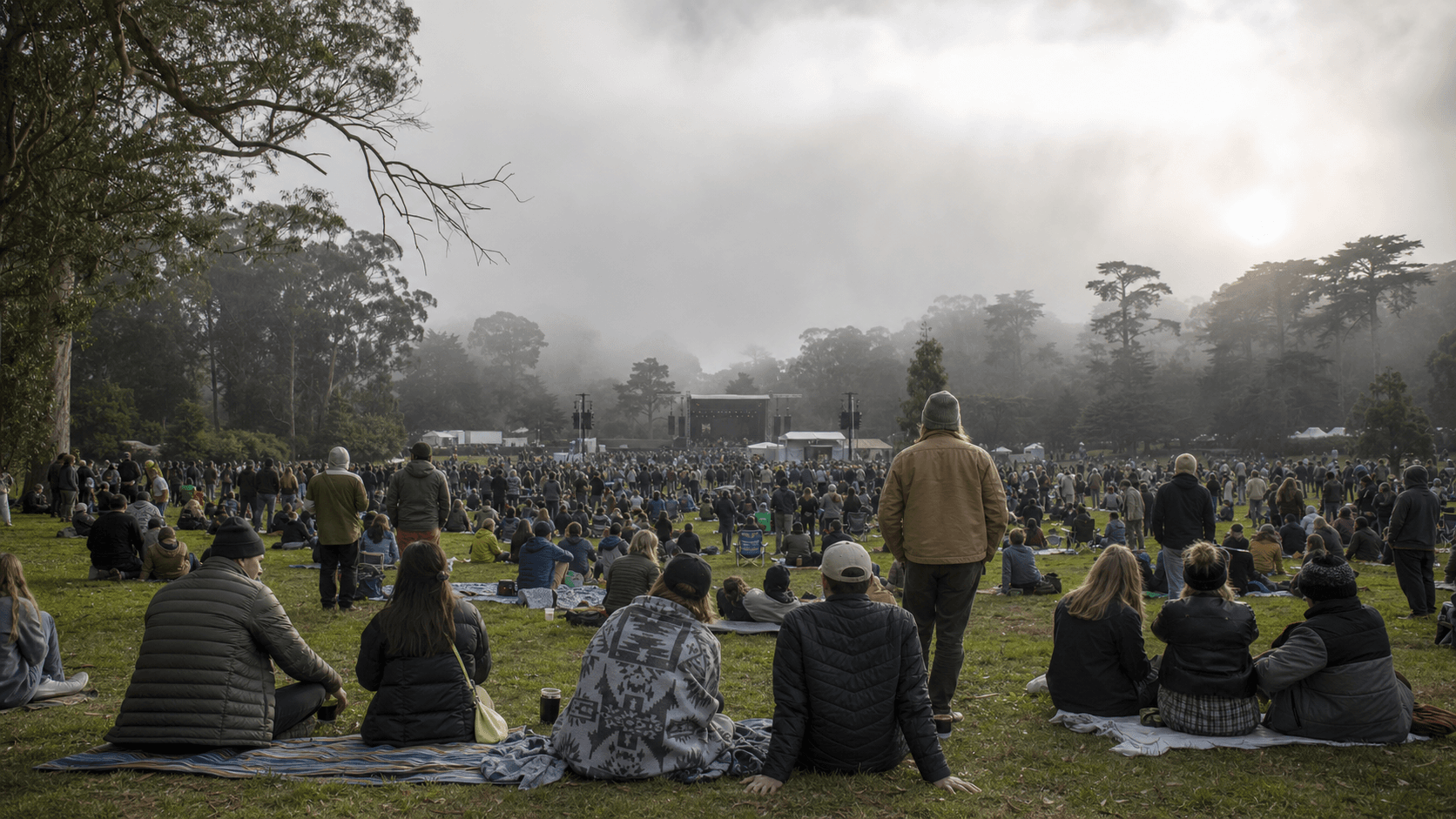
Outside Lands turns western Golden Gate Park into a small city for three days. Weather questions are unusually practical here because most visitors remain outside for ten or more hours, move between meadows, sit on grass, and finish the night near the foggiest edge of San Francisco. A citywide forecast can be sunny and mild while the festival grounds are gray, damp, and several degrees cooler.
Outside Lands Music Festival takes place at Golden Gate Park in San Francisco. For 2026, the official festival FAQ lists August 7–9, gates opening at 11 a.m., music beginning at noon, and music ending at 10 p.m. all three days. It is a three-day, rain-or-shine outdoor festival with long walking distances, open meadows, crowded stages, and programs that continue well after sunset. That shape is why this page follows event hours instead of the calendar day: an overnight low says nothing about an afternoon festival, and a daily high says nothing about an evening program that runs after dark.
Dates and hours here follow the current occurrence and link to the official event site. Organizers decide admission, closures, postponements, set times, and cancellations. This page explains the weather; it is not a substitute for an organizer notice.
The venue, the seasonal pattern, and the packing logic hold up year to year. The dates do not, so confirm the current occurrence before you book anything.
Weather profile
August at the park is governed by the marine layer. Low stratus often enters from the Pacific overnight and may thin during the afternoon before rebuilding in the evening. Local hourly history from 2014 through spring 2026 puts the average festival-hour temperature near 62 degrees, average wind near 11 mph, and total cloud cover near 43 percent. Those averages hide the two familiar modes: a bright, comfortable afternoon or a gray day that never fully warms.
Those averages are a baseline, not a forecast. They tell you whether to expect a jacket, whether rain belongs in the plan, and which of fog, heat, or wind is this venue's recurring problem. They cannot tell you about a specific date. Use them now, then replace them with the event-week forecast when it opens.
Regional microclimates can be sharp. An exposed park can be colder, cloudier, or windier while a sheltered plaza nearby is mild and calm. Elevation, terrain, water, and the street grid all affect when weather arrives and how it feels. The numbers on this page come from a forecast point chosen for this venue, not a citywide average.
Air temperature is also only part of the story. Sun, shade, and wind change how a number feels over a long day outside. Pavement and crowds make a sunny plaza warmer than the reading; shade and a steady breeze make an inland 70 feel considerably cooler. Read the temperature range alongside wind and cloud cover instead of treating one number as the answer.
Rain probability is the most misread value on any forecast. Twenty percent describes the chance of measurable rain, not how long it lasts or how hard it falls. It could be a five-minute shower or the leading edge of a system. What matters is when: during event week, check whether the risk sits before gates, over the main program, or after everyone has gone home.
What weather can change the event
Ordinary fog rarely stops the festival, but it changes comfort, visibility across large stages, photography, and how quickly clothing becomes damp. Wind makes a modest temperature feel colder and can lift dust from busy paths. Heat is less common but significant because shade and water demand rise quickly in a crowd. Wildfire smoke is the low-frequency, high-consequence August variable and should be checked separately from cloud cover.
Weather sensitivity is not a cancellation threshold. Organizers weigh site conditions, public safety, equipment, and the trend, not one number on a consumer forecast. A rain-or-shine policy still allows pauses for genuinely hazardous weather, and a cloud icon does not mean the day is ruined.
The combinations are what get people. Light rain with no wind is fine in a shell. The same rain with strong gusts defeats umbrellas, rattles signage and sound equipment, and punishes anyone waiting in the open. Moderate heat with shade and water is a different day than the same temperature on bare pavement. Low cloud is a minor comfort note at one event and the entire story at another.
Air quality needs its own check during wildfire season. Smoke arrives under clear skies, and no weather icon communicates it. If regional fires are burning, use official AQI guidance rather than the look of the sky.
Lightning is rare here compared with most of the country, which is exactly why people underestimate it. If you hear thunder or an organizer calls an evacuation, move to the directed shelter. Do not use a forecast page to second-guess a safety instruction. The same goes for flooding, damaging wind, extreme heat, and any emergency alert.
How to read the forecast
Start with the verdict at the top of this page, then look at the four main values and the event-specific conditions under them. Temperature and rain answer a different question than wind, fog, visibility, or smoke do. No single number decides the day.
Confidence builds in stages. More than a week out, the seasonal averages are genuinely more useful than any hourly prediction, which is why this page leads with them. In the last week, day-by-day and hour-by-hour forecasts become worth acting on. On the day itself, live observations, radar, and official messages beat any forecast.
One caveat on the timestamp: it shows when this forecast was generated, and weather models run on their own schedule. Refreshing the page does not conjure a newer model run.
For a multiday event, compare the same hours across days rather than the daily summaries. For a single-day event, treat arrival, program, and departure as three separate questions. An overnight shower is irrelevant to a dry morning race, and an afternoon high tells you nothing about a midnight fireworks show.
Finally, related measurements are not interchangeable. Cloud cover is not cloud ceiling. Visibility is not air quality. A monthly average is not a prediction. Check the one tied to the impact you actually care about.
Timing your day
The warmest, clearest hours are midafternoon, and the headliners play as the park is cooling off. That gap is the whole planning problem: you arrive in one kind of weather and leave in another. Rather than comparing days, use the timeline to find the coldest, windiest, or foggiest block on the day you are already going, and carry the layer that covers it.
At ten to fourteen days out, the useful signal is a pattern: warm, wet, windy. Keep plans flexible and do not read the hourly numbers. Around seven days, comparing event days starts to mean something. At two or three days, arrival hours and program hours are worth planning around. On the day, watch the trend and the official channels.
When this page names a better day, it is ranking weather only. Lineup, crowd size, ticket price, and who can get a ride are not in that calculation, and any of them can outweigh a few degrees. For a single-day event the real decision is usually narrower: when to show up, what to carry, and whether to move an optional outdoor stretch out of a risk window.
Do not chase small changes. Sixty-four degrees becoming sixty-three is not news. A rain window sliding into the headline set, fog holding two hours longer than expected, or gusts crossing from breezy into difficult are news. The verdict at the top of this page is written to surface that kind of change and ignore the rest.
Most people are at Outside Lands on the day their band is playing, so this page is not trying to talk you into a different one. What it can tell you is what Friday feels like versus Saturday, so you know whether you need the heavier jacket tonight or just the shell. The exception is air quality: if AQI climbs into a health-relevant range, that is a real decision, and official public-health guidance should outrank a lineup.
Venue microclimates
The western end of the grounds feels the ocean influence first. Open meadows expose people to wind, while wooded paths and dense crowds can feel sheltered. Grass can remain wet or soft long after drizzle ends. Conditions near the park entrances, in the Inner Sunset, or on an eastbound ride home may be noticeably warmer, which is why packing for a downtown temperature is a recurring mistake.
A city forecast is not necessarily a venue forecast. The site may sit closer to the ocean, farther inland, beside open water, inside a sheltered street grid, or on a slope. Those differences influence wind, afternoon temperature, fog penetration, and how quickly conditions change after sunset. The forecast location is chosen to represent the venue as closely as possible.
Conditions can also vary within a large site. An exposed stage, grandstand, route segment, or waterfront edge may feel colder and windier than a crowded sheltered area. Grass can remain wet after rain has ended; pavement can radiate heat after the air begins cooling. A forecast cannot map every few yards, so the guide identifies the recurring contrasts visitors can plan around.
If you are meeting a group, choose a location and communication plan before arrival. Weather can change crowd movement, cell service can be strained at major events, and an unexpected shower sends many people toward the same covered spaces. Saving tickets, maps, transit directions, and the organizer's alert channel offline is a small preparation with a large payoff.
What to wear and bring
Bring a packable wind-resistant jacket, a warm mid-layer for the final sets, comfortable water-resistant shoes, sunscreen, and a hat that will not blow away. A small ground layer or permitted blanket should be chosen with damp grass in mind. If smoke is possible, sensitive visitors should bring their usual protective supplies and use official AQI guidance. Confirm the current bag rules before choosing what fits.
Layers are the regional default because the useful outfit often changes between travel, waiting, the main program, and the trip home. A light wind-resistant outer layer usually adds more flexibility than one bulky item. On a warmer day, choose breathable clothing and retain a compact layer for evening or transit. On a wet day, a hooded waterproof shell works better in crowds and gusts than a large umbrella.
Sun protection belongs in the bag even if the morning is cloudy. Low clouds can clear, thin cloud still transmits ultraviolet radiation, and many event sites offer limited shade. Water, sunscreen, sunglasses, and a secure hat are practical. For cool-season evening events, add an insulating mid-layer, warm socks, and something dry to change into if rain is possible.
Check the official bag and prohibited-item policy before packing. Large umbrellas, hard-sided coolers, outside beverages, chairs, and professional camera equipment may be restricted even when they would otherwise seem weather-smart. The organizer's rules always outrank a general packing recommendation.
People with children, older adults, mobility needs, or health conditions should plan around exposure time as well as the headline forecast. A long security line in sun, rain, cold, or wind may matter more than conditions during the seated portion. Accessibility entrances, medical tents, water stations, and covered rest areas are worth locating in advance.
Travel and contingency plans
Weather compounds the event’s transportation load. Fog and darkness slow people on park paths, rain concentrates pickup demand, and a cold finish sends crowds toward transit at the same moment. Save the festival map and return route offline, choose a group meeting point, and expect a walk beyond the first transit stop or rideshare zone. The official transportation plan, not a generic map estimate, should guide the last mile.
Major events reshape traffic even in perfect weather. Rain slows boarding and road travel, heat increases demand for rides, and a late program change can send a large crowd toward transit at once. Build margin into the trip and check the organizer, local transit agencies, and city emergency channels before departure.
Use a simple backup ladder. Plan A is the preferred schedule and viewing area. Plan B changes timing, clothing, or a location within the site. Plan C is the organizer-approved alternative or an indoor activity nearby. The point is not to predict every disruption; it is to avoid making the entire day depend on one fragile assumption.
For ticketed events, weather and refund policies are separate. “Rain or shine” usually means ordinary rain does not automatically produce a refund, but official terms vary. Follow the event's ticket provider and organizer for binding admission and refund information.
After the event, expect the local weather to matter on the trip home. Evenings can cool quickly, exposed winds can persist, and rain or snow may intensify after the headline program. Keep a final layer and transportation plan available instead of using everything during the first hour.
Planning as the date approaches
Several weeks ahead, use the seasonal profile to choose likely clothing, identify the venue’s recurring weather issue, and decide whether you need a backup plan. Confirm the current date, location, hours, admission rules, and transportation details with the organizer.
About two weeks ahead, watch for a broad warm, wet, smoky, or windy pattern. Exact hourly timing will still change, but the pattern can tell you whether to keep both days open, reserve flexible transportation, or prepare rain and heat alternatives.
One week ahead, compare the scheduled event hours. At two or three days, focus on arrival time, the headline program, departure, and any weather threshold that can change the experience. On the day itself, check the latest conditions before leaving and again when you reach the venue area.
Plans should become more specific as confidence improves, but always leave room for local variation. If official instructions conflict with weather guidance, follow the organizer and public-safety agencies. This weather service is an independent planning tool, not the event operator.
FAQ
Outside Lands weather questions
What is the typical weather at Outside Lands?
Western Golden Gate Park is usually cool in August, often near the low 60s during festival hours, with recurring low clouds and a colder evening.
Does fog cancel Outside Lands?
Ordinary San Francisco fog usually changes comfort and visibility rather than canceling the festival. Follow organizers for any operational change.
Does it rain at Outside Lands?
Measurable August rain is rare, but drizzle and fog moisture are possible. The event is advertised as rain or shine.
What should I wear to Outside Lands?
Use layers: breathable daytime clothing, a wind-resistant jacket, and a warmer layer for evening. Choose shoes for long distances and potentially damp grass.
Which Outside Lands day has the best weather?
One week out, the noon–10 p.m. forecasts for all three days appear above. That said, most people go on the day their band is playing. The more useful question is usually what to bring on your day rather than which day to pick.
Why is Golden Gate Park colder than downtown?
The park is closer to the Pacific and directly exposed to the marine layer and onshore wind, while downtown and eastern neighborhoods are often more sheltered.
When does the detailed forecast appear?
The hour-by-hour forecast appears one week before the event. A broader early outlook appears during the preceding week.
Is SFBayWeather an official festival alert?
No. SFBayWeather provides independent planning guidance; Outside Lands and public-safety agencies control official event decisions.
Sources and methodology
- Outside Lands official FAQ — 2026 dates, hours, venue, and operating policies
- Outside Lands festival information — Current entry, transportation, and festival logistics
- SFBayWeather hourly climate dataset — Venue-level historical temperature, wind, cloud, and fog profile